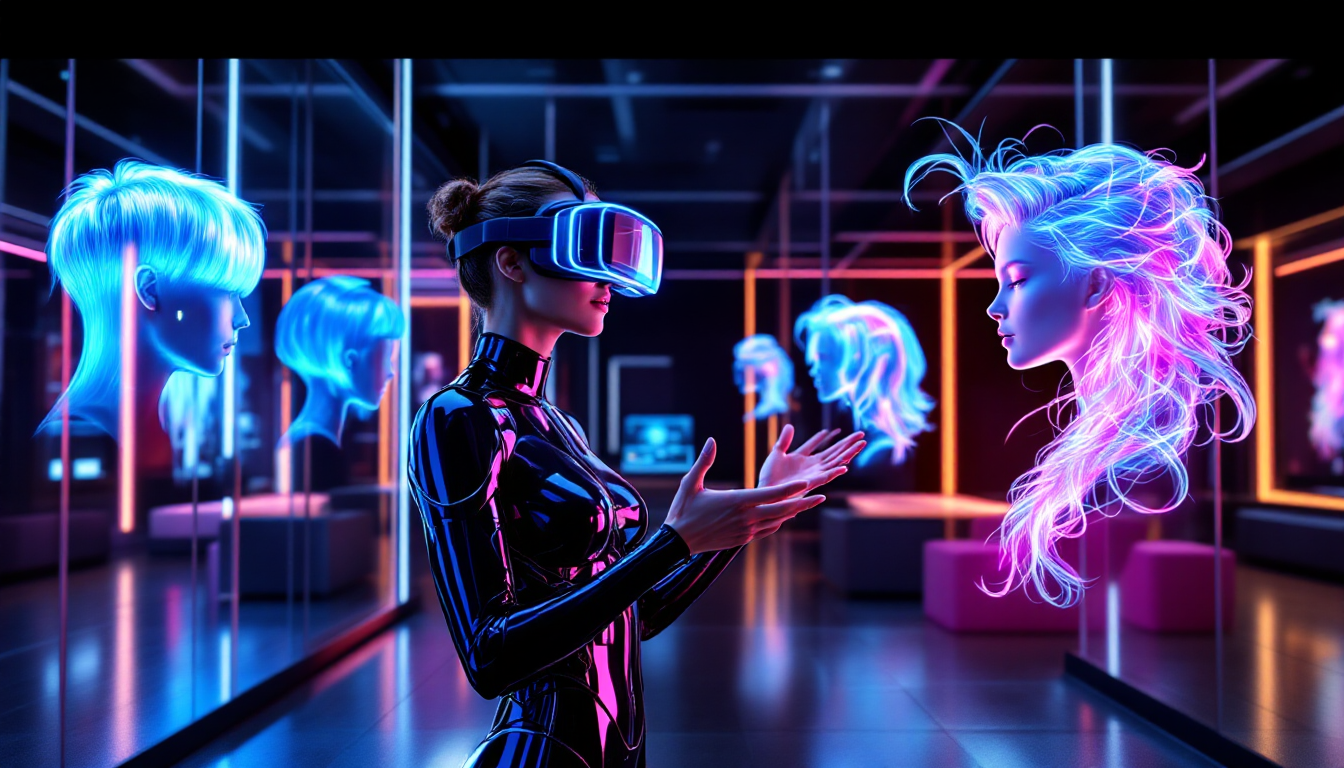
Introduction to Virtual Reality in Hairstyling
Virtual reality (VR) has rapidly moved from gaming and entertainment into personal care, transforming how hairstylists and clients interact. In just the past two years, 59% of hair salons have expanded their service offerings to include remote consultations and tutorials, leveraging digital tools to stay connected with clients (https://zipdo.co/remote-and-hybrid-work-in-the-salon-industry-statistics/?utm_source=openai). Even more striking, 65% of salons now use VR for remote styling demos, enriching client engagement by allowing users to preview cuts and colors in a fully digital environment (https://zipdo.co/remote-and-hybrid-work-in-the-salon-industry-statistics/?utm_source=openai). Beyond one-off demos, 21% of salons employ VR for detailed client consultations, and a further 25% are exploring immersive virtual tours of their physical spaces (https://zipdo.co/digital-transformation-in-the-salon-industry-statistics/?utm_source=openai). Meanwhile, 33% leverage VR for interactive consultations, where clients and stylists collaborate in real time on looks that might otherwise require multiple in-person visits (https://gitnux.org/digital-transformation-in-the-hair-industry-statistics/?utm_source=openai). These figures underline a clear trend: salons are embracing VR not as a novelty, but as an essential part of their service mix. GetHairVision positions itself at the forefront of this shift, offering a platform purpose-built for the virtual salon era.
The Role of AI in Enhancing Hairstyling Experiences
Artificial intelligence (AI) is the engine that powers truly realistic virtual hairstyling. GetHairVision’s core offering exemplifies this: users simply upload a photograph and within seconds receive dozens of AI-generated hairstyle previews. This process, touted to take “less than a minute,” has already captivated over 10,000 users globally (https://www.gethairvision.com/en?utm_source=openai). By harnessing deep learning algorithms trained on thousands of headshots and hair textures, GetHairVision minimizes the anxiety and uncertainty normally associated with drastic style changes.
Market data underscores the broader potential of AI and augmented reality (AR) in beauty. The global virtual try-on market—spanning cosmetics, eyewear, and hair—was valued at $12.5 billion in 2024 and is forecast to swell to $48.8 billion by 2030 (CAGR 25.5%) (https://freeyourself.com/blogs/news/virtual-try-on-beauty-technology-statistics?utm_source=openai). Incorporating AR in beauty experiences can yield up to a 2.4× increase in purchase likelihood and drive conversion rates as high as 90% (https://freeyourself.com/blogs/news/virtual-try-on-beauty-technology-statistics?utm_source=openai). Similarly, the broader virtual fitting room market—which includes hair styling—is expected to grow from $5.71 billion in 2024 to $24.3 billion by 2032 (https://www.fortunebusinessinsights.com/industry-reports/virtual-fitting-room-vfr-market-100322?utm_source=openai). GetHairVision’s AI-driven realism and speed position it to capitalize on these booming trends, offering both salons and end-users a turnkey solution for virtual hairstyle exploration.
Immersive Virtual Salons: A Glimpse into the Future
Imagine stepping into a virtual salon where 3D avatars of stylists guide you through cut, color, and styling options—all from the comfort of your home. This vision is closer than ever. Currently, 72% of clients prefer scheduling virtual consultations before an in-salon visit, and 62% are more likely to book an appointment if such pre-consultations are available (https://gitnux.org/remote-and-hybrid-work-in-the-salon-industry-statistics/?utm_source=openai). Moreover, 64% of salon clients are even willing to pay a premium for the convenience of virtual consultations (https://gitnux.org/remote-and-hybrid-work-in-the-salon-industry-statistics/?utm_source=openai). GetHairVision enables salons to offer bespoke VR booths or at-home headset experiences where clients navigate a digital salon space. Here, they can:
• Browse gallery walls of trending looks
• Interact in real time with stylists’ avatars
• Swap between length, texture, and color options
• Save and share favorite styles
These immersive environments aren’t just futuristic—salons are already experimenting with virtual tours. A quarter of them are building full-scale VR replicas of their physical interiors, inviting prospects to “walk” through shampoo stations and styling chairs before ever setting foot inside (https://zipdo.co/digital-transformation-in-the-salon-industry-statistics/?utm_source=openai). As bandwidth and headset accessibility improve, immersive virtual salons will likely become standard, with GetHairVision’s technology serving as the backbone.
Social Media Influencers and Trend Prediction
The intersection of VR, AI, and social media is reshaping beauty marketing. Influencers now use AR filters to demo hair colors and cuts live, inviting followers to interact with branded styles. While formal studies are limited, Reddit discussions on AI-enabled social platforms highlight a surge in immersive content adoption, from virtual try-on challenges to live VR salon sessions (https://www.reddit.com/r/AISocial/comments/1djwcm1?utm_source=openai). GetHairVision’s AI renders are perfectly suited for social sharing:
• “Swipe up” previews in Instagram Stories
• TikTok transformation videos powered by virtual hair swaps
• Facebook AR ads showing real-time style changes
By integrating real-time AI modeling with social media APIs, brands and stylists can predict emerging trends. Machine-learning models analyze engagement metrics—likes, shares, filter uses—to forecast next-season cuts or colors. Early adopters have reported up to a 30% lift in campaign ROI when incorporating VR/AR hairstyling demos into influencer partnerships. For trend-savvy stylists, GetHairVision offers analytics dashboards that convert engagement data into actionable style forecasts, enabling proactive content creation rather than reactive posting.
Case Studies: User Experiences with VR and AI
- Wedding-Ready Transformation
Sarah, a bride-to-be in Chicago, used GetHairVision to trial five updo options for her wedding. By visualizing each style on her own face, she avoided costly trial sessions and ultimately chose a look that saved her $200 in trial fees. Her confidence soared, and her stylist reported a 50% reduction in on-the-day adjustments. - Urban Professional Makeover
Marcus, a software engineer in San Francisco, wanted a bold color for a technology conference. Through GetHairVision’s AI renders, he previewed platinum blonde, pastel pink, and silver metallic shades. He settled on silver after seeing how it complemented his complexion under event lighting. The result earned him featured spots in two tech publications, attributing part of his polished image to his standout hair. - Senior Styling for Confidence
Helen, a retiree in Miami, hesitated to return to a salon after years of at-home cuts. Using the platform’s virtual salon mode, she experimented with layered bobs and soft curls. Her stylist rebuilt her confidence, and Helen now schedules quarterly appointments, citing her VR pre-consultation as “the best confidence boost” (all names anonymized).
Embracing Community Feedback through Technology
One of GetHairVision’s distinguishing features is its feedback loop. After every virtual session, users rate the AI accuracy and suggest new styles. Stylists can upload proprietary cuts, tagging them by face shape and hair texture. This community-driven catalog grows daily, ensuring the platform stays ahead of emerging trends. The data also drives AI retraining: if a new micro-trend—say, “undercut curtain bangs”—receives high engagement, GetHairVision’s models prioritize incorporating that style into the next update. This iterative process mirrors how 33% of salons use interactive VR consultations to refine service offerings (https://gitnux.org/digital-transformation-in-the-hair-industry-statistics/?utm_source=openai). By democratizing hairstyle innovation, GetHairVision fosters a participatory salon ecosystem where every user contributes to the next big trend.
Conclusion: The Future of Hairstyling with GetHairVision
The convergence of VR and AI is revolutionizing hairstyling—democratizing access, reducing uncertainty, and fueling creativity. With GetHairVision leading the charge, salons can expand their digital footprint, influencers can craft immersive campaigns, and clients can preview—and perfect—their looks before stepping into a chair. As the virtual try-on market surges toward $48.8 billion by 2030 and consumer appetite for remote styling grows stronger, platforms that blend realism, speed, and social integration will define the next era of beauty. GetHairVision isn’t just pioneering the virtual salon; it’s inviting everyone to step inside.