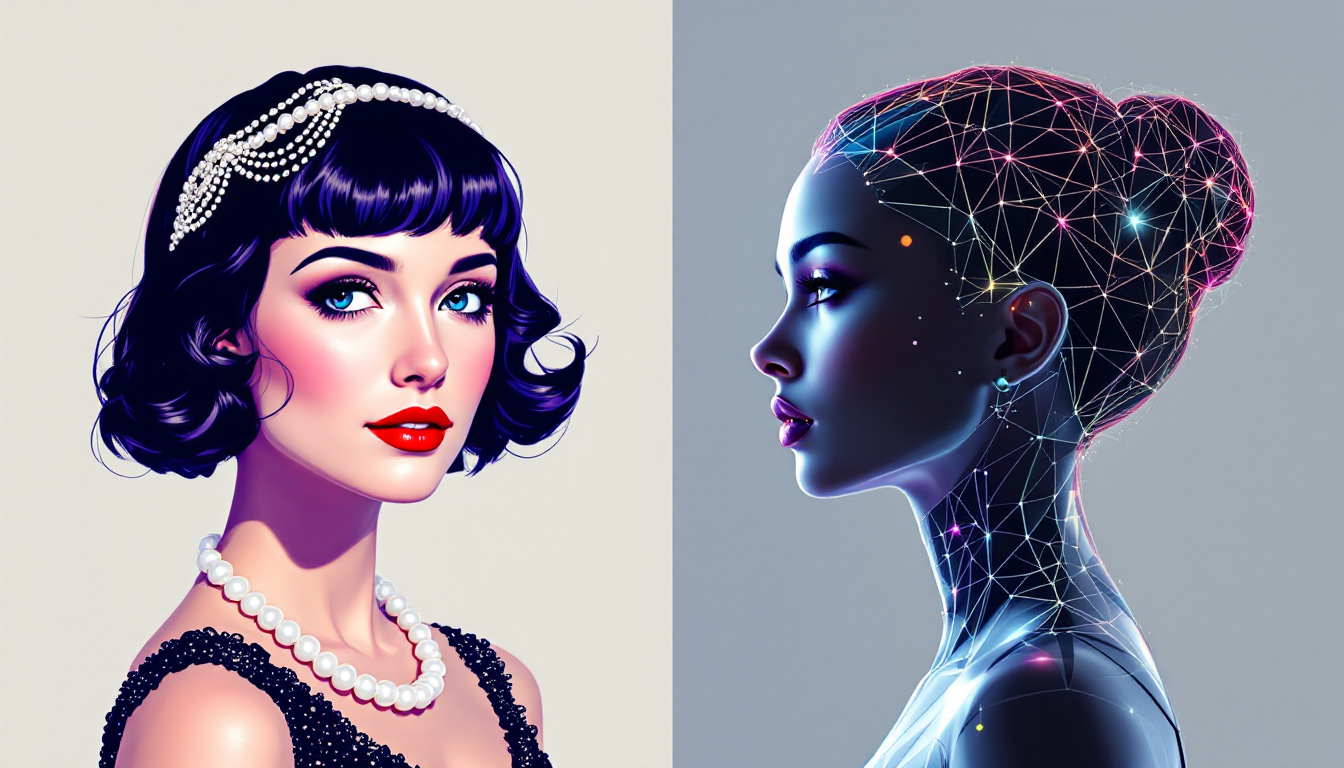
Introduction: Merging History with Technology
Hairstyles have always served as powerful markers of identity, status and cultural change. From the elaborate wigs of 18th-century French aristocrats to the rebellious mohawks of punk rockers, hair has conveyed personal and social narratives. Today, an unexpected collaborator is joining historians and stylists alike: artificial intelligence. By analyzing vast archives of images and metadata, AI tools are rediscovering forgotten classics, quantifying trend cycles and even generating entirely new looks that draw on centuries of hair innovation. In this article, we trace the arc of hairstyling history, explore how AI is mining that past to forecast tomorrow’s trends, highlight real-world examples and examine the implications for professionals in the salon chair.
The Evolution of Hairstyles Through the Ages
-
Antiquity to Middle Ages
• Ancient Egypt and Greece: intricate braids, wigs and headpieces signified wealth and religious role.
• Medieval Europe: women’s hair was covered or tightly bound; men favored longer locks only among the nobility. -
Renaissance to 18th Century
• Renaissance Italy and France: elaborate up-dos adorned with jewels, ribbons and pearls.
• 1700s Bouffant and Beehive origins: aristocrats at Versailles elevated powdered, towering hair to a symbol of courtly elegance (Bouffant, en.wikipedia.org). -
20th Century Revolutions
• 1950s Beehive revival: stylists such as Raymond Bessone reimagined the 18th-century bouffant for post-war glamour, worn by figures like Jacqueline Kennedy.
• 1980s Texture and Edge: Jheri curls, perms, mullets and mohawks reflected bold self-expression; Black American urban culture popularized the hi-top fade, as seen in hip-hop and sports icons (Hi-top fade, en.wikipedia.org).
• 1990s The Rachel: Jennifer Aniston’s layered cut on Friends spawned a worldwide phenomenon, later seeing a resurgence with a 179% spike in salon requests post-reunion and hundreds of millions of social media views (The Rachel, en.wikipedia.org). -
21st Century and Beyond
• Millennial minimalism to Gen Z experimentation: sleek bobs, curtain bangs, pastel colors and ‘glass hair’ demonstrate an appetite for both retro references and technological innovations in color and texture.
AI’s Role in Analyzing Historical Hair Trends
The vast archives of print, film and digital photography present both an opportunity and a challenge: too much data for the human eye to process in full. AI excels at pattern recognition, classification and clustering across massive datasets, enabling:
• Automated style tagging. Deep-learning models can classify hair length, silhouette and texture across centuries of images.
• Temporal trend mapping. Algorithms detect when certain silhouettes reappear—confirming the adage that fashion is cyclical.
• Cultural context analysis. Natural-language processing on captions and articles enriches image data with insights into social meaning.
Salon-grade applications testify to AI’s current influence:
• GHD’s CurlFinder analyzes curl pattern, thickness and styling goals to recommend tailored tools (Vogue.com).
• In the Asia-Pacific region, 57% of consumers say AI-driven personalization guides their beauty purchases; Unilever’s Scalp + Hair Therapist and BeautyHub PRO harness generative AI for bespoke hair and scalp regimens (GlobalData.com).
• Industry adoption statistics show 62% of salons using AI in marketing, 48% in booking systems and 88% accuracy in AI-based hair condition analysis (ZipDo.co).
Predicting Future Styles: How AI Creates New Trends
Beyond analysis, AI is a creative engine. Two major approaches drive trend forecasting and concept generation:
-
Generative Models
• GANs and diffusion networks power platforms like ReelMind.ai to synthesize novel hairstyles from text prompts or uploaded images—imagine a “bioluminescent braided updo” visualized in seconds (ReelMind.ai).
• Text-conditioned 3D models such as HAAR produce strand-level, physics-ready hair shapes that can be rotated, styled and integrated into digital avatars (arXiv:2312.11666). DiffLocks reconstructs curls and afros from a single photo, leveraging a dataset of 40,000 hairstyles (arXiv:2505.06166). -
Forecasting Algorithms
• AI trend reports for 2024+ spotlight three pillars:
– Hyper-personalization: contour cuts mapped to bone structure, individualized care routines.
– Sustainability: eco-friendly products and green styling practices.
– Retro revivals: ’70s shags, ’90s Rachel cuts and curtain bangs climbing social feeds (Cryptopolitan.com). -
Emerging Tech
• Augmented-reality try-ons let clients preview dynamic hairstyles that move with ambient light and motion (HairstyleTryOn.ai).
• 3D-printed extensions and accessories, custom-fitted to a client’s hair geometry.
• Bio-luminescent or color-shifting fibers that respond to mood or environment.
• Smart scalp diagnostics merging microscopy with nutraceutical recommendations.
Case Studies: Modern Hairstyles Inspired by the Past
-
Amy Winehouse’s Beehive Redux
• The 1950s beehive reemerged as a symbol of edgy glamour in Winehouse’s signature look, linking French aristocracy to British soul revival. -
The Rachel Returns
• Powered by TikTok and Instagram, salons worldwide saw a resurgence of the layered Rachel, proving AI’s retro-revival forecasts accurate. -
Hi-Top Fade in Streetwear Culture
• Once a staple of 1986–93 Black urban style, the hi-top fade has been reinterpreted by athletes and fashion influencers—echoing AI predictions of texture diversity and cultural homage. -
AI-Generated Avant-Garde
• Designers use ReelMind.ai and HAAR prototypes to present runway-ready, historically informed yet futuristic up-dos—merging powdered 18th-century volume with cyberpunk color shifts.
The Impact on Hairstyling Professionals
AI’s entry into salons brings both opportunity and challenge:
• Enhanced consultations. Stylists armed with AI insights can recommend historically informed cuts and modern adaptations tailored to face shape, hair health and personal style.
• Skill augmentation. Learning to operate AR systems, 3D printing extensions and AI diagnostics will be part of future training curricula.
• Business optimization. AI-driven booking, marketing segmentation and inventory management free up time for creativity and client care.
• Ethical considerations. Data privacy, algorithmic bias in beauty standards and the role of human artistry must be navigated responsibly.
Conclusion: The Future of AI in Hairstyling
From the powdered bouffants of Versailles to bio-responsive fibers, hair tells our collective story—and AI is scripting the next chapters. By mining historical archives, generating unprecedented concepts and enabling hyper-personalized experiences, AI bridges tradition with tomorrow’s vision. For stylists and consumers alike, the message is clear: the past will always inform our future, but technology is expanding the palette of what hair can become. As these tools mature, we can expect salons to transform into tech-infused studios and hair itself to evolve into a dynamic canvas for self-expression across dimensions yet to be imagined.