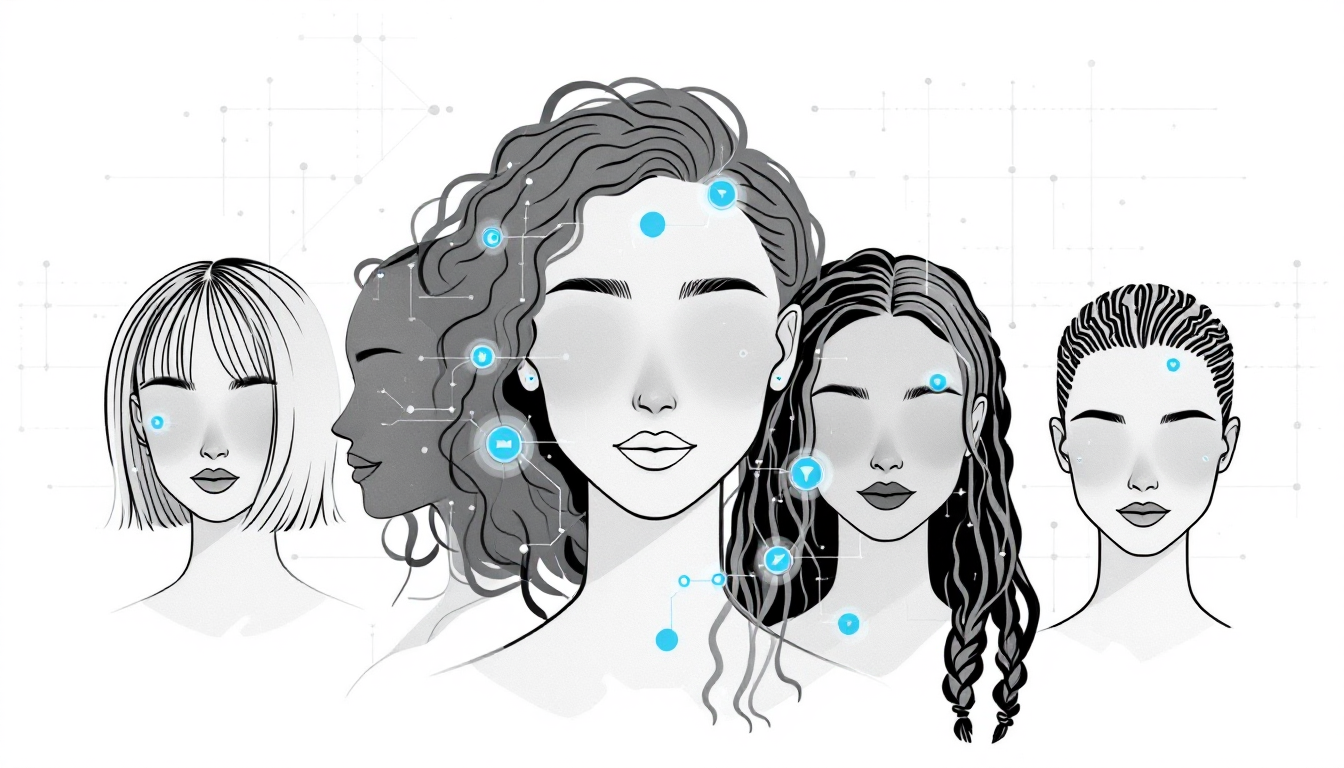
Introduction to AI in Hairstyling
The beauty industry is undergoing a digital transformation, and one of its most exciting frontiers is AI-driven hairstyling. No longer must you flip through magazine clippings or rely solely on a stylist’s intuition—artificial intelligence can now map your unique facial features and predict which cuts, colors, and textures will flatter you most. By harnessing computer vision, deep learning, and neural networks, AI platforms generate hyper-realistic hairstyle previews in seconds, empowering you to experiment risk-free before stepping into the salon. This fusion of fashion and technology delivers a level of personalization and confidence previously unattainable, turning hairstyling into a data-driven experience tailored exclusively to you.
Understanding Your Face Shape
Before AI can recommend the perfect style, it must understand your face shape—a foundational element in determining flattering haircut and color trends. Common face shapes include:
• Oval: Balanced proportions, slightly longer than wide.
• Round: Width and length are nearly equal, with softer angles.
• Square: Broad forehead and jawline, angular features.
• Heart: Wider forehead, high cheekbones, pointed chin.
• Diamond: Narrow forehead and jawline, pronounced cheekbones.
• Oblong/Rectangular: Longer face length with straight sides.
To self-assess, measure across your forehead, cheekbones, jawline, and face length (hairline to chin). Note where your face is widest and the sharpness of your angles. Understanding these dimensions helps you—and AI—narrow down the most harmonious styles for your individual structure.
How AI Analyzes Face Shapes
Modern AI hairstyle tools begin by dissecting your selfie into quantifiable facial landmarks—eyes, nose, mouth, jawline—and calculating shape ratios. Leading platforms include:
• FaceHair: Utilizes convolutional neural networks to assess face shape, hair texture, and even scene lighting, producing realistic previews with 85–90 % accuracy in real-life resemblance (https://www.lionaibox.com/ai/facehair?utm_source=openai).
• AIhairstyles: Processes a single high-quality selfie in just 5–10 seconds to identify your face shape and suggest optimally flattering cuts, lengths, and colors (https://www.navto.ai/aihairstyles?utm_source=openai).
• HairSim: Combines deep learning and advanced computer vision to detect subtle facets of facial geometry—such as bone structure and curvature—and simulates hair texture, volume, and movement in each style preview (https://marioapps.com/apps/hairsim/?utm_source=openai).
These systems continually refine their models by aggregating user feedback and real-world salon outcomes, ensuring that recommendations grow more personalized and precise over time.
AI-Powered Hairstyle Recommendations
Once face shape and features are mapped, AI unleashes an expansive library of options:
• AI Hairstyle Changer (EDUCBA) offers over 500 styles—from trendy bobs and layers to celebrity-inspired cuts—instantly matched to your facial proportions (https://www.educba.com/ai-hairstyle-makeover/?utm_source=openai).
• YouCam Makeup delivers 45+ hairstyle templates for men and women, 100+ colors, plus wig and bangs simulations—all tailored to your face shape and hair type (https://www.unite.ai/lv/best-ai-hairstyle-apps/?utm_source=openai).
• Conversational AI stylists like Google’s Gemini can diagnose your face shape from a selfie and refine suggestions based on your maintenance preferences, length goals, and lifestyle needs (https://www.tomsguide.com/ai/google-gemini/i-used-gemini-to-find-the-best-haircut-for-my-face-shape-heres-how-you-can-too?utm_source=openai). Gemini Nano Banana, a lightweight photo-editing variant, delivers creative cuts—such as pixie or wolf cuts—with striking realism, though it may struggle with complex updos and varied textures (https://www.tomsguide.com/ai/google-gemini/i-used-googles-nano-banana-to-try-a-bunch-of-different-hairstyles-and-the-results-blew-me-away?utm_source=openai).
Privacy and data security remain paramount. Tools like AIhairstyles comply with GDPR and CCPA/CPRA, allow anonymous use, and automatically delete images after 30 days of inactivity—or on-demand—ensuring your personal data stays protected (https://www.navto.ai/aihairstyles?utm_source=openai; https://aihairstyles.com/en-US?utm_source=openai).
Benefits of Customized Hairstyling
- Confidence and Self-Expression: AI lets you visualize bold transformations—platinum blondes, asymmetrical cuts, or textured waves—before committing, reducing regret and boosting self-esteem.
- Time and Cost Savings: Avoid multiple salon visits and trial-and-error sessions. You arrive at your stylist with a clear, AI-validated vision.
- Data-Driven Precision: Algorithms weigh dozens of facial metrics, offering finely tuned suggestions that human judgment alone may overlook.
- Accessibility: Virtual try-ons democratize high-end styling services, letting anyone experiment from home, regardless of location or budget.
- Creative Exploration: With hundreds of styles at your fingertips, you may discover looks you never considered—transforming hairstyling into a playful, low-stakes adventure.
Future Trends in AI Hairstyling
The pace of innovation shows no signs of slowing. Cutting-edge research promises even greater realism, speed, and personalization:
• Stable-Hair (July 2024) employs a diffusion-based two-stage approach—stripping hair from the image then transferring a target style via a Hair Extractor and Latent IdentityNet—to achieve unprecedented fidelity in hair swapping tasks (https://arxiv.org/abs/2407.14078?utm_source=openai).
• HairFastGAN (April 2024) uses an encoder-based architecture to perform high-res style transfers under one second, even in challenging pose-shift scenarios on NVIDIA V100 hardware (https://arxiv.org/abs/2404.01094?utm_source=openai).
Next-gen systems will likely integrate real-time AR mirrors, more nuanced texture detection for curly and coily hair, and voice-driven styling consultations. As AI models mature, expect hyper-personalized trend forecasting—where your genetic hair profile, lifestyle data, and seasonal fashion cycles all inform the perfect cut, color, and care regimen.
Conclusion: Embrace Your Unique Look
AI is revolutionizing hairstyling by marrying scientific precision with creative freedom. By understanding your face shape, tapping into advanced facial analysis, and exploring vast style libraries—all while safeguarding your privacy—you can confidently curate a look that’s uniquely you. Whether you’re craving a dramatic chop, a subtle refresh, or a color overhaul, AI tools remove the guesswork and elevate your salon experience. Dive into today’s leading platforms, experiment fearlessly, and let cutting-edge technology guide you to your next signature hairstyle.