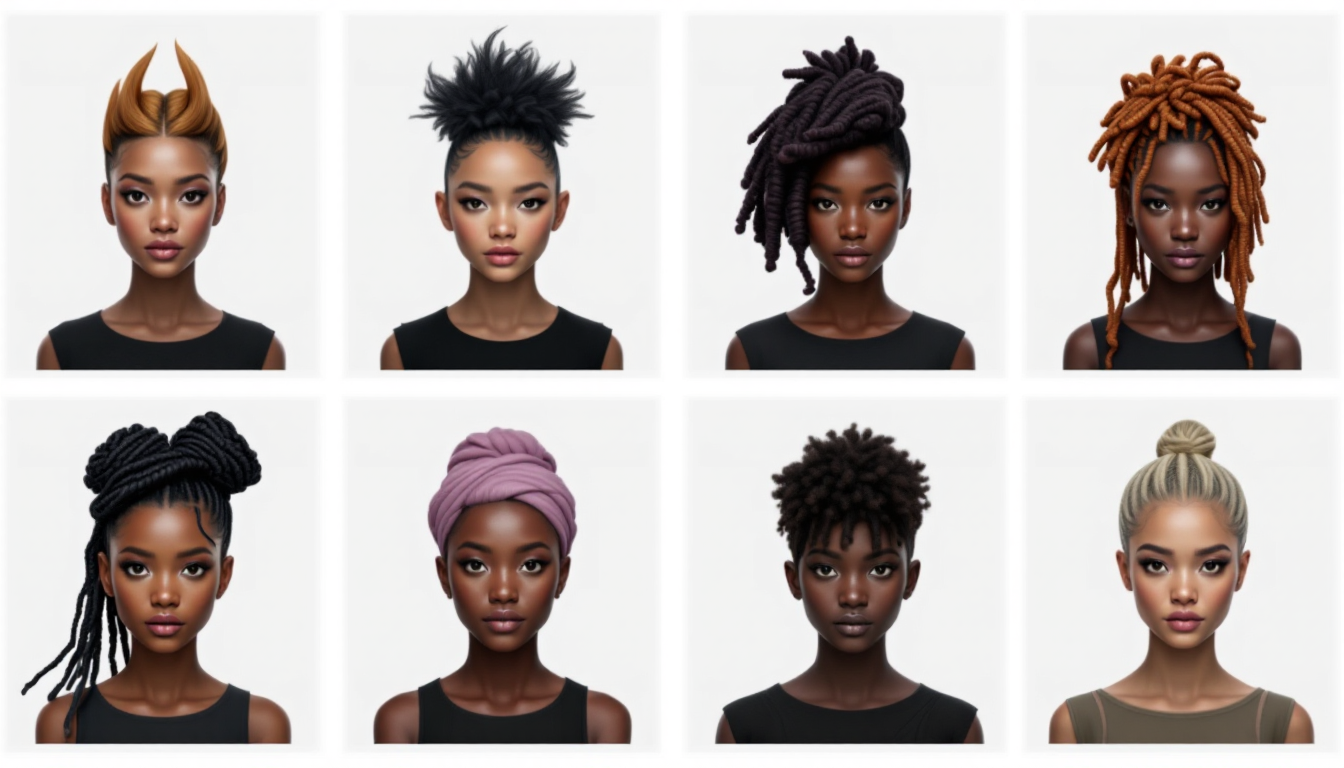
Hairstyle Inspiration from Around the Globe: How AI Celebrates Diversity
Introduction to Cultural Diversity in Hairstyling
Hairstyles have always been far more than aesthetic choices—they’re statements of identity, markers of heritage and culture, and symbols of personal and communal pride. From the intricate cornrows of West Africa to the elegant chignons of East Asia, every tradition carries centuries of history and meaning. Yet for most of us, experimenting with these global styles in real life can feel daunting: Will it suit my face shape? Am I honoring the style respectfully? Today, AI-driven tools are breaking down those barriers. By simulating, contextualizing and educating users about culturally significant looks, AI is transforming sheer curiosity into informed creativity—and celebrating the world’s rich tapestry of hair traditions in pixel-perfect detail.
- How AI Tools Are Revolutionizing Hairstyle Inspiration
Advances in computer vision and generative modeling have produced powerful new ways to visualize and try on hairstyles without ever picking up scissors.
• TANGLED Framework (2025)
– Generates full 3D hair strands from a single photo, accommodating “arbitrary styles and viewpoints” drawn from a MultiHair Dataset of 457 diverse, culturally annotated hairstyles.
– By explicitly tagging styles like African braids, South Asian buns or Indigenous feathered headdresses, TANGLED improves its ability to generalize beyond Eurocentric norms and produce authentic, respectful renderings.
– (Source: “TANGLED: Generating 3D Hair Strands from Images with Arbitrary Styles and Viewpoints,” arxiv.org/abs/2502.06392)
• Stable-Hair: Diffusion-Based Hairstyle Transfer (2024)
– Applies a robust latent diffusion model to transfer any real-world hairstyle—including those with complex textures—onto user-submitted photos, preserving both the user’s identity and the nuanced details of the target style.
– Enables users to visualize themselves in cultural styles they might never have had the confidence to try in real life, all in high fidelity.
– (Source: “Stable-Hair: Real-World Hair Transfer via Diffusion Model,” arxiv.org/abs/2407.14078)
• Cross-Cultural Fashion Design with LLMs & Diffusion (2025)
– Combines Large Language Models and Latent Diffusion Models fine-tuned on an international corpus of fashion photography and descriptions.
– Although focused on clothing, the underlying approach—semantic conditioning on cultural attributes—paves the way for AI systems that can recommend hairstyle variations based on region, festival or historical era.
– (Source: “Cross-Cultural Fashion Design via Interactive Large Language Models and Diffusion Models,” arxiv.org/abs/2501.15571)
- Exploring Global Hairstyles: A Digital Experience
Virtual try-on platforms are where these research breakthroughs meet everyday users, empowering exploration, education and play.
• Ulta Beauty’s GLAMlab (StyleGAN2)
– Built on NVIDIA’s StyleGAN2, GLAMlab lets shoppers upload a selfie and instantly experiment with dozens of hairstyles—straight, curly, braided and beyond—alongside vibrant color changes.
– By incorporating styles drawn from a spectrum of ethnic hair types, it encourages inclusive experimentation “before you commit,” lowering the stakes of trying something new.
– (Source: NVIDIA Blog, blogs.nvidia.com/blog/ulta-beauty-stylegan2)
• GlamAI Virtual Try-On
– Offers an integrated “digital dressing room” for hair, makeup and accessories. Users can browse curated, culturally inspired collections—such as Afro-Latinx festival looks or Scandinavian winter braids—and see them applied in real time.
– The platform’s emphasis on global style categories makes inclusivity feel like a natural part of the discovery process.
– (Source: Wikipedia, en.wikipedia.org/wiki/GlamAI)
• Artisse AI
– Known for hyper-realistic scene and hair transformations, Artisse AI’s app surfaces hairstyles from every corner of the globe—be it traditional Japanese shimada buns or Pacific Islander floral crowns—against dynamic backgrounds that tell a story.
– Its success across multiple markets underscores a universal appetite for inclusive self-expression.
– (Source: Wikipedia, en.wikipedia.org/wiki/Artisse_AI)
- The Importance of Cultural Appreciation in Styling
As AI makes it easier to sample and remix global hairstyles, it also carries a responsibility: ensuring that cultural appreciation does not slip into appropriation.
• Contextual Metadata
– The most respectful AI systems tag origins, meanings and traditional contexts alongside the hairstyle preview. For example, a virtual try-on of Ghanaian Fulani braids might include a short note on their cultural roots and contemporary significance.
• Community Collaboration
– Involving cultural insiders—hairstylists, anthropologists and community leaders—in dataset curation and style descriptions helps root AI recommendations in lived experience, not stereotypes.
• Transparent Credits
– Allowing users to “learn more” via embedded links or pop-up cards fosters deeper understanding—turning a playful makeover into an opportunity for cross-cultural dialogue.
- Case Studies: Successful AI Hairstyling Implementations
Real-world deployments illustrate the power of AI to drive both business growth and social impact.
• Ulta Beauty’s GLAMlab
– After launching the StyleGAN2-powered tool, Ulta reported a 30% increase in online engagement with hairstyle pages and a significant uplift in bookings for in-salon color consultations.
• GlamAI
– Usage of their global style collections doubled in 2023, with 40% of users exploring at least one hairstyle outside their own ethnic tradition—a sign that inclusivity features drive exploration.
• Artisse AI
– Expanded to 15 markets within its first year, demonstrating the universal demand for culturally diverse self-representation.
• Textured-Hair Analysis & Product Matching
– Platforms like Myavana (in partnership with The Beauty Genie) use AI to analyze curl patterns and texture, then recommend products formulated for specific hair types—addressing a historic under-served segment in beauty tech.
– From April 2024 to March 2025, product launches labeled for “African/American hair type” rose by 36% in Europe and 33% in North America, reflecting growing industry focus on textured-hair inclusivity.
– (Source: personalcareinsights.com/news/inclusive-hair-care-ai-science.html)
- Future Perspectives: AI and Inclusive Hairstyle Trends
Looking ahead, several trends promise to further democratize and diversify our digital hairstyle playgrounds.
• Dynamic AR Storytelling
– Imagine video filters that adapt your chosen style to different backdrops—festival stages, traditional ceremonies or fantasy settings—telling a richer cultural narrative.
• Personalized AI Styling Coaches
– Chatbot stylists powered by LLMs could suggest cut, color and care routines based on your hair’s unique properties, face shape and even cultural preferences, weaving in historical anecdotes and styling tips.
• Fairness-Driven Model Audits
– As AI systems grow more powerful, rigorous evaluation frameworks—assessing representation across gender, ethnicity and hair texture—will ensure all users see themselves authentically reflected.
• Open-Source Cultural Hair Libraries
– Community-maintained repositories of 3D hair models, textures and style metadata could empower indie developers and stylists to build localized, respectful try-on experiences.
- Conclusion: Embracing Diversity Through Technology
AI-powered hairstyle inspiration isn’t just a flashy gimmick—it’s a vehicle for cultural exchange, creative confidence and social equity. By leveraging cutting-edge models like TANGLED and Stable-Hair, integrating real-world virtual try-ons from Ulta, GlamAI and Artisse, and grounding innovation in community collaboration, we can celebrate the world’s hair heritage in all its brilliance. As these tools evolve, they hold the promise of making every user—regardless of background—feel seen, respected and inspired to explore the kaleidoscope of global hairstyles.