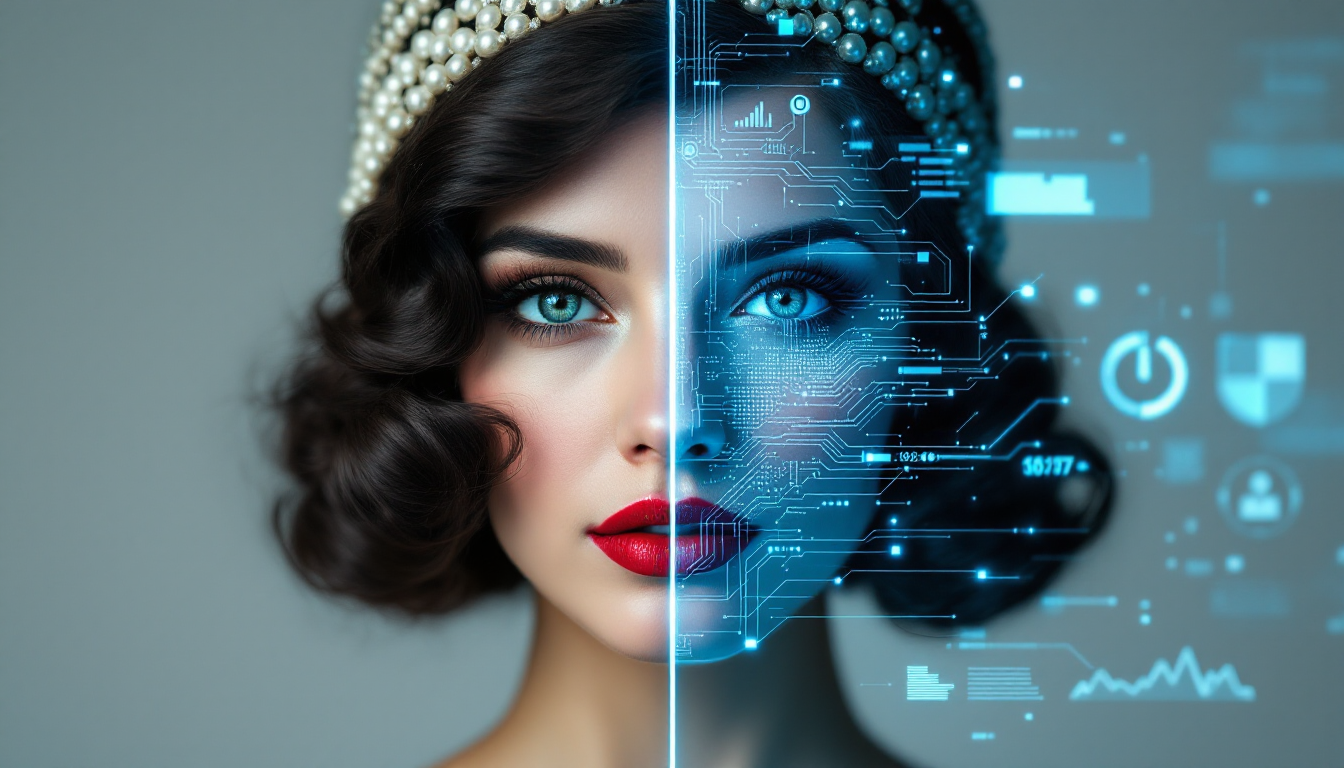
Introduction to Historical Hairstyles
Throughout human history, elaborate hairstyling has served as much more than simple grooming—hair has been a living canvas reflecting social status, cultural identity, technological innovation, and aesthetic ideals. From the braided wigs of ancient Egypt to the structured finger waves of the Roaring ’20s, each era’s signature look tells a story. Yet for most of us, these iconic styles remain locked in illustrated plates, black-and-white photos, or dusty museum vitrines—unreachable except through imagination or expensive professional reconstructions. Today, cutting-edge AI tools are dissolving that barrier. By merging deep-learning–powered style transfer with face-shape analysis and high-resolution image rendering, these platforms let anyone virtually “try on” an 18th-century pompadour or a 1940s victory roll in seconds. In this post, we explore how artificial intelligence is breathing new life into vintage hairstyles, creating a living bridge between bygone salon traditions and modern self-expression.
The Role of AI in Reviving Vintage Styles
Modern AI hairstyle try-on platforms were born to help users experiment with contemporary cuts and colors—yet their underlying technologies are perfectly suited to vintage revival. Key capabilities include:
• Face-shape detection and alignment, ensuring that any style—be it a micro bob or an 18th-century powdered wig—conforms convincingly to the user’s unique features.
• Photorealistic style transfer, learned from vast image datasets, which can reproduce the precise curls, waves, or up-dos characteristic of different periods.
• High-resolution rendering pipelines accessible via REST APIs, delivering polished before-and-after images in under 10 seconds.
Platforms leading the way today—VModel AI, Style Look Lab, Fotor, HairTry, and HeyBeauty—show just how seamless this experience can be:
• VModel AI lets you upload a portrait and reference image, then generates a realistic preview instantly (vmodel.ai).
• Style Look Lab’s face-shape–aware AI has served over 100,000 users, performing 500,000+ transformations with a 4.9/5 satisfaction rating (stylelooklab.com).
• Fotor offers batch “3×3 grid” try-ons—nine variations in under a minute—ideal for quick color or length comparisons (fotor.com).
• HairTry’s 1,000+ hairstyle library includes facial-feature–based recommendations at 95% accuracy, saving users an average of $200 per salon visit and boosting salon booking rates by up to 40% (hairtry.app).
• HeyBeauty adds 360° previews, real-time color customization, and salon integration, enhancing both user confidence and professional consultation workflows (heybeauty.ai).
While these tools predominantly showcase modern or trending cuts, the same AI pipelines—fed with well-curated vintage reference sets—can replicate period-specific techniques, textures, and silhouettes with astonishing fidelity.
Iconic Hairstyles from Different Eras
Imagine stepping into a single app and instantly toggling through centuries of coiffure history. Here are just a few legendary looks awaiting virtual exploration:
• Ancient Egypt (c. 3000–30 BCE): Intricately braided wigs and decorative beads signified nobility and ritual status.
• Renaissance Europe (14th–17th c.): Heart-shaped hairlines, high buns, and pearl-encrusted nets framed aristocratic portraits.
• Victorian Era (1837–1901): Elaborate Gibson Girl up-dos, cascading ringlets, and ornate hairpieces spoke to decorum and domestic ideals.
• 1920s Flappers: Soft, finger-pressed waves and the iconic micro bob embodied modernity and rebellion.
• 1940s Victory Rolls: Sculpted rolls on either side of the head paid wartime homage to aeronautic motifs.
• 1950s Pin Curls & Bouffants: Voluminous curls and teased crown lifts became symbols of postwar glamour.
• 1960s Mod: Sleek beehives and flip-ends reflected Space Age optimism and youth culture.
• 1980s Big Hair: Layers of mousse, volume, and bold colors captured rock-and-roll attitudes.
• 1990s Grunge: Tousled, undone styles and choppy layers embraced an intentional “anti-fashion” aesthetic.
By training AI models on annotated photo archives, period illustrations, and surviving salon manuals, virtual try-on platforms can reconstitute these styles—letting you preview how finger waves might suit your face or whether Marie Antoinette–inspired poufs flatter your jawline.
How Modern Tools Enhance Visualization
Bringing these historic visions to life isn’t just a matter of overlaying a filter. Leading AI tools incorporate:
• Face-shape–aware mapping: Style Look Lab analyzes jaw, cheek, and forehead proportions before fitting curls or buns (stylelooklab.com).
• Instant batch comparisons: Fotor’s 3×3 grids let you weigh several vintage variations—such as different 1920s wave patterns—side by side in under 60 seconds (fotor.com).
• Feature-driven recommendations: HairTry’s 95%-accuracy engine suggests the most authentic Victorian up-do or 1960s flip based on your facial landmarks (hairtry.app).
• 360° and interactive previews: HeyBeauty’s real-time color sliders and dynamic angle rotations reinforce confidence before any real-world commitment (heybeauty.ai).
Under the hood, these experiences rest on deep-learning architectures originally developed for modern style transfer—yet they can be retrained or fine-tuned on historical imagery, vintage catalogs, and museum collections to achieve period accuracy.
User Experiences: Trying on Historical Looks
Early adopters are already discovering the joy of hairstyling time travel:
• Beauty influencers document virtual 1920s sessions, comparing finger waves with flapper-era headbands before filming tutorial reels.
• Salon professionals use AI previews to propose 1950s pin-curl regimens to retro-chic clients—closing bookings 40% faster (hairtry.app).
• History educators employ virtual try-on modules in online courses, allowing students to “wear” ancient Roman braids or medieval veils as part of interactive lessons.
• Costume designers for film and theater finalize casting alignments by showing actors in digital 18th-century up-dos, eliminating guesswork in makeup trailers.
Across demographics, users cite reduced haircut anxiety, greater financial savings (often over $200 per visit), and an elevated sense of creative agency.
Future Prospects: Expanding the Virtual Hairstyle Library
The frontier of AI-powered vintage hairstyling is wide open. Key enablers include:
• DeepSketchHair: This model translates simple sketches into 3D hair forms, suggesting a pathway for artists or historians to input line-drawn references and receive fully realized vintage up-dos in three dimensions (arxiv.org/abs/1908.07198).
• CHARM: An autoregressive system for stylized hair modeling, whose parametric controls could adapt to the structured symmetry of Victorian or Edwardian coiffures (arxiv.org/abs/2509.21114).
• Broader fashion-tech momentum: Unicorns like SpreeAI—a $1.5 billion–valued virtual-clothing try-on startup—demonstrate massive market appetite for immersive self-representation tools (en.wikipedia.org/wiki/SpreeAI).
• Scalability signals: Artisse AI’s 5 million+ generated images underscore how quickly user demand can scale for any visually driven customization feature, from dresses to dreadlocks (en.wikipedia.org/wiki/Artisse_AI).
By partnering with digital archives, fashion historians, and museum collections, tomorrow’s apps could launch vast libraries of dated hairstyles—complete with metadata on regional variants, social symbolism, and step-by-step styling notes—ready for instant virtual trial.
Conclusion
Bringing hairstyle history into the digital age, AI-powered virtual try-on tools are more than playful filters; they are portals to our collective past. As machine learning architectures mature and vintage reference datasets expand, expect to zip from a Victorian salon to a Flapper speakeasy or an Ancient Egyptian court with a single selfie. Beyond personal experimentation, these innovations promise new educational resources, richer costume design workflows, and deeper cultural appreciation. In the not-too-distant future, discovering your perfect 18th-century pompadour—or deciding whether the 1960s bouffant truly complements your cheekbones—will be as effortless as opening an app. History has never looked so good.