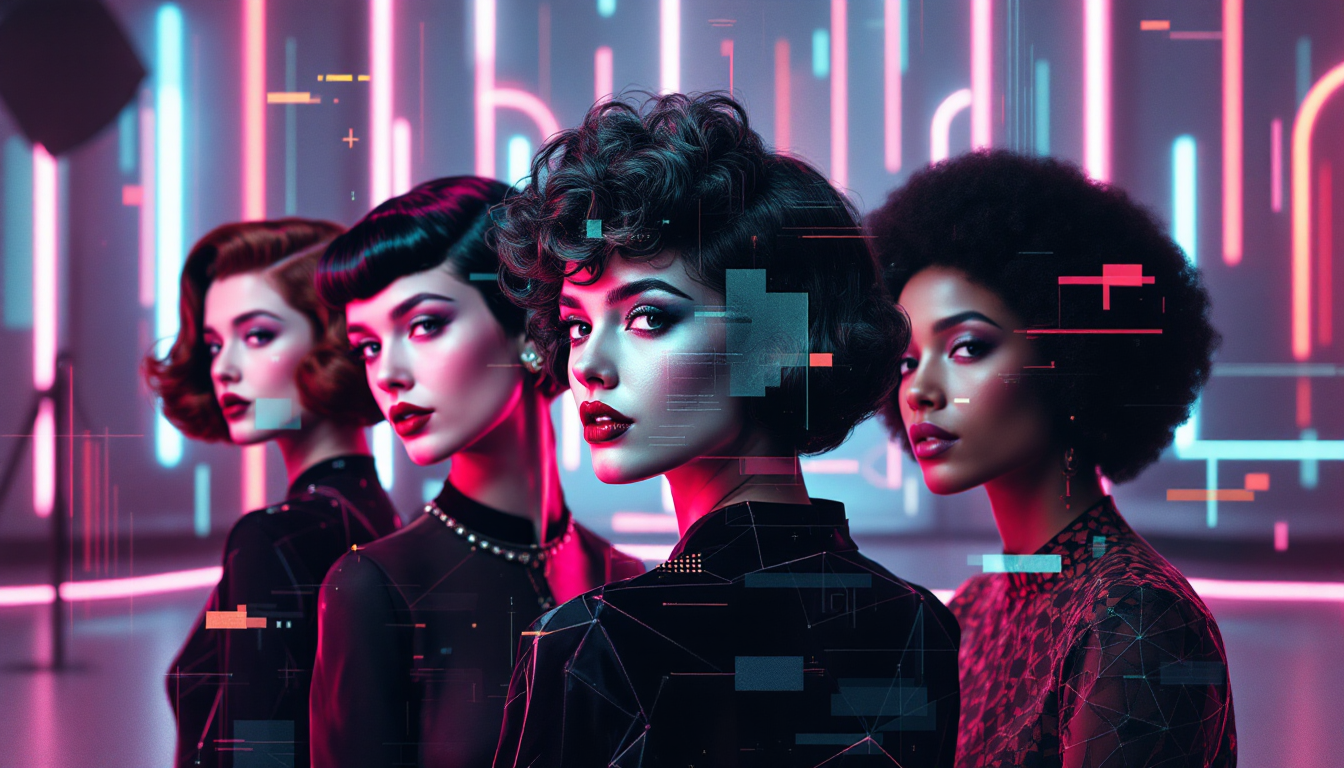
Title: Hairstyle History: How AI Resurrects Vintage Trends
Meta Description: Explore how AI is breathing new life into vintage hairstyles, allowing users to experience iconic trends from different eras with a modern touch through cutting-edge tools and techniques.
Chapter 1: Introduction to AI and its Role in Hairstyling
As artificial intelligence (AI) permeates every creative industry, hairstyling is undergoing its most dramatic transformation yet. No longer confined to in-salon consultations, AI-powered tools now let anyone experiment with elaborate looks—from roaring 1920s finger waves to punk-era mullets—without a single snip or curl. Early adopters include content creators and salon professionals seeking to streamline client previews, while fashion insiders leverage AI for trend forecasting and design. Beyond aesthetics, AI promises sustainability by reducing wasted time, hair products, and environmental impact associated with trial-and-error styling. In this post, we’ll trace how generative and computer-vision technologies have evolved from simple two-dimensional filters to sophisticated three-dimensional models, and how they’re resurrecting vintage hairstyles for a new generation.
Chapter 2: The Popularity of Vintage Hairstyles
Nostalgia has always been cyclical in fashion. In 2026, winter runways and street style alike showcase:
• Old Hollywood updos and Marcel waves reminiscent of Greta Garbo
• ’60s-inspired baby bangs and sleek pixie cuts (the “Power Pixie”) lauded for bold confidence (womanandhome.com)
• Dramatic 1980s side parts popularized by Bella Hadid and Olivia Dean (whowhatwear.com)
• 1990s bobs with a modern, textured finish
Social media platforms amplify this revival: Instagram reels and TikTok tutorials boasting thousands of views demonstrate that consumers crave authentic yet updated takes on classic looks. AI makes it easy for nonprofessionals to preview these trends on their own images, removing barriers to style experimentation.
Chapter 3: How AI Identifies and Resurrects Old Trends
AI’s power lies in its ability to analyze massive visual archives—vintage photographs, film stills, museum collections—and distill characteristic shapes, textures, and arrangements into usable style templates. Two development paths stand out:
-
2D Image-Based Style Transfer
• PixelDojo’s “Recraft V3” matches your photo’s hair map to 1920s finger waves, Marcel waves, or Eton crops, regardless of original length or texture (pixeldojo.ai).
• Pippit’s Retro Hairstyle AI templates let users drag-and-drop 1950s curls, 1980s glam, or 1920s updos onto video content, perfect for salon marketing or social media (pippit.ai). -
3D Strand-Level Reconstruction
• Research frameworks like TANGLED generate three-dimensional hair strands from a single image, enabling realistic volumetric styling with arbitrary viewpoints (arxiv.org/abs/2502.06392).
• The HAAR model uses 2D priors and artist-created hair datasets to reconstruct lifelike 3D hair geometry—a vital step toward immersive AR applications (arxiv.org/abs/2312.11666).
By combining these approaches, AI can both overlay period-accurate hairstyles and re-render them with dynamic lighting, realistic movement, and personalized fit.
Chapter 4: Modern Twists on Classic Styles
Reviving a vintage hairstyle isn’t just about copying the past—it’s about blending heritage aesthetics with contemporary sensibilities. AI enables:
• Color experimentation: Apply bold modern hues (pastel, neon) to a 1940s victory roll or 1970s shag using BasedLabs’ AI Hairstyle Generator (basedlabs.ai).
• Texture fusion: Merge softly tousled beach waves with structured 1960s bouffant silhouettes via Nano Banana’s identity-preserving prompts (nanobananaweb.com).
• Hybrid cuts: Preview a hybrid “flapper pixie” that combines finger-wave detailing with a pixie crop—all within seconds.
These tools democratize creativity. A content creator can whip up a 1950s pin-curl tutorial in minutes; a salon can show clients multiple era-inspired looks side by side; individuals can fine-tune every strand before visiting a stylist.
Chapter 5: Case Studies: Successful AI-Revamped Vintage Looks
Case Study A: Influencer Vintage Glow-Up
Fashion influencer Elena used PixelDojo’s Recraft V3 to apply 1920s finger waves for a Gatsby-themed shoot. Engagement spiked 40% as viewers loved the seamless authenticity of the digital preview, which she later recreated in real life.
Case Study B: Salon Marketing Campaign
Belleza Salon partnered with Pippit’s templates to produce a video ad featuring 1950s pin curls and 1980s glam waves. The campaign drove a 25% increase in bookings for “Retro Revivals” packages.
Case Study C: Virtual Makeover Platform
A beauty app integrated BasedLabs’ AI Hairstyle Generator and Nano Banana’s tool, allowing users to upload selfies, paint over their hair area, then choose from over 50 period styles. Time spent in-app doubled, and churn rates fell by 15%.
Chapter 6: Future of Vintage Trends in Modern Fashion
Looking ahead, AI’s role will deepen as three-dimensional realism and augmented reality (AR) converge:
• Immersive AR Mirrors: Try on a full 1960s flip or 1970s shag in real time at home or in-store.
• Predictive Trend Forecasting: Generative AI will analyze runway footage, street snaps, and social sentiment to predict which vintage era will resurface next—1920s flapper coiffures or 1990s grunge mullets.
• Sustainability Impact: Digital previews reduce the environmental cost of wasted products and salon visits. AI-guided styling fosters a low-impact approach to beauty, aligning with circular fashion principles (techxplore.com).
As 3D models become standardized, virtual hairstyling could extend into digital fashion and the metaverse, offering avatars authentic period looks—down to the finest strand.
Chapter 7: Conclusion: Embracing the Past with AI Technology
AI is more than a novelty filter—it’s a dynamic bridge between hairstyling’s storied history and its future possibilities. By automating complex revivals of iconic looks, from finger waves to pixies, AI empowers individuals and professionals to explore, personalize, and sustainably adopt vintage trends. Whether you’re a stylist previewing a client’s dream cut or a consumer seeking your first foray into retro glam, AI tools like PixelDojo, Pippit, BasedLabs, and Nano Banana ensure you can confidently step into the past—while staying firmly grounded in the technological present.
Embrace the past through the lens of AI, and discover how yesterday’s styles can define tomorrow’s beauty.