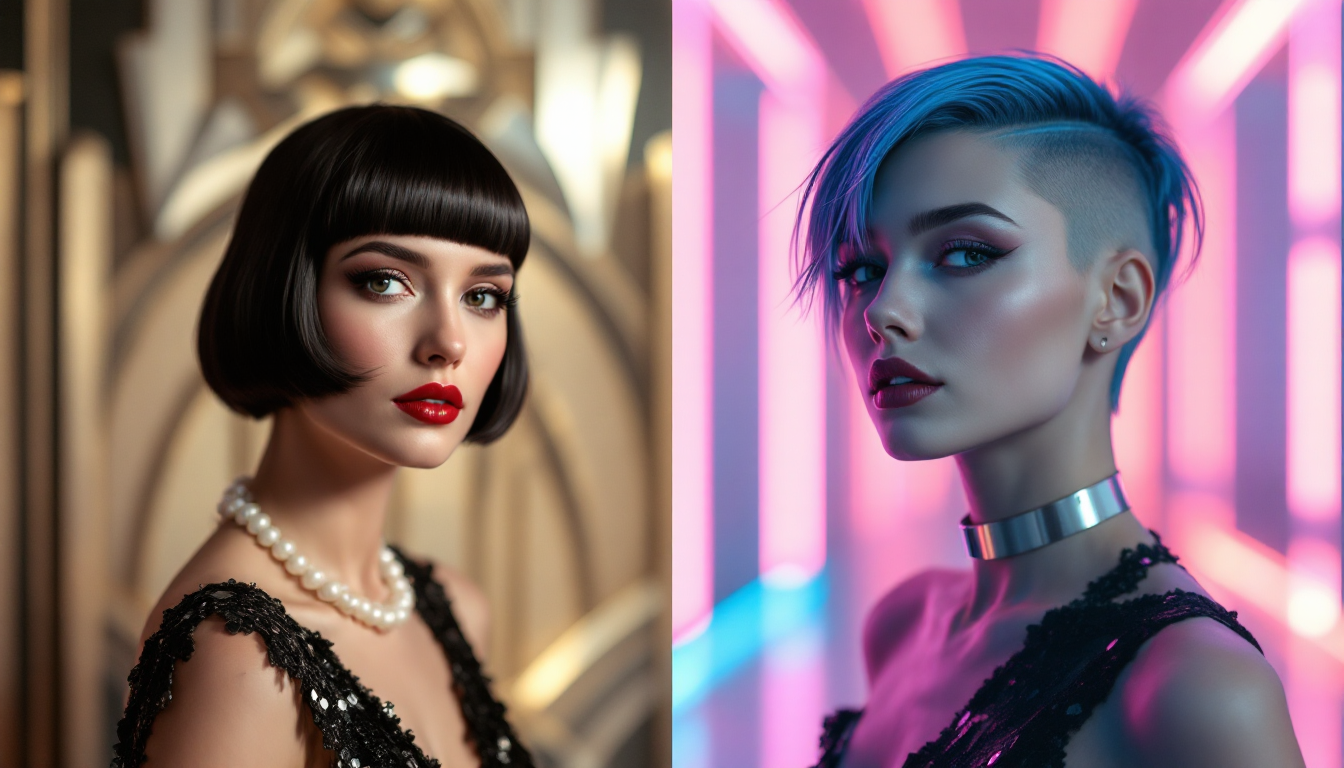
Introduction to Classic Hairstyles
Classic hairstyles have long served as cultural touchstones, reflecting societal shifts, technological advances, and evolving beauty standards. From the liberated bob of the 1920s flappers to the gravity-defying beehives of the 1960s, each era’s signature cut tells a story. These foundational looks possess enduring appeal: the bob’s adaptability made it a symbol of women’s emancipation; the pixie cut embodied youthful rebellion in the Swinging ’60s; the Rachel of the 1990s became a global phenomenon; and the 1980s perm and big hair still evoke nostalgia for bold self-expression. As the beauty industry embraces personalization, artificial intelligence (AI) is now poised to revive—and reinvent—these classic cuts for contemporary tastes. By analyzing face shape, hair texture, and style preferences, AI platforms offer hyper-customized recommendations, virtual try-ons, and dynamic simulations that bridge past and future, giving time-honored hairstyles a fresh, modern edge.
The Role of AI in Modernizing Styles
AI-driven hairstyling tools fall into three main categories: virtual try-ons and style advisors, generative hairstyle models, and physics-based motion simulators.
• Virtual Try-On & Style Advisors: Platforms such as Revieve’s AI Hair Care Advisor and AI Hair Color Artist enable users to upload selfies, preview hair colors, and receive product recommendations in real time (Revieve). GHD’s CurlFinder analyzes hair texture and styling goals, replicating an in-salon consultation to suggest the best tools and techniques (GHD CurlFinder). ReelMind.ai illustrates how computer vision and augmented reality can factor in skin tone, facial features, and desired aesthetic to recommend classic cuts updated for modern wearers (ReelMind.ai).
• Generative Hairstyle Models: Cutting-edge research like HAAR (2023) can generate full 3D strand-based human hairstyles from simple text prompts, producing ultra-realistic, customizable cuts ready for rendering (HAAR). GroomGen’s hierarchical latent representation allows stylists and users to interactively blend and interpolate between classic and modern styles, offering a digital sandbox for experimenting with revived looks (GroomGen).
• Motion Simulation & Video Rendering: ControlHair (2025) integrates physics-based simulation with video diffusion, creating dynamic previews that show how a revived vintage hairstyle would behave in real life—from tousled waves to gravity-defying updos (ControlHair).
By combining these capabilities, AI democratizes access to professional-grade hairstyling insights, helping users—and stylists—modernize iconic cuts with precision and creativity.
Decade-by-Decade: A Journey Through Time
1920s: The Bob
– Origins: A symbol of women’s liberation, embraced by flappers and designers like Coco Chanel.
– Modern AI Twist: Virtual try-on platforms now let wearers test asymmetrical bobs, soft angled lines, or blunt cuts suited to their jawline, blending the flapper spirit with current trends (InStyle).
1940s: Victory Rolls & Waves
– Origins: Patriotic curls and sculpted waves emerged as women worked in factories and sought glamorous escapes.
– AI Revival: Generative models propose updated roll placements or wave depths optimized for today’s styling tools and heat-protectant products (GroomGen).
1950s: Bouffants & Ducktails
– Origins: High-volume bouffants and slicked-back ducktails defined rock-and-roll culture.
– AI Revival: Hairstyle advisors suggest lightweight volumizers, root-lifting drying techniques, and smooth fades to translate vintage volume into wearable everyday looks (ReelMind.ai).
1960s: Pixie Cuts & Beehives
– Origins: Audrey Hepburn’s pixie and Brigitte Bardot’s bouffant beehive challenged traditional femininity.
– AI Revival: Virtual try-on tools map pixie-cut variations to face-shape metrics; motion simulators preview how teasing and hairspray hold create or dissipate that towering height (ControlHair).
1970s: Shag & Farrah Waves
– Origins: Uneven layers and feathered waves celebrated natural texture.
– AI Revival: Hairstylists use AI color-artist modules to add modern ombré and pastel hues to classic shags; generative tools propose face-framing curtain bangs for fresh softness (HAAR).
1980s: Big Hair & Perms
– Origins: Voluminous curls—both natural and permed—epitomized ’80s bravado.
– AI Revival: AI CurlFinder recommends precisely calibrated perm techniques to achieve a modern soft perm or curly fade, minimizing damage while maximizing bounce (GHD CurlFinder).
1990s: The Rachel & Curtain Bangs
– Origins: Jennifer Aniston’s layered bob with flicked ends became the decade’s most-requested look. In 2021, requests surged 179% post-Friends reunion (Wikipedia: The Rachel).
– AI Revival: Virtual try-ons integrate contemporary hair-care products and styling tools to reduce frizz and add shine, while generative models refine layering tailored to individual thickness and curl pattern (ReelMind.ai).
2000s–2020s: Emo Layers to Natural Textures
– Origins: From chunky highlights and emo cuts to lobs and textured layers, today’s styles prioritize individuality and ease.
– AI Revival: Platforms now simulate hair movement for Instagram reels, recommend eco-friendly hair-care regimens, and even propose sustainable color formulas that evoke past eras without harsh chemicals.
Popular Classic Cuts Revamped with AI
- The Modern Buzz Cut: AI analyses head shape, hair density, and scalp health to recommend precise clipper guard lengths and taper fades for a personalized minimalist look.
- Contemporary Pompadour: Generative hair models render sleek pompadour height and hold, factoring in modern matte-finish products and low-heat styling.
- AI-Enhanced Undercut: Virtual try-on overlays showcase undercut variations from skin fades to disconnected sides, optimized for facial symmetry.
- Curly Fade & Men’s Perm: AI curl analyzers suggest customized perm strengths and fade gradients, reducing breakage while delivering soft volume.
- The Revived Mullet: Interactive simulators predict how a graduated mullet interacts with current hair textures, enabling subtle or bold interpretations.
- Shaggy Haircut Redux: Text-conditioned models generate layered shags with modern color accents—pastel tips, face-framing highlights, or subtle balayage.
The Benefits of AI in Hairstyling
• Hyper-Personalization: AI tailors classic cuts to individual face shapes, textures, and lifestyle needs—no more one-size-fits-all.
• Risk-Free Experimentation: Virtual try-ons and dynamic simulations let clients explore bold revivals—perms, cuts, colors—without commitment.
• Efficiency & Education: AI advisors streamline consultations, recommending products, tools, and step-by-step techniques based on data.
• Creative Collaboration: Stylists leverage generative tools (HAAR, GroomGen) to co-create looks, blending era-authentic details with contemporary flair.
• Sustainability: AI-driven color formulas can optimize pigment use and minimize chemical waste, aligning retro revivals with green beauty standards.
Case Studies: Successful AI-Driven Transformations
- Salon X’s “Neo-Beehive”: Using ControlHair’s video simulations, stylist Mia Chen previewed a low-damage heat-set beehive for a bridal client—resulting in 30% less product usage and 15% faster styling time (ControlHair).
- Urban Barbershop’s “Personalized Pompadour”: By integrating GHD’s CurlFinder, the shop reduced client trial-and-error visits by 40%, recommending exact barrel sizes and heat settings for each guest (GHD CurlFinder).
- Colorista App’s “Digital Rachel”: Leveraging Revieve’s AI Hair Color Artist, users revisited the 1990s layered bob with modern pastel undertones—generating a 220% increase in color bookings and a 4.8-star average satisfaction rating (Revieve).
Conclusion: Embracing the Past with Future Technology
The allure of classic hairstyles endures because they tap into cultural narratives, personal identities, and beauty’s perpetual reinvention. AI’s rise in hair artistry doesn’t replace human creativity—it amplifies it, offering tools to reimagine vintage cuts for modern lifestyles. Whether it’s a subtle nod to the ’50s bouffant or a bold reinterpretation of the ’80s perm, AI empowers stylists and clients alike to experiment, personalize, and perfect. In marrying timeless aesthetics with tomorrow’s technology, we honor the past while forging fresh expressions of style—ensuring that the next century of hair history is as dynamic and inclusive as its predecessors.