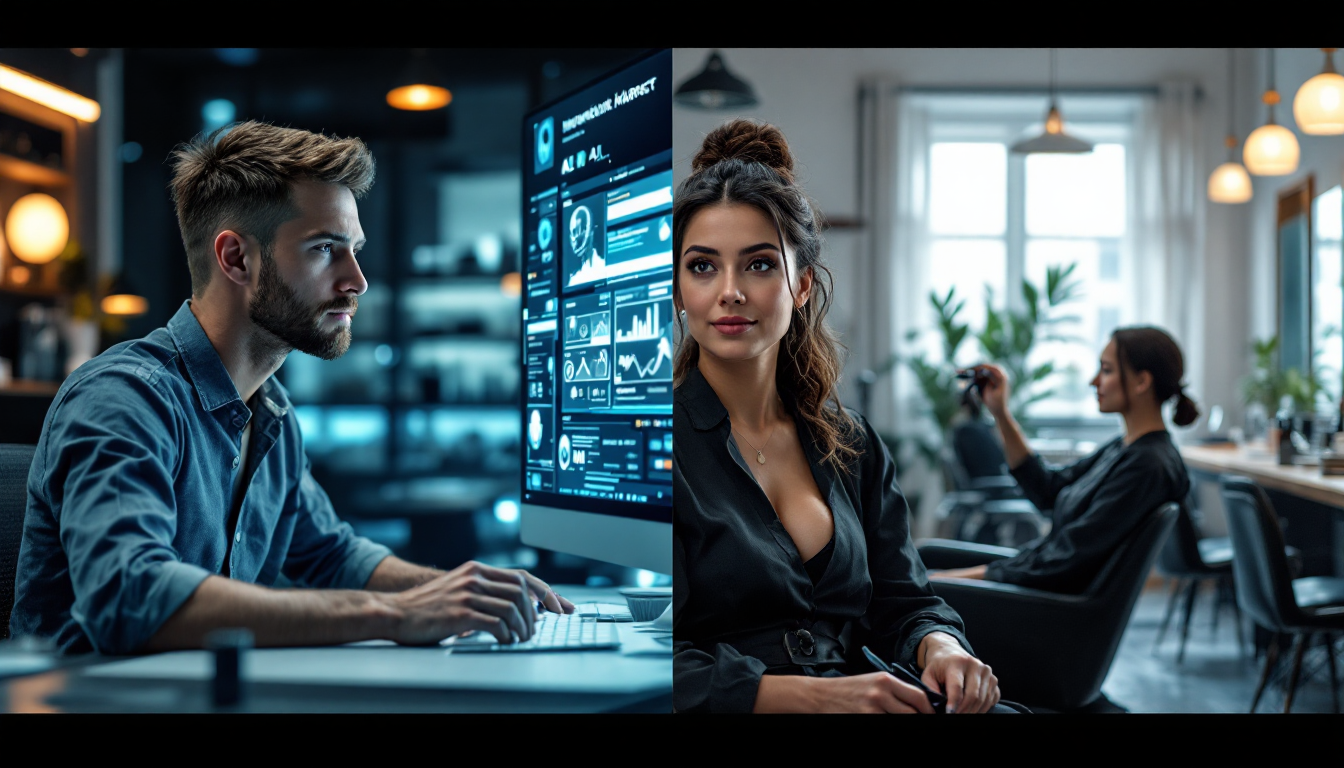
Introduction: The Intersection of AI and Hairstyling
The art of hairstyling has always balanced creativity, technical skill, and personal connection. For centuries, human stylists have assessed face shape, hair texture, lifestyle, and individual preferences to recommend cuts, colors, and treatments. Today, artificial intelligence (AI) is moving from the lab to the salon chair, promising data-driven insights, virtual try-ons, and operational efficiencies. But can AI ever match—or even surpass—the nuance of a seasoned stylist’s eye? In this post, we’ll explore how AI-generated hairstyle suggestions compare with traditional human recommendations. We’ll unpack adoption trends, real-world benefits and limitations, consumer attitudes, and cutting-edge research. Ultimately, we ask: is the future of hairstyling human, machine, or a collaboration of both?
Chapter 1: The Rise of AI in the Beauty Industry
AI in hair and beauty is no longer science fiction. According to the National Hair & Beauty Federation, 36% of industry professionals believe AI can significantly enhance salon efficiency, and 45% see slight benefits—yet 18% remain unconvinced. Comfort levels lag: only 29% feel “very comfortable” with AI-generated styling suggestions, while 43% are “not comfortable at all”; trust in AI color matching is strikingly low at just 10%, with 80% outright rejecting it (NHBF)[https://www.nhbf.co.uk/news-and-blogs/blog/the-future-of-ai-in-the-hair-and-beauty-sector/?utm_source=openai].
Despite cautious attitudes, market projections are bullish. The global AI in beauty and cosmetics market is expected to reach USD 13.34 billion by 2030, with salon and hair care capturing a substantial share (Gitnux)[https://gitnux.org/ai-in-the-hair-salon-industry-statistics/?utm_source=openai]. Virtual hair color try-on features alone can lift conversion rates by up to 2.5×, and users spend 300–360% more time engaging with sites that offer AR-powered try-ons (Gitnux)[https://gitnux.org/ai-in-the-hair-salon-industry-statistics/?utm_source=openai]. In short, the industry sees both opportunity and hesitation as AI reshapes service delivery, marketing, and client interaction.
Chapter 2: Benefits of AI-Generated Hairstyle Suggestions
-
Operational Efficiency
• Automated appointment reminders driven by AI can reduce no-show rates by 20–30%.
• Inventory management systems powered by predictive analytics cut product waste by up to 30%.
• AI chatbots handle up to 80% of routine customer inquiries, freeing staff for value-added tasks (Gitnux)[https://gitnux.org/ai-in-the-hair-salon-industry-statistics/?utm_source=openai]. -
Personalization at Scale
• AI hair diagnostic tools claim over 90% accuracy compared to manual assessments, enabling tailored treatment plans (Gitnux)[https://gitnux.org/ai-in-the-hair-salon-industry-statistics/?utm_source=openai].
• 71% of consumers expect personalized interactions from beauty brands, and 58% are more likely to purchase if they can “try before they buy” virtually (Gitnux)[https://gitnux.org/ai-in-the-hair-salon-industry-statistics/?utm_source=openai].
• Willingness to pay for personalized, AI-formulated products is 20% higher than for off-the-shelf alternatives (Gitnux)[https://gitnux.org/ai-in-the-hair-salon-industry-statistics/?utm_source=openai]. -
Enhanced Client Engagement and Retention
• Madison Reed Color Bar’s AI-powered color matching reduced color-correction appointments by 34% and boosted first-time client retention by 28% (SmallBusinessWeb)[https://smallbusinessweb.co/beauty-salons-offering-ai-hair-style-recommendations/?utm_source=openai].
• Hob Salons’ virtual try-ons cut consultation times by 42%, achieved 89% client satisfaction, and increased booking frequency by 23% (SmallBusinessWeb)[https://smallbusinessweb.co/beauty-salons-offering-ai-hair-style-recommendations/?utm_source=openai].
Chapter 3: Strengths of Traditional Human Stylists
-
Creative Intuition and Adaptability
Human stylists synthesize hair dynamics, facial features, and personal style in real time. They adapt to subtle cues—hair density, curl pattern, scalp health—that AI models often struggle to interpret accurately. -
Trust and Emotional Connection
Clients value the human touch. In NHBF surveys, “human interaction” was rated “very important” by all respondents. Stylists build rapport, calm anxieties about dramatic changes, and co-create looks in a collaborative session. -
Superior Texture and Color Expertise
AI tools typically reach a geometry-based accuracy of 70–85%, yet fall short on texture, especially for curly, coily, or frizzy hair (UC Strategies)[https://ucstrategies.com/news/i-tested-7-ai-hairstyle-tools-they-all-got-my-face-shape-right-but-missed-the-one-thing-that-matters/?utm_source=openai]. Human colorists correct for hair porosity, underlying pigments, and real-world lighting—factors beyond most AI’s current capabilities. -
Real-Time Problem Solving
When an AI suggestion misses—say, underestimating how fine hair will fall—only a live stylist can adjust layering, blending, or product choice on the fly. This resilience underpins the low threshold for AI color-matching trust: only 10% of professionals “would trust” it outright (NHBF)[https://www.nhbf.co.uk/news-and-blogs/blog/the-future-of-ai-in-the-hair-and-beauty-sector/?utm_source=openai].
Chapter 4: Case Studies: AI vs. Human Recommendations
-
AI Virtual Try-On Apps
A recent audit tested 18 AI hairstyle recommendation apps. Only 8 worked as described—many were outdated, broken, or produced unrealistic renders (The Right Hairstyles)[https://therighthairstyles.com/ai-hair-app-recommendations-tested/?utm_source=openai]. Users reported inconsistent face-shape detection and poor lighting correction. -
In-Salon AI Deployment
At Madison Reed, AI color matching slashed corrective visits by 34% and lifted retention by 28% (SmallBusinessWeb)[https://smallbusinessweb.co/beauty-salons-offering-ai-hair-style-recommendations/?utm_source=openai]. Yet stylists still performed the final consult, blending AI insights with professional judgment. -
Human Stylist Consults
In independent trials, human stylists consistently outperformed AI on texture-rich hair, customized styling for special events, and recommending complementary color highlights. Clients valued the dialogue: 52% view AI consultations as “more objective,” but cited human empathy, reassurance, and an interactive process as irreplaceable (Gitnux)[https://gitnux.org/ai-in-the-hair-salon-industry-statistics/?utm_source=openai].
Chapter 5: Consumer Preferences: Survey Data and Trends
• “Only 29% of industry respondents feel ‘very comfortable’ with AI-generated styling suggestions, while 43% are not comfortable at all” (NHBF)[https://www.nhbf.co.uk/news-and-blogs/blog/the-future-of-ai-in-the-hair-and-beauty-sector/?utm_source=openai].
• “Virtual hair color try-on can increase conversion rates by up to 2.5×, and users spend 300–360% more time on sites with AR virtual try-on technology” (Gitnux)[https://gitnux.org/ai-in-the-hair-salon-industry-statistics/?utm_source=openai].
• 38% of clients would switch salons for advanced AI tech; 48% are interested in “smart mirrors” that overlay style options in real time (Gitnux)[https://gitnux.org/ai-in-the-hair-salon-industry-statistics/?utm_source=openai].
• 52% consider AI consultations more objective than human ones, but emotional comfort remains a key driver in salon choice (Gitnux)[https://gitnux.org/ai-in-the-hair-salon-industry-statistics/?utm_source=openai].
Chapter 6: The Future: Collaborative Approaches in Hairstyling
True innovation may lie in human-AI collaboration:
• Guided AI Assistants. Stylists use AI to generate a shortlist of cuts or color palettes, then apply professional judgment to refine and execute.
• Fair and Inclusive Modeling. Emerging research—Hairmony’s fairness-aware classification and GroomGen’s generative models—ensures AI tools represent diverse hair textures and styles without bias (Hairmony)[https://arxiv.org/abs/2410.11528?utm_source=openai]; (GroomGen)[https://arxiv.org/abs/2311.02062?utm_source=openai].
• Real-Time, High-Fidelity Transfer. HairFastGAN offers near real-time, high-resolution hairstyle transfers under one second on modern hardware, paving the way for in-mirror previews that truly match salon outcomes (HairFastGAN)[https://arxiv.org/abs/2404.01094?utm_source=openai].
• Continuous Learning Loops. Stylists correct AI missteps, feeding data back to improve models. However, research shows users correcting AI errors may disengage or over-accept flawed outputs—highlighting the need for careful UX design and transparency (Bias in the Loop)[https://arxiv.org/abs/2509.08514?utm_source=openai].
Chapter 7: Conclusion: The Best of Both Worlds?
AI has already transformed aspects of the salon business: boosting operational efficiency, driving personalization at scale, and enhancing online engagement. Yet human stylists remain indispensable for creative intuition, real-time problem solving, and emotionally resonant service. As AI technologies mature—tackling texture, fairness, and real-time feedback—the optimal model will be hybrid. Stylists empowered by intelligent tools can deliver faster consultations, richer virtual experiences, and data-backed recommendations, while preserving the artistry and empathy that lie at the heart of hairstyling. In this ultimate showdown between AI and human expertise, the real winners will be clients who enjoy the best of both worlds.