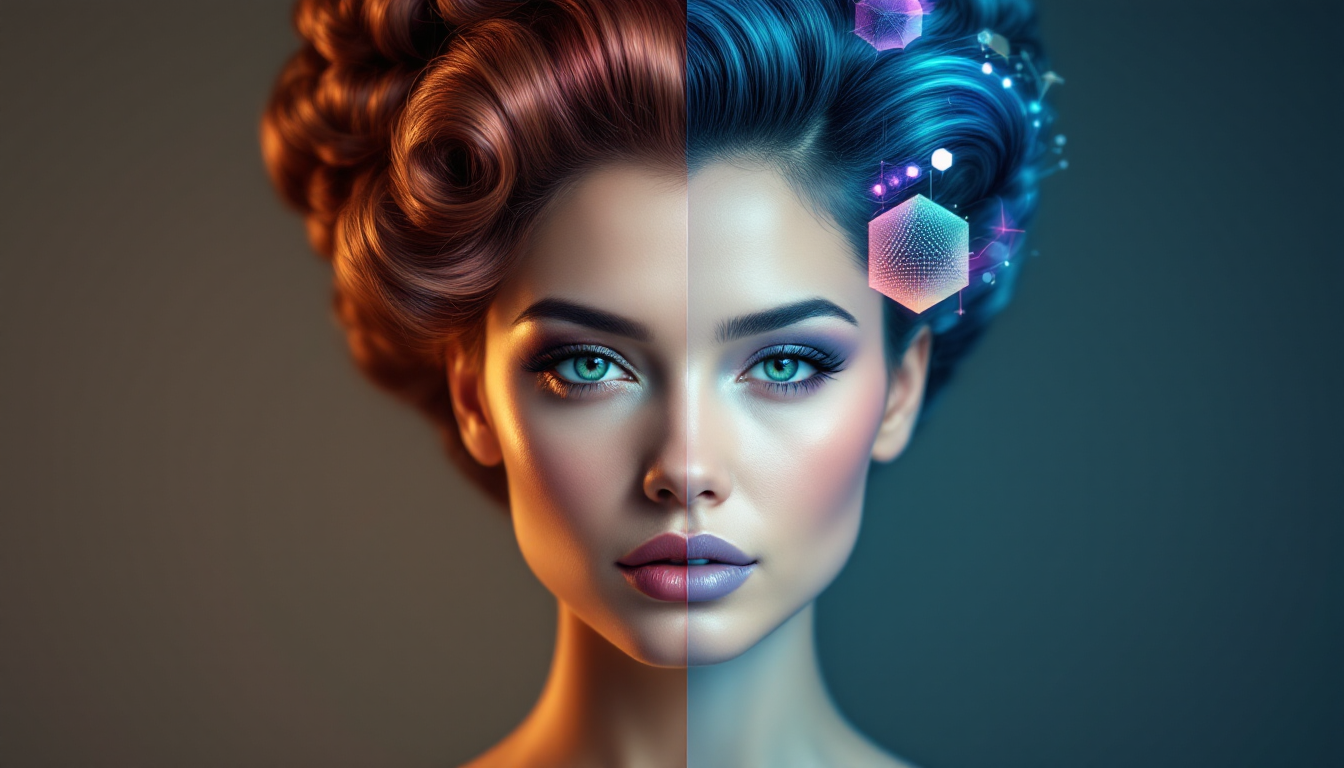
Introduction to AI in Hairstyling
Artificial intelligence has transcended mere algorithmic predictions to become an indispensable creative partner—especially in the beauty and fashion industries. From automating salon bookings to analyzing hair health, AI now helps professionals and enthusiasts alike visualize entirely new looks. One of the most exciting frontiers is historical hairstyle recreation: leveraging machine learning, computer vision, and generative models to resurrect the elegance of bygone eras in seconds. Whether you’re a vintage aficionado dreaming of 1920s finger waves or a filmmaker seeking authentic Victorian updos, AI tools have opened the door to hyper-realistic, interactive styling experiences.
The Charm of Vintage Hairstyles
Vintage hairstyles carry more than aesthetic appeal—they’re cultural time capsules.
• Victorian era (1837–1901): intricate updos, braids woven with ribbons or flowers, and elaborate hair ornaments reflected social status and refinement.
• Roaring Twenties (1920–1929): the liberated “bob” cut and finger waves symbolized modernity and women’s newfound freedoms.
• Old Hollywood (1930s–1950s): sculpted waves and glamorous curls, immortalized by stars like Veronica Lake, epitomized red-carpet allure.
These styles resurface cyclically—runways and Instagram feeds attest to our collective nostalgia. Yet reproducing them authentically is painstaking, often requiring specialized training. AI bridges that gap, marrying historical accuracy with modern convenience.
How AI Brings Historical Hairstyles to Life
AI-driven platforms now offer everything from quick portrait filters to advanced 3D recreations:
• Fotor’s “AI Time Machine” transforms a single selfie into a remarkably realistic period portrait—complete with era-appropriate hairstyle, attire, and background—in about 30 seconds. Users can choose Victorian, Regency, Roaring Twenties, and other looks with a click (fotor.com).
• PixelDojo’s “Recraft V3” specializes in 1920s finger waves and Marcel waves. Employed by over 10,000 creators, it boasts a 95% satisfaction rate, seamlessly overlaying sculpted waves onto photos and videos (pixeldojo.ai).
• Somny’s Period Costume AI Generator accepts 10–15 reference photos to render lifelike portraits across multiple historical periods—regency gowns with empire silhouettes, Victorian bustles, and matching hairstyles (somny.com).
• ReelMind.ai offers 101+ specialized video-generation models (Flux, Runway series) that recreate elaborate Old Hollywood curls or intricate Victorian updos in motion. Their multi-image fusion ensures consistency of curls, ornaments, and volume across every frame—crucial for filmmakers and content creators ([reelmind.ai/blog/old-hollywood-hairstyle-ai-for-beauty-and-fashion-trends?utm_source=openai], [reelmind.ai/blog/hair-art-victorian-ai-s-historical-beauty-style-visualization?utm_source=openai]).
Modern Twists on Classic Looks
The intersection of AI and creative experimentation has led to fresh reinterpretations of vintage styles:
• Text-conditioned 3D generation: The HAAR model can produce strand-level 3D hairstyles from textual prompts—imagine “Gibson Girl updo with soft tendrils”—ready for physics-based animation in virtual environments ([arxiv.org/abs/2312.11666?utm_source=openai]).
• Single-image 3D reconstruction: DiffLocks uses a diffusion-transformer framework to recover detailed 3D geometry from a single photo, faithfully reproducing curls, twists, and volume—even afro or tightly coiled styles—opening new possibilities for VR heritage exhibits ([arxiv.org/abs/2505.06166?utm_source=openai]).
• High-fidelity strand datasets: GeomHair extracts individual hair strands from colorless 3D scans, building a “Strands400” dataset that enables ultra-realistic digital avatars without relying on color, perfect for museums or period dramas ([arxiv.org/abs/2505.05376?utm_source=openai]).
• Artistic fusion: Digital artist Bas Uterwijk leverages Artbreeder to blend classical portraiture with photographic realism—“filling in” hair details from paintings and sculptures to breathe life into historical figures ([aol.com/news/artist-ai-technology-historical-figures-121041999.html?utm_source=openai]).
Engaging Vintage Enthusiasts with Technology
AI tools aren’t just for professionals—they empower hobbyists, reenactors, and social media communities:
• Interactive photo challenges: Users share before-and-after portraits, exploring “My 1920s Self” or “Victorian Tea Party” filters on TikTok and Instagram.
• Virtual styling tutorials: AI-driven apps guide users through step-by-step finger-wave or updo techniques, using augmented reality overlays to indicate finger placement and wave patterns in real time.
• Collaborative platforms: Communities on PixelDojo and ReelMind.ai exchange presets, reference images, and video snippets—amassing over 10,000 creators on PixelDojo alone with a 95% satisfaction rate (pixeldojo.ai).
• Gamified learning: Quizzes on hairstyle history let users “unlock” digital badges (e.g., “Art Deco Wave Master”) as they try different AI filters and share their creations.
The Future of Vintage Styling with AI
Emerging research and technologies promise even deeper immersion:
• Real-time AR integration: Imagine smartphone apps that overlay a Victorian updo onto your reflection as you adjust pins and comb.
• Cross-modal models: Future systems may accept voice prompts—“Make me look like a 1940s movie star”—and instantly render both hairstyle and makeup in 3D.
• Hyper-realistic VR salons: Powered by HAAR and DiffLocks, users can virtually step into a 19th-century parlor, interact with AI stylists, and walk away with a digital souvenir.
• Heritage preservation: Museums could use GeomHair-derived avatars of historical figures to guide visitors, complete with period-correct hairstyles and attire.
Conclusion: Bridging Past and Present
AI has ushered in a new era for vintage hairstyling—one where the meticulous artistry of historical hairdressers meets the speed, accessibility, and versatility of modern technology. From quick portrait filters to research-grade 3D reconstructions, enthusiasts and professionals alike can explore, recreate, and reimagine iconic styles with unprecedented fidelity. As AI continues to evolve, it will not only preserve our sartorial heritage but also inspire novel fashion narratives, ensuring that the elegance of the past remains vibrant in the digital age.