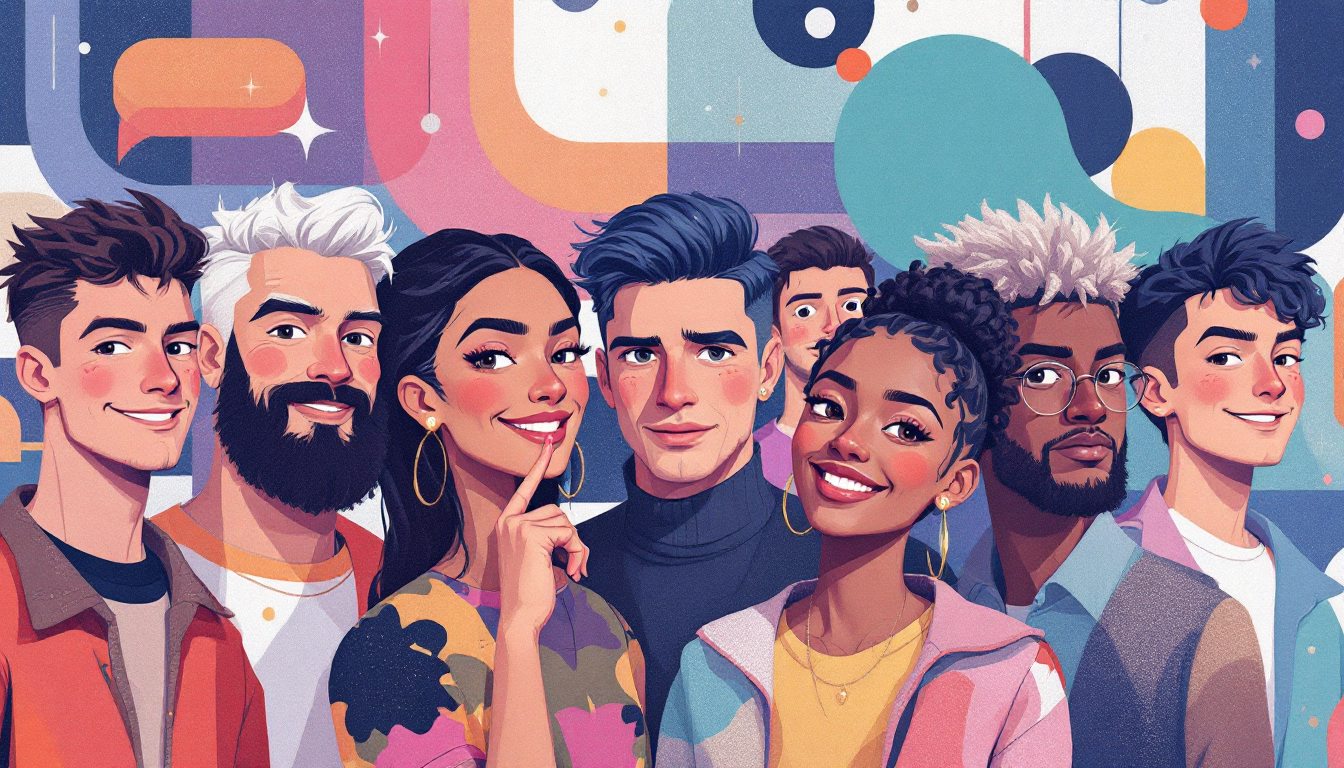
From Dreadlocks to Pixie Cuts: Exploring AI’s Versatility with Diverse Hair Types
-
Introduction to AI in Hairstyling
The hairstyling industry has long been a blend of art, fashion, and personal expression. Today, artificial intelligence is reshaping how we envision and experiment with hair—with virtual try-ons, generative design tools, and automated consultations. As consumers demand ever more personalization, AI systems must recognize and render every texture, curl pattern, and cultural hairstyle with equal fidelity. In this post, we’ll explore how AI accommodates dreadlocks, pixie cuts, box braids, and the full spectrum in between—highlighting breakthroughs, real-world applications, and the challenges that lie ahead. -
Understanding Diverse Hair Types
Human hair varies not only in color but in structure:
• Straight (Type 1)
• Wavy (Type 2)
• Curly (Type 3)
• Coily/kinky (Type 4)
Each type brings its own set of thickness, porosity, and styling behavior. Beyond texture, cultural traditions have given rise to specialized techniques—cornrows, dreadlocks, bantu knots, pixie cuts—that carry deep personal and communal meaning. For AI to serve all users, models must learn from balanced datasets reflecting this full spectrum. Without that, virtual hairstyles risk feeling generic or, worse, insensitive to cultural context. -
AI’s Role in Embracing Cultural Hairstyles
a. Virtual Try-On Tools for Dreadlocks and Locs
Platforms like Dearify.ai now offer AI dreadlocks filters that detect your natural hair texture—straight, curly, or coily—and overlay realistic locs, complete with highlights and jewelry adjustments (dearify.ai). Locs AI takes customization further: users can tweak loc size, thickness, styling (updos or half-downs), and even simulate growth stages. According to Locs AI, over 80 million virtual previews have been conducted, with a 99.1 % realism rating among both users and professional locticians (aiimageedit.org).
b. Generative Style Libraries
On Hugging Face, the “AI Hairstyle Changer” exposes 93 distinct hairstyles and 29 colors—including pixie cuts, box braids, cornrows, mohawks, and more—allowing anyone to imagine themselves with a culturally significant or avant-garde style in seconds (huggingface.co). This breadth underscores AI’s potential to democratize hairstyling inspiration.
- Case Studies: Successful AI Hairstyling Applications
a. TANGLED: 3D Strand-Level Realism
TANGLED is a diffusion-based system that generates fully 3D hair strands from a single photo, leveraging a MultiHair Dataset of 457 hairstyles annotated with 74 attributes—many of them culturally significant (e.g., dreadlocks, Afros, twists). Its outputs can be rotated, animated, and integrated into AR applications for avatars or virtual fittings (arxiv.org).
b. GroomGen: Hierarchical Hair Geometry
GroomGen encodes hair at both the strand and style level using a hierarchical latent representation. Stylists and developers can sample new looks, interpolate between styles (e.g., transitioning smoothly from a curly bob to a finger-wave updo), or edit strand-level details for hyper-realistic visualizations (arxiv.org).
c. HairFIT: Pose-Invariant Hairstyle Transfer
HairFIT enables reliable hairstyle transfer between images with varying poses and occlusions. By aligning flow-based hair regions and employing semantic-region-aware inpainting, it preserves realism even when hair overlaps the face or shoulders—enabling users to see themselves in anything from a shaved pixie cut to a cascading braid, regardless of the original photo’s angle (arxiv.org).
- Challenges and Opportunities
a. Persistent Bias in AI Hair Generation
Despite progress, many popular image generators still default to Eurocentric norms. One study found 37 % of AI-generated women featured blonde hair, with lighter skin tones and thin bodies, while men predominantly had brown hair and eyes (bulimia.com). Another analysis highlights how straight hair and light complexions are repeatedly normalized, sidelining coily textures and darker tones (richtmann.org). Anecdotal reports on Reddit corroborate these findings: some users note that AI tools struggle with straight-root modeling, yet occasionally produce surprisingly accurate coily textures—underscoring uneven performance across hair types (reddit.com).
b. Data Gaps and Labeling Complexities
High-quality, annotated datasets for diverse hairstyles remain scarce. Capturing the nuanced geometry of twists versus curls, or the cultural context behind a bantu knot, demands both technical rigor and cultural competence.
c. Opportunity: Collaborative Dataset Building
Engaging with stylists, cultural experts, and communities can enrich AI training data—ensuring models learn from authentic examples and respect the heritage behind each style.
-
The Future of AI in Inclusive Haircare
• Personalized Hair Health Insights: Integrating scalp imaging with AI to recommend treatments that suit individual textures.
• Real-Time AR Mirror Experiences: Combining TANGLED-style 3D strand generation with live-video overlays for salon-grade virtual try-ons.
• Cross-Platform Standardization: Open benchmarks for hair representation that encourage fairness in texture, style, and color.
• Education and Storytelling: Embedding cultural context and history into AI-driven style recommendations—so users learn the origins of Afro-centric braiding, natural hair movements, and more. -
Conclusion: Celebrating Diversity with Technology
AI’s rapid advances are opening doors to unprecedented personalization in hairstyling—from dreadlocks and box braids to razor-sharp pixie cuts. Yet true inclusivity demands more than technical prowess: it requires intentional dataset curation, bias audits, and community collaboration. As stylists, developers, and users alike embrace these tools, we have an opportunity—and a responsibility—to ensure every hair type and cultural tradition is rendered with respect, accuracy, and joy. Let’s push AI beyond generic beauty norms and celebrate the rich tapestry of human hair in all its forms.