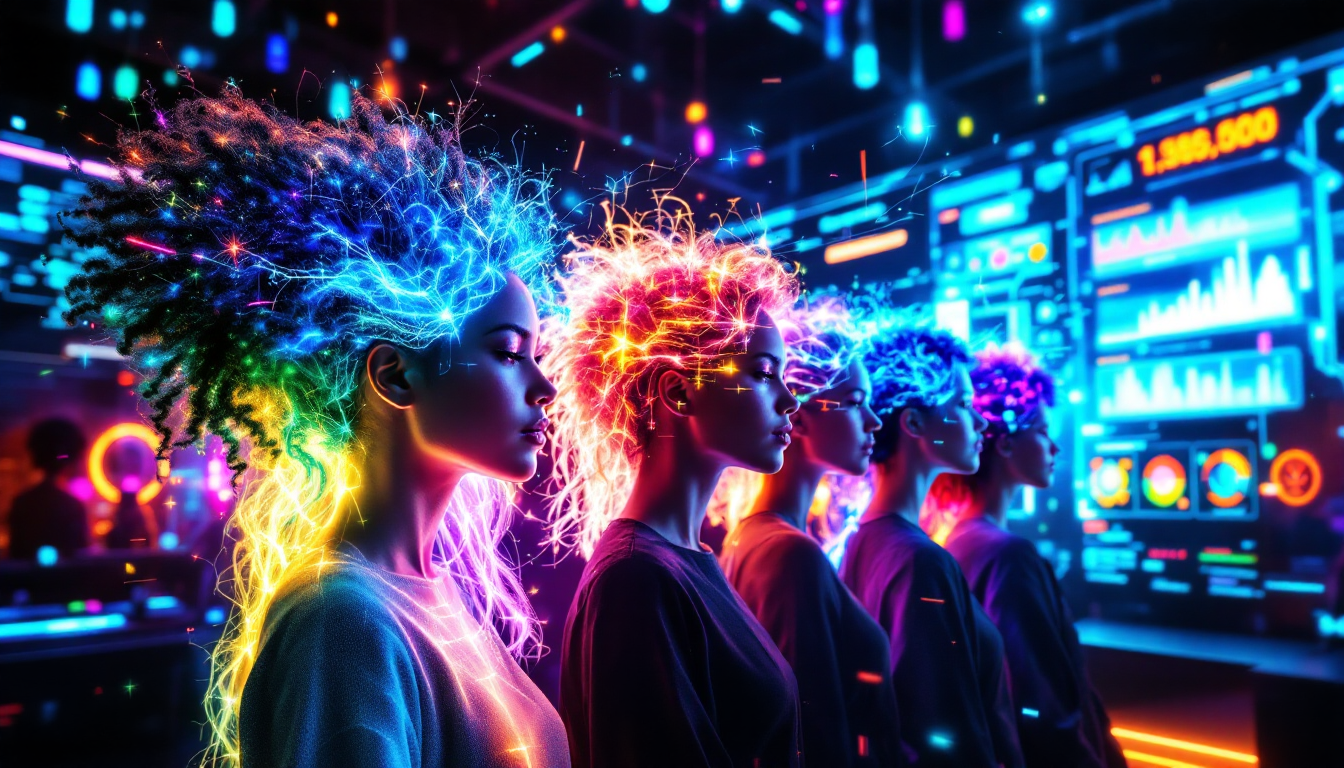
The Digital Makeover: How AI is Revolutionizing Hair Coloring Practices
Introduction to AI in Hair Coloring
Artificial intelligence (AI) has moved from the realm of sci-fi into salons and consumer apps, fundamentally transforming how we choose, preview, and even formulate hair color. No longer must clients rely on static swatches or the stylist’s intuition alone: AI–powered tools analyze individual traits, simulate outcomes in real time, and recommend hues tailored to skin tone, eye color, hair health and personal style. This new paradigm elevates confidence, reduces guesswork, and streamlines salon workflows, creating a win-win for both consumers and industry professionals.
The Evolution of Hair Coloring Techniques
- Ancient and Pre-Industrial Methods
• Early civilizations used plant-based dyes (henna, indigo, cassia) for subtle tints and conditioning.
• Mineral and chemical pigments emerged in the 19th century, introducing permanent and semi-permanent synthetic dyes. - The Rise of Professional Color Formulation
• Mid-20th-century salons standardized color lines, but shade selection remained subjective—clients viewed color charts under salon lights, then waited weeks to see real results. - Digital Simulations and AR Previews
• Early 2000s: Basic photo-editing software allowed clients to “photoshop” hair color, but results were blocky and unrealistic.
• Late 2010s: Augmented reality (AR) apps introduced live virtual try-on, overlaying color filters atop video feeds. These still lacked truly personalized recommendations and often failed on curly or multi-tonal hair textures. - AI-Driven Breakthroughs
• Today’s AI leverages deep learning, computer vision and cloud computing to analyze hair type, texture, existing color and facial features—producing hyper-realistic, dynamically lit previews on all hair types in real time (Revieve’s AI Hair Color Artist) and recommending precise dye formula adjustments to account for gray blending, highlights or balayage.
How AI Personalizes Hair Color Suggestions
AI personalization rests on three pillars: data collection, predictive modeling and adaptive learning.
• Data Collection & Diagnostics
– High-resolution imaging captures hair strand thickness, curl pattern, scalp condition and underlying pigment (dark vs. light).
– Skin-tone analysis uses facial segmentation to recommend complementary undertones (warm, cool, neutral).
– Lifestyle inputs (sun exposure, styling habits) refine durability and damage-control suggestions.
• Predictive Modeling
– Machine-learning algorithms compare user profiles against vast databases of past transformations to predict which shades and techniques yield the most flattering and long-lasting results.
– AI color-matching tools report up to 30% improvement in shade-match accuracy versus traditional swatch comparisons (Ai In The Cosmetology Industry Statistics: Reports 2025, wifitalents.com).
• Adaptive Learning & Feedback Loops
– Post-service feedback (client satisfaction ratings, photos of final results) continuously trains models to refine recommendations.
– Stylists can override AI suggestions and annotate why, creating human-in-the-loop corrections that improve future performance.
Benefits of AI-Driven Hair Color Previews
- Consumer Confidence & Engagement
– Hyper-realistic virtual try-ons lead to 2.5× higher conversion rates and 300–360% longer engagement times on e-commerce sites offering AR tools (AI In The Hair Salon Industry Statistics: Market Data Report 2025, gitnux.org).
– Brands using Revieve’s AI Hair Color Artist saw up to a 300% increase in conversions, 30% larger average cart sizes and 2.5× longer session durations (Revieve AI Hair Color Artist | Virtual Hair Color Try-On Solution, revieve.com). - Personalized Shopping Experiences
– 45% of consumers prefer AI-based hair analysis recommendations, and 60% are more inclined to buy products suggested by AI (AI In The Hair Care Industry Statistics: ZipDo Education Reports 2025, zipdo.co).
– 65% of consumers trust AI diagnostics over traditional methods, driving repeat purchases and loyalty. - Salon Operational Efficiency
– AI-powered scheduling and appointment reminders reduce no-shows by 20%, while intelligent inventory management cuts waste and manual stock-taking hours (AI In The Salon Industry Statistics: ZipDo Education Reports 2025, zipdo.co).
– Salon owners report 25% revenue growth and 45% lower operating costs after adopting AI tools. - Elevated Stylist Productivity
– With AI handling shade matching and pre-booking consultations, stylists spend more time on creative technique and client interaction—improving satisfaction (72% of salons report happier clients when using AI tools).
Real-World Examples of AI in Hair Coloring
• Revieve AI Hair Color Artist (revieve.com/insider/news/revieve-unveils-hair-color-artist-redefining-virtual-hair-color-try-on-with-cutting-edge-ai-technology-from-revieve-and-google-cloud)
– Real-time or still-image color visualizations adaptable to all hair types. Integrated on major beauty-brand websites and in-store kiosks.
• Visuali.io (visuali.io/examples/hair-color-and-style-preview)
– Users upload photos, apply dozens of AI-rendered hues and download reference images to share with stylists.
• Sally Beauty’s ColorView (allure.com/story/sally-beauty-colorview-hair-color-try-on)
– Launched 2019 with YouCam technology, this in-app and in-store feature increased customer confidence and reduced return rates.
• YouCam Makeup (wikipedia.org/wiki/YouCam_Makeup)
– With over 1 billion downloads by October 2025, many beauty brands embed YouCam’s virtual try-on SDK to showcase hair and cosmetics before purchase.
Addressing Concerns and Misconceptions
• Color Accuracy vs. Real-World Results
– Reality: AI previews approximate dyed outcomes under ideal lighting. Stylists calibrate formulas and conduct strand tests to reconcile any discrepancies.
– Solution: Built-in disclaimers, calibration sliders and “real sample” hair patch options help manage expectations.
• Data Privacy and Consent
– Concern: Users worry about facial scans and profile data misuse.
– Mitigation: Transparent privacy policies, opt-in image storage, end-to-end encryption and GDPR/CCPA compliance reassure users their biometric data remains secure.
• Technological Replacement of Stylists
– Misconception: AI will replace human artistry.
– Reality: AI acts as an assistant—providing objective analysis, freeing stylists to focus on advanced techniques, creative color blending and the social aspects of the salon experience.
Future Trends in AI and Hair Color Technology
- Advanced Formulation Engines
– AI-driven dye mixers that recommend precise chemical ratios for custom in-salon blends, minimizing trial-and-error and chemical waste. - Immersive AR/VR Consultations
– Virtual salon environments where clients and stylists meet in the metaverse, experimenting with 3D hair models under simulated lighting conditions before any physical dye is applied. - Proactive Hair Health Diagnostics
– Integrating scalp microbiome analysis and UV exposure data to forecast damage, suggest protective toners and recommend scheduling for gloss or nourishment treatments. - Subscription-Based Color Services
– At-home color kits tied to AI coaching apps that guide users step-by-step through mixing, application and post-color care, with real-time feedback via video analysis. - Sustainability and Ingredient Transparency
– AI platforms matching consumer values—recommending ammonia-free, cruelty-free or upcycled pigment options based on individual preferences and ethical scoring.
Conclusion: Embracing AI for a Colorful Future
AI is no longer an abstract novelty but a transformative force reshaping every facet of hair coloring. From hyper-realistic virtual try-ons that boost sales and confidence, to salon-optimized operations and personalized shade recommendations that deepen client loyalty, the data is clear: AI elevates both artistry and efficiency. By addressing concerns around accuracy, privacy and human-machine balance, the industry can harness AI as a creative partner. As we look ahead, emerging trends promise even richer, more sustainable and immersive color experiences. Stylists, brands and consumers who embrace this digital makeover will pioneer the next chapter of hair artistry—one pixel, one strand and one perfectly matched hue at a time.