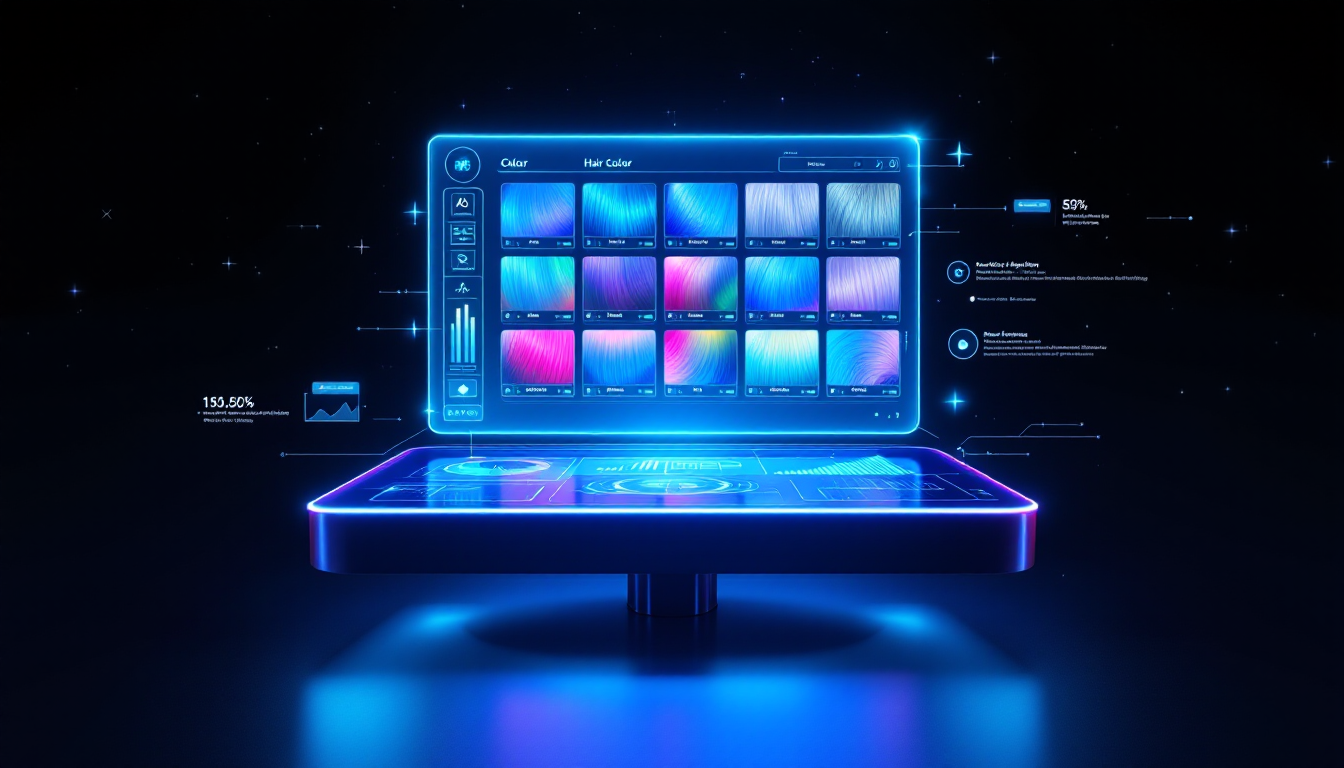
Beyond Haircuts: Exploring AI’s Role in Predicting Hair Color Trends
Introduction to AI in Hairdressing
The world of hairdressing has long revolved around the craft of cutting, styling, and coloring hair based on intuition, trends observed in fashion shows, and stylist experience. Today, artificial intelligence (AI) is transforming this landscape—shifting salons from reactive trend followers to proactive trend setters. No longer confined to recommending cuts that suit a face shape, AI-driven tools can now forecast hair color trends months or even years in advance, helping salons, color brands, and stylists stay ahead of consumer demand. In this post, we’ll explore how AI analyzes massive data sets, the underlying technologies that power trend prediction, real-world impacts on salon operations, and what the future holds for AI-led hair color forecasting.
How AI Analyzes Hair Color Trends
-
Data Ingestion Across Channels
• Social Media Monitoring: AI platforms scrape millions of public posts and images from Instagram, TikTok, Pinterest, and fashion blogs. By running computer-vision models over these images, they tag emerging hair colors—rose gold highlights, “buttery blonde,” sorbet pink, and more—quantifying how often each appears and their rate of growth.
• Consumer Interaction Signals: E-commerce behavior, salon booking patterns, and virtual try-on session logs feed into trend models. Rising click-throughs on a burgundy shade in a virtual try-on app can signal an impending spike in salon requests.
• Cultural and Geographic Context: Natural language processing (NLP) on trend reports, articles, and social captions helps AI understand cultural zeitgeists behind color choices (e.g., “90s grunge comeback,” “Cottagecore rose”). -
Forecasting Accuracy
• General AI-driven trend-prediction models in hair fashion reach approximately 80% accuracy in anticipating which colors will surge over the next six to twelve months (gitnux.org).
• WGSN’s TrendCurve AI reports over 90% accuracy, enabling global fashion and beauty brands to align product development and marketing calendars with predicted color trends (bestcolorfulsocks.com).
• Heuritech’s proprietary algorithms also exceed 90% accuracy forecasting color and style trends up to two years ahead, by correlating social-media image analysis with consumer purchase behaviors (bestcolorfulsocks.com). -
Real-Time Adaptation
AI models continuously retrain as new data streams in. If a celebrity or influencer debuts a pastel “mermaid blue” hue and it goes viral, the AI can detect the pattern within days—alerting color houses and salons to prepare limited-edition dyes or in-salon campaigns.
The Technology Behind Trend Prediction
-
Machine Learning Architectures
• Time-Series Forecasting: Recurrent neural networks (RNNs) and transformer models analyze trend trajectories over time, projecting which shades will grow or wane.
• Computer Vision: Convolutional neural networks (CNNs) classify hair colors and textures in images, even under varying lighting conditions.
• Generative Models: GANs (Generative Adversarial Networks) and diffusion models simulate realistic hair color variations on virtual models, helping brands visualize future palettes before physical formulation. -
Cutting-Edge Research
• Stable-Hair: A diffusion-based framework offering high-fidelity virtual hair transfer with precise color control. This allows stylists to present ultra-realistic “after” visuals to clients (arxiv.org/abs/2407.14078).
• HairFastGAN: An encoder-based GAN that performs real-time hairstyle and color transfers, preserving both shape integrity and color accuracy—key for seamless virtual try-ons (arxiv.org/abs/2404.01094). -
Commercial Tools and Platforms
• Revieve’s AI Hair Color Artist: Provides salons with in-app recommendations and virtual trials of trending shades in real time (en.wikipedia.org/wiki/Revieve_%28company%29).
• YouCam Makeup / Sally Beauty’s ColorView: An AR-powered virtual try-on that lets consumers experiment with dozens of professional hair dyes before purchase, driving a 50% increase in online engagement (api4.ai; allure.com/story/sally-beauty-colorview-hair-color-try-on).
Impact on the Hairdressing Industry
-
Adoption Rates
• 60% of professional hair designers use AI tools for color selection and style planning (zipdo.co).
• In North America, 45–65% of salons have integrated AI-driven systems for bookings, consultations, and virtual try-ons (gitnux.org). -
Operational Efficiency & Client Satisfaction
• AI reduces consultation time by ~35%, freeing stylists to focus on creative execution rather than manual color matching (gitnux.org).
• Virtual try-on solutions achieve 75% user satisfaction in-salon—with clients more confident in their choices and fewer “remake” appointments (gitnux.org).
• AI-driven personalization increases customer retention by 20% and loyalty by 35%, as bespoke color plans foster deeper client-stylist relationships (gitnux.org). -
Business Growth
• Beauty brands incorporating AI-forecasted shades into limited-edition launches see faster sell-through rates.
• Salons leveraging AI trend insights report up to a 15% boost in service revenue, driven by upselling of trending color add-ons and retail products.
Personalized Hair Color Recommendations
-
Skin-Tone & Complexion Analysis
AI examines client photos to identify undertones (warm, cool, neutral), recommending complementary hair palettes. This replaces one-size-fits-all swatches with data-backed color pairings that flatter individual coloring. -
Hair Texture & Health Profiling
By analyzing strand thickness, porosity, and existing dye residue, AI suggests formulas that achieve the desired vibrancy without compromising hair health—minimizing breakage and fade. -
Virtual Consultation Workflows
• Step 1: Client uploads multiple selfies under different lighting.
• Step 2: AI maps face shape, skin tone, and hair baseline.
• Step 3: System proposes 3–5 trending shades—drawing on global forecast data.
• Step 4: Client virtually “tries on” selected shades in real time, votes on favorites, and books a follow-up appointment with preloaded color formulas. -
Enhanced Loyalty & Upsell Opportunities
Personalized shade histories and AI-powered reminders—when colors need refreshing—keep clients returning every 6–8 weeks, boosting lifetime value.
Future Prospects of AI in Hair Styling
-
Deeper Integration with E-Commerce and Supply Chains
• Real-time dye formulation: Brands could auto-blend custom hues based on AI predictions and ship directly to salons or consumers.
• Inventory optimization: AI demand forecasts help distributors stock the right pigment kits, reducing waste and stock-outs. -
AI-Driven Sustainable Practices
• Eco-friendly formulations will be recommended based on environmental impact scores, aligned with both trend data and sustainability metrics.
• Virtual try-ons reduce sample usage, lowering chemical and packaging waste. -
Strategic Partnerships & Innovation Hubs
• Estée Lauder’s AI Innovation Lab (partnered with Microsoft) aims to accelerate responsiveness to emerging color and beauty trends across its portfolio (voguebusiness.com).
• At events like the Bronner Brothers Hair Show 2024, AI demos highlighted how salon owners can proactively plan seasonal campaigns and product launches by tapping into real-time social and purchase data (reelmind.ai/blog/bronner-brothers-hair-show-2024-beauty-trends-with-ai). -
The Rise of AI Salon Assistants
• Voice-activated AI sidekicks that suggest color tweaks mid-service (e.g., “Add a cooler violet undertone to match her winter wardrobe”).
• Automated aftercare bots delivering tailored post-color treatment plans via chat apps—maintaining color vibrancy and client engagement between visits.
Conclusion: Embracing AI Innovations
AI is no longer a futuristic novelty—it’s a tangible, revenue-driving force reshaping how salons forecast, create, and deliver hair color. From 90%-plus trend-prediction accuracy to virtual try-ons that slash consultation time by over a third, the data speaks: AI empowers stylists to make bolder creative choices, deepen personalization, and ultimately build stronger client loyalty. As the technology matures—with diffusion models like Stable-Hair and real-time GANs steering the next wave of virtual hair demos—forward-thinking salons and brands that embrace AI will lead the charge in defining what’s “in” tomorrow’s hair color scene. The question is no longer if you’ll adopt AI—it’s how quickly you’ll integrate it into your color chair.