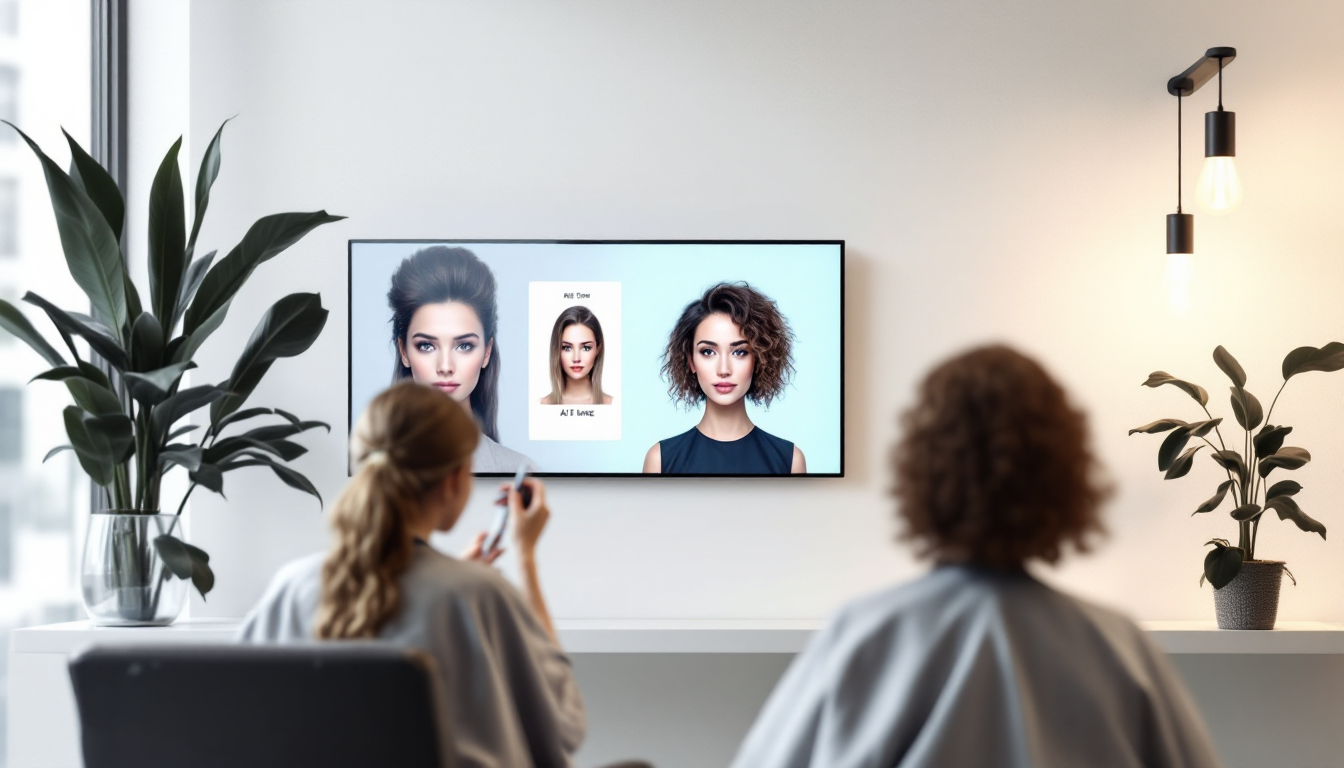
From Pixels to Perfection: How AI Personalizes Your Ideal Haircut Experience
Explore how AI technology analyzes individual style preferences, lifestyle habits, and unique facial characteristics to craft a personalized haircut experience. Dive into the science of AI algorithms and how GetHairVision optimizes each user’s journey from digital preview to real-world perfection.
-
Introduction to AI in Beauty
Choosing a new haircut has always been fraught with uncertainty: Will the style suit my face shape? Will I regret it two weeks later? AI-powered visualization tools are transforming this process by letting users “see your next haircut — before you cut it.” GetHairVision, for example, allows secure photo uploads and delivers dozens of realistic hairstyle previews in seconds, eliminating guesswork and salon-day anxiety (gethairvision.com). Similarly, HaircutAI claims to help users avert bad haircuts and costly mistakes by offering virtual try-ons that align with each individual’s facial structure and style goals (creati.ai/ai-tools/ai-hairstyleapp/?utm_source=openai). These platforms turn a high-risk decision into an informed, confidence-boosting experience. -
Understanding the Technology
At the core of AI haircut personalization lie computer vision, machine learning and generative modeling techniques. FaceHair.ai analyzes facial landmarks, proportions and skin tone to recommend haircuts tailored to each user’s geometry (creati.ai/ai-tools/facehair/?utm_source=openai). Pippit’s “AI Choose My Haircut” builds on this by combining preference inputs—such as desired length, texture and maintenance level—with algorithmic matching to templates that suit different face shapes (pippit.ai/templates/ai-choose-my-haircut?utm_source=openai). Behind the scenes, these systems rely on large datasets of hairstyles and facial scans, training convolutional neural networks to detect features like jawline angles and forehead height before suggesting optimal cuts. -
How AI Analyzes Your Style Preferences
Personal style is shaped by more than face shape alone. AI platforms let users specify aesthetic influences—classic bobs, modern fades, bohemian waves—and weight those against real-world constraints such as hair thickness and curl pattern. By ingesting preference tags alongside photographic data, the algorithms can rank hairstyles that match both the user’s taste and their hair’s inherent characteristics. For example, HaircutAI offers over 90 style options and applies a scoring system that elevates looks compatible with the user’s hair texture and personal color palette (creati.ai/ai-tools/ai-hairstyleapp/?utm_source=openai). This two-pronged analysis ensures the virtual preview feels authentic to each individual. -
Lifestyle and Facial Features Integration
A successful haircut must fit into the wearer’s daily routine. Does your day start at the gym or in a boardroom? How much time can you devote to styling each morning? Leading tools incorporate lifestyle questionnaires—covering activity levels, grooming time and profession—to fine-tune suggestions. Simultaneously, facial feature analysis employs landmark detection: eyes, nose, mouth and chin positions define face shape categories (round, oval, square, heart). The Haircut AI app for iOS/iPad uses these landmarks to recommend cuts that complement a user’s natural angles, then offers side-by-side comparisons and color experimentation before exporting salon-ready style sheets (apps.apple.com/us/app/haircut-ai-face-analysis/id6751164512). -
The Science Behind AI Algorithms in Haircutting
Recent academic research has propelled hair modeling from flat overlays to photorealistic, strand-level representations. Neural Strands (2022) learns hair geometry from multi-view images, enabling dynamic lighting and movement effects in real time (arxiv.org/abs/2207.14067). More advanced still is the HAAR model (December 2023), which introduces text-conditioned generative modeling of 3D, strand-based hairstyles for production-ready assets (arxiv.org/abs/2312.11666). Complementary approaches like HairFIT and GroomGen enable pose-invariant hairstyle transfer and hierarchical latent representations, ensuring that virtual trials maintain fidelity whether the user’s head is turned, tilted or in motion (arxiv.org/abs/2206.08585). -
User Journey: From Digital Preview to Salons
The typical workflow begins with a user uploading a clear portrait. Within 30 seconds—or less—platforms such as AI Hair Lens deliver ultra-realistic previews of 100+ hairstyles with 95% reported accuracy, serving a community of over 50,000 users (aihairlens.com). Users can download images, create mood boards or generate salon-ready color codes shared directly with their stylist. A popular Reddit prompt, “The Perfect Hair Makeover Companion,” underscores demand for high-resolution previews plus personalized cut and color recommendations that translate seamlessly from screen to salon chair (reddit.com/r/ChatGPT/comments/1hwnuc1). -
Benefits of Personalized Haircuts
• Reduced Anxiety and Regret: Virtual try-ons let users “not guess, know,” bridging communication gaps with stylists (apps.apple.com/us/app/haircut-ai-face-analysis/id6751164512).
• Cost and Time Savings: Avoiding salon do-overs lowers expenses and maximizes stylist appointments’ value (creati.ai/ai-tools/ai-hairstyleapp/?utm_source=openai).
• Confidence and Satisfaction: AI Hair Lens reports a 99.5% user satisfaction rate, demonstrating the emotional payoff of precise personalization (aihairlens.com).
• Empowered Decision-Making: Access to dozens of tailored options encourages experimentation without commitment. -
Future Trends in AI and Hairstyling
Enterprise-level solutions are expanding beyond cuts into holistic beauty experiences. Revieve, a Finnish SaaS provider, integrates AI and AR for skin care, makeup and hair care personalization. Its AI Hair Care Advisor and Hair Color Artist now offer real-time hair color try-ons, launched in early 2025, and custom routine recommendations based on user-specific traits (en.wikipedia.org/wiki/Revieve_%28company%29). Looking ahead, we can expect deeper AR integration in salon mirrors, real-time AI assistants guiding stylists during cuts, and metaverse-ready avatars enabling virtual consultations across the globe. -
Conclusion: Embracing a Technological Transformation
From the first photo upload to the final salon reveal, AI has revolutionized how we choose and experience haircuts. By combining facial feature analysis, lifestyle profiling and cutting-edge generative models, platforms like GetHairVision deliver personalized journeys that minimize risk and maximize confidence. As enterprise players and academic research push boundaries, the future promises seamless digital-to-physical transitions, ensuring every haircut is not just a change in appearance but the perfect expression of individual style.