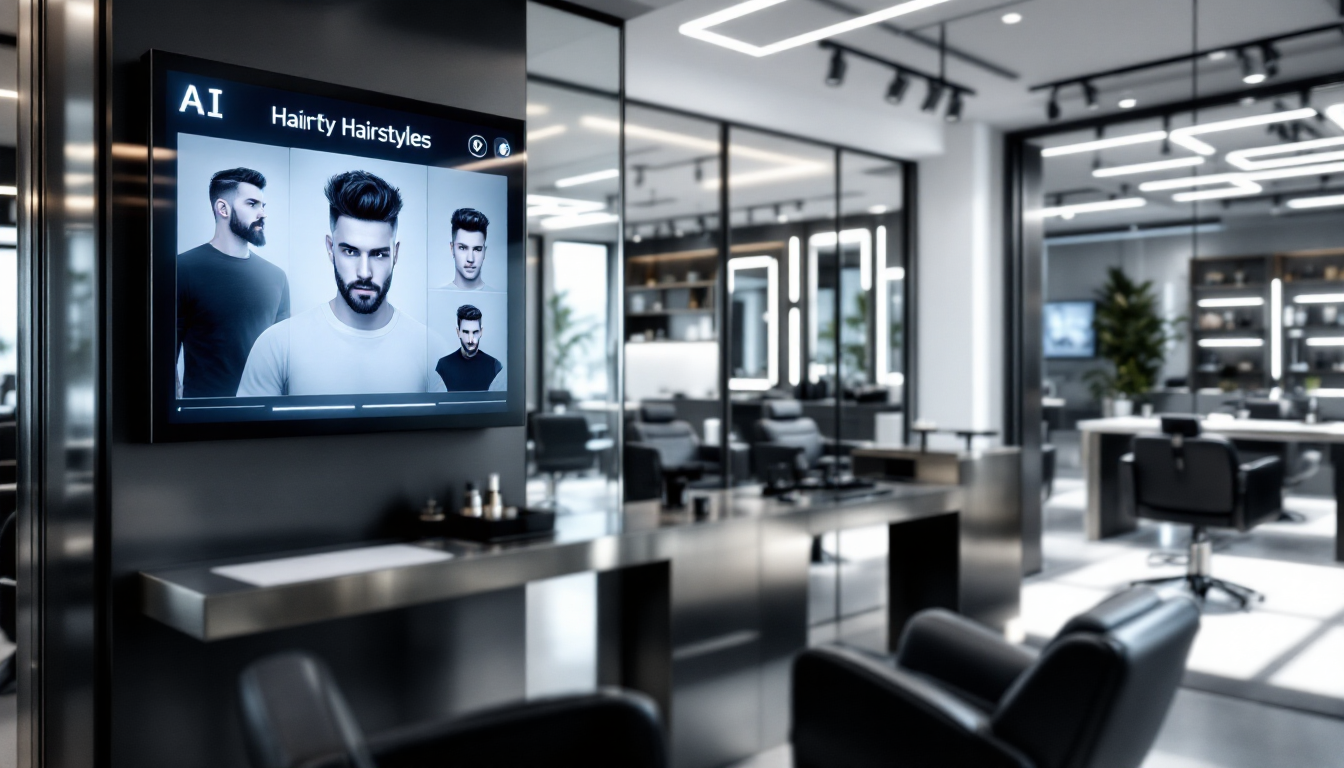
Introduction to AI in Men’s Grooming
Today’s men expect more than a basic haircut or shave—they want a styling experience that reflects their individual features, lifestyle and personal brand. Artificial intelligence is transforming that expectation into reality. By combining computer vision, machine learning and generative models, AI-driven grooming platforms function as “virtual barbers,” offering risk-free experimentation, hyper-personalized recommendations and seamless at-home or in-salon experiences. Whether you’re a style-conscious consumer or a busy professional barber, AI tools are streamlining consultations, boosting confidence and elevating client satisfaction.
Chapter 1: The Evolution of Men’s Hair and Grooming
• From Barbershops to Digital DIY: For centuries, men relied on local barbers for classic cuts and straight-edge shaves. The 20th century introduced men’s lifestyle magazines and home grooming kits. The early internet brought YouTube tutorials and influencer-driven trends.
• The Personalization Imperative: By the 2010s, consumers demanded more than one-size-fits-all. They wanted styles tailored to face shape, hair texture and personal taste—yet DIY guessing games often led to disappointing results.
• Enter AI: Starting around 2020, advances in facial-landmark detection and generative AI unlocked true personalization. Now, real-time hairstyle try-on, automated clipper adjustments and data-driven styling advice bridge the gap between imagination and outcome.
Chapter 2: How AI Personalizes Hairstyle Suggestions
Consumer-Facing Try-On Tools
• MenHair (https://menhair.app/?utm_source=openai)
– Browser-based, no-install tool. Upload a selfie, select from 30+ contemporary and classic men’s cuts, and receive photorealistic previews in seconds. Photos are processed via Google AI; no images are stored after session end.
• BarberGPT.ai (https://www.aicovery.com/tools/barbergpt-ai-hairstyle-simulator?utm_source=openai)
– Leverages generative-AI to match styles to facial geometry and lighting. Offers 40+ styles with realistic rendering, all in a lightweight web interface.
Academic and Research Innovations
• HaReS (2025) uses convolutional neural networks to detect face shape and recommend hairstyles—and even complementary eyewear—based on facial proportions (HaReS paper).
• Emerging generative models such as HAAR (Text-Conditioned 3D Strand-Based Hairstyle Generation) aim for true-to-life, strand-level realism and full 3D control (HAAR on arXiv).
• Internal innovations like GetHairVision integrate trend analytics, suggesting styles based on current runway, celebrity and social-media trends, refined by each user’s hair type and face shape.
Chapter 3: AI Beyond Hairstyles: Comprehensive Grooming Advice
Virtual Grooming Assistants
• Master Barber via yeschat.ai (https://www.yeschat.ai/gpts-9t557DRtJoq-Master-Barber?utm_source=openai)
– GPT-4o and DALL·E–powered assistant offering:
• Personalized haircut and beard-shaping suggestions
• Skincare routines tailored to skin type
• Product recommendations and nutrition tips for hair health
• Revieve’s AI/AR Platform (https://en.wikipedia.org/wiki/Revieve_%28company%29?utm_source=openai)
– Integrates into e-commerce and in-store apps to deliver:
• AI-driven hair color and style try-on
• Skincare and makeup virtual consultations
• Cross-channel personalization from mobile to point-of-sale
Business Intelligence & Operations
• SQUIRE AI (https://getsquire.com/ai?utm_source=openai)
– Embeds AI into barbershop management systems to optimize:
• Marketing campaigns and client outreach
• Automated appointment reminders and rebooking
• Inventory forecasting for products and retail lines
Chapter 4: Case Studies: Success Stories from AI-Powered Grooming
StyleForge 3D Barber Assistant
• App Store rating: 4.8/5
• Delivers 500+ photorealistic 3D styles, updated weekly
• Reported benefits for salons:
– 35% increase in average ticket size
– 50% faster client consultations
– 25% rise in repeat bookings
– Higher overall customer satisfaction (https://apps.apple.com/by/app/styleforge-3d-barber-assistant/id6520393091?utm_source=openai)
My-Blades Tensor 1 AI-Powered Clipper
• Launched October 2025
• Adapts blade speed and pressure in real time to hair type and desired style
• 26,000 strokes per minute; onboard sensors ensure uniform cutting height
• Professional barbers report consistent quality, reduced hand fatigue and fewer touch-ups (https://www.globenewswire.com/news-release/2025/10/21/3170682/0/en/My-Blades-Launches-Tensor-1-The-World-s-First-AI-Powered-Hair-Clipper-for-Professional-Barbers.html?print=1\&utm_source=openai)
Quantifiable Industry Impact (ZipDo, 2025)
• 67% of customers prefer salons using AI for personalized suggestions
• 33% reduction in styling errors and operational costs
• 41% increase in client loyalty and retention
• 28% of shops employ AI analytics to track style preferences
• 15% rise in online bookings; 19% higher appointment adherence
(https://zipdo.co/ai-in-the-barber-industry-statistics/?utm_source=openai)
Chapter 5: Challenges and Opportunities in AI Grooming
Challenges
• Data Privacy & Security: Safeguarding client photos and personal data is paramount.
• Algorithmic Bias: Ensuring models serve diverse hair textures, skin tones and cultural style cues.
• Adoption Barriers: Training barbers and shop owners to trust, integrate and maintain AI tools alongside hands-on skills.
• Technical Constraints: Achieving true strand-level realism and 3D interactivity remains computationally intensive.
Opportunities
• Hyper-Personalization at Scale: AI can tailor every aspect of grooming—from cut and color to skincare and nutrition—based on biometric and lifestyle data.
• Omnichannel Integration: Bridging e-commerce, in-store experiences and mobile apps for seamless client journeys.
• Subscription & Membership Models: Recurring revenue based on AI-driven home-care plans, product refill delivery and virtual check-ins.
• Cross-Industry Partnerships: Collaborations between AI platforms, hair-care product brands and fashion labels to deliver co-branded experiences.
Chapter 6: The Future of AI in Men’s Grooming
• Real-Time AR Mirrors & Glasses: Imagine smart mirrors or AR glasses that overlay styles live during consultations or at home.
• Predictive Hair Health Analytics: Wearable or IoT sensors could monitor scalp moisture, UV exposure and hair breakage, feeding data to AI for preemptive care plans.
• Metaverse Grooming Salons: Virtual barbershops in VR environments where you customize avatars down to individual strands.
• Advanced Generative Styling: Models like GroomGen delivering completely novel, trend-setting hairstyles based on user prompts, social data and runway collections.
Chapter 7: Conclusion: Embracing AI for a Modern Grooming Experience
Artificial intelligence is no longer a futuristic novelty in men’s grooming—it’s the present. From consumer apps that let you trial dozens of haircuts in minutes to professional tools that boost salon revenue and efficiency, AI is reshaping every facet of the grooming journey. By embracing these technologies responsibly—prioritizing privacy, inclusivity and education—consumers and professionals alike can unlock the full potential of personalized style. The age of the virtual barber has arrived: it’s time to experience grooming tailored precisely to you.