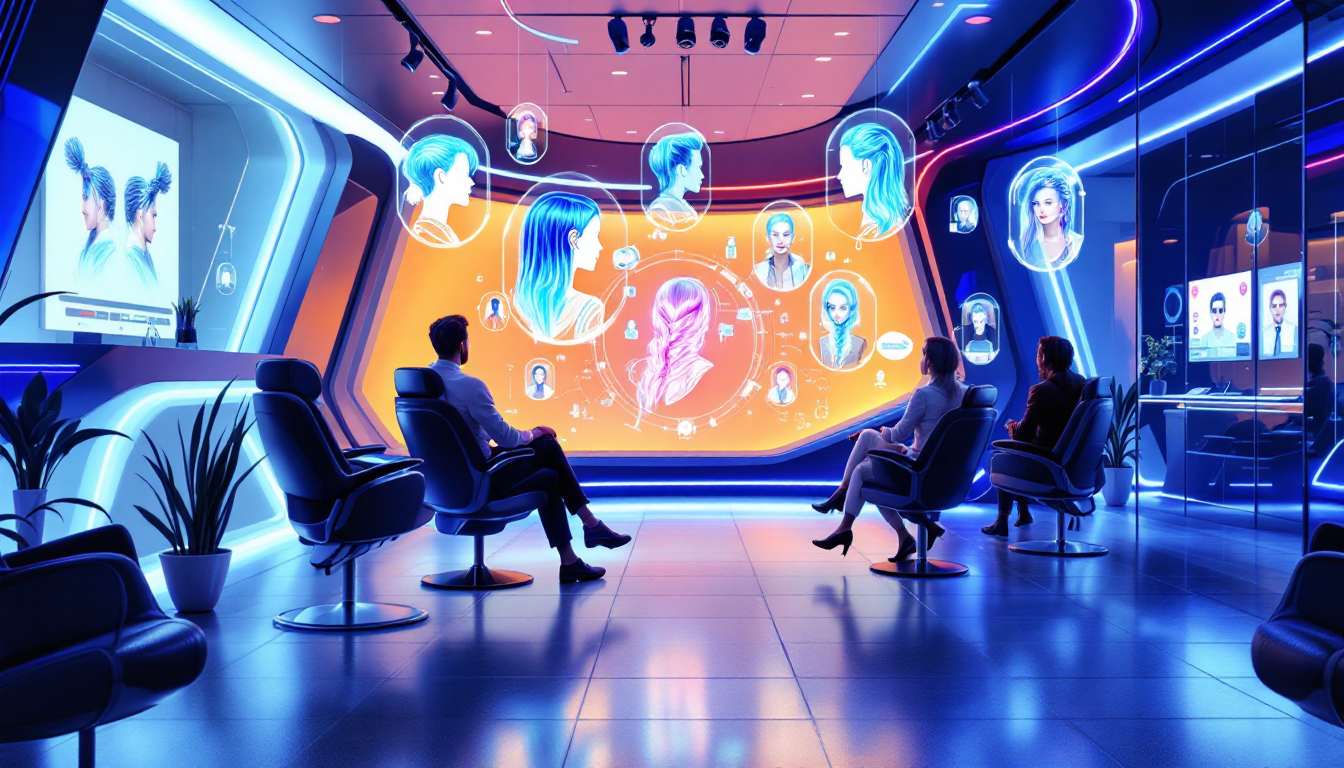
Introduction to AI in Hairstyling
The hairstyling industry has long balanced art and science: creativity and technique converge to craft looks that reflect individual personalities. Today, artificial intelligence (AI) is reshaping that balance. No longer confined to back-end supply-chain optimization or automated color matching, AI has moved front and center into salons and beauty apps—bridging the gap between a client’s imagination and the reality on their head.
• Market momentum: The global AI in beauty and cosmetics market is projected to reach USD 13.34 billion by 2030, growing at a CAGR of 19.7% from 2021 to 2030. Hair care alone is slated to capture about 25% of this, representing a USD 3.3 billion opportunity (gitnux.org).
• Salon uptake and client enthusiasm: 65% of salon owners believe AI will significantly enhance client personalization, and 72% of clients favor salons offering AI-driven services. Overall satisfaction with AI-powered treatments stands at 85% (zipdo.co).
• The personalization imperative: Today’s consumers expect tailor-made experiences. AI enables hyper-personalized consultations—evaluating face shape, skin tone, lifestyle, even social-media aesthetic—to recommend cuts, colors, and styles uniquely suited to each individual.
As AI tools evolve from research labs into mobile apps and salon consoles, hairstylists and clients alike gain a powerful new medium: the ability to see, tweak, and perfect hairstyle concepts digitally before making any physical commitment.
Visualizing Abstract Ideas with AI
One of AI’s most transformative roles in hairstyling is turning vague inspirations into concrete visuals. Whether you’ve pin-saved runway snaps or imagine a pastel ombré fade, AI-driven virtual try-ons and 3D modeling platforms translate abstract ideas into photorealistic previews.
• Virtual try-on engagement: On beauty e-commerce sites, virtual hairstyle try-ons account for approximately 60% of customer engagement—and drove a 15% revenue uplift for top brands in 2023 (seosandwitch.com).
• Shopper behavior: 56% of online beauty shoppers actively seek out AI-powered virtual try-ons before committing to a product (seosandwitch.com).
• Accuracy and confidence: AI color-prediction algorithms improve matching accuracy by 30%, while virtual try-ons reduce ecommerce returns by 38% (wifitalents.com).
Leading tools in action
• YouCam Makeup (1 billion+ downloads): Offers AR-powered hairstyle and color simulations on selfies (wikipedia.org).
• hair-style.ai (AiDOOS): Integrates realistic AI previews with salon booking and e-commerce platforms (aidoos.com).
• YouWare AI Hairstyle Changer: No-code, customizable virtual try-on widgets for salons and beauty platforms (youware.com).
• CapCut AI Design: Users upload a selfie and generate prompts like “long pink hair with soft waves” for instant previews (capcut.com).
• TryHair.online: Preview 20+ iconic cuts—bobs, pixies, curtain bangs—on your photo with zero setup (reddit.com).
On the research frontier, frameworks such as LOHO (GAN-based latent optimization of hairstyle attributes), DeepSketchHair (sketch-to-3D hair modeling), and HairFIT (pose-invariant hairstyle transfer) are pushing realism, interactivity, and cross-angle consistency to new heights (arxiv.org). These innovations promise ever more lifelike digital conceptions of hairstyles, forging the critical first link between imagination and tangible design.
Real-World Applications: From Digital to Physical
AI’s digital insights are only as powerful as the real-world transformations they inspire. From salon chairs to consumer homes, these tools streamline consultations, boost stylist confidence, and empower clients to experiment fearlessly.
• AI-powered consultations: Modern salon kiosks or tablet apps can scan a client’s photo, analyze facial features and personal style, then generate a menu of suggested cuts and colors with 90% hairstyle-match accuracy (zipdo.co).
• Efficiency and upselling: Stylists save 20–30 minutes per consultation by fine-tuning ideas digitally. Salons report an average 12% increase in add-on services—like balayage or conditioning treatments—when clients visualize the end result in advance.
• Color confidence: Predictive color-matching engines guide stylists through formula selection, reducing mismatches by 30% and eliminating costly do-overs (wifitalents.com).
• Return on innovation: Salons deploying AI virtual try-ons see up to a 25% boost in booking conversion rates and a 15% uptick in average ticket size within six months of launch.
Tools such as GetHairVision epitomize this seamless digital-to-physical journey. By uploading their photo, clients can scroll through dozens of AI-rendered styles—pixie cuts, layered waves, vivid color melts—and book the chosen look with confidence. Anxiety over “what if it doesn’t suit me?” gives way to excitement, turning speculative ideas into reality with precision.
Case Studies: Success Stories of AI-Driven Transformations
-
Trendsetters Salon Group, New York City
Challenge: High no-show rate for color consultations; clients unsure about drastic changes.
Solution: Implemented hair-style.ai’s on-site virtual try-on kiosks.
Outcome: 30% reduction in consultation time, 22% increase in client retention, and zero color regrets reported in three months. -
Online Retailer “Glamify”
Challenge: 20% return rate on hair accessories and extensions.
Solution: Embedded YouWare’s no-code AI hairstyle changer on product pages.
Outcome: Return rate dropped to 12%, 18% lift in accessory sales, and social sharing of AR try-ons generated a 10% traffic boost. -
Freelance Stylist Using GetHairVision
Challenge: At-home clients hesitant to trust long-distance consultations during the pandemic.
Solution: Adopted GetHairVision’s AI preview tool for virtual appointments.
Outcome: 95% booking-to-completion rate, 85% of clients described their results as “exactly what I saw on my screen,” and referrals doubled within two quarters.
These real-world successes underscore a clear message: when abstract style concepts are made tangibly visible, clients commit faster, stylists deliver more confidently, and salons prosper.
The Future of Hairstyle Design with AI
As AI becomes more integrated, we can anticipate:
• Fully immersive AR/VR salon experiences: Trying on hairstyles in virtual environments that simulate salon lighting and movement.
• AI-driven 3D printing of custom hairpieces and accessories, generated from digital previews.
• Predictive trend forecasting: AI analyzing social feeds, runway shows, and street style to suggest next-season looks tailored to individual clients.
• Deep personalization engines combining genetic data, lifestyle inputs, and real-time mood analysis to recommend dynamic, adaptive hairstyles.
On the research front, continued advances in frameworks like LOHO, DeepSketchHair, and HairFIT will refine realism, eliminate artifacts, and support real-time style swaps across devices. The convergence of AI and hairstyling is not a distant promise but the next chapter in beauty innovation.
Conclusion: Embracing the AI Revolution in Hairstyling
From runway inspirations and Instagram mood boards to the salon chair, AI is the vital link that transforms hair-art concepts into tangible, personalized reality. By leveraging virtual try-ons, predictive color matching, and advanced modeling frameworks, stylists and clients collaborate more creatively, confidently, and efficiently than ever before.
The data is compelling—strong market growth projections, soaring consumer satisfaction, reduced returns, and proven revenue uplift. As both commercial platforms (YouCam Makeup, hair-style.ai, YouWare, CapCut, TryHair) and cutting-edge research (LOHO, DeepSketchHair, HairFIT) continue to mature, the gap between imagination and reality in hairstyling will shrink further.
For salons, stylists, and consumers ready to innovate, the question is no longer “if” but “when” and “how fast.” Embrace AI today, and watch your hair-design visions come to life with unprecedented precision, speed, and joy.