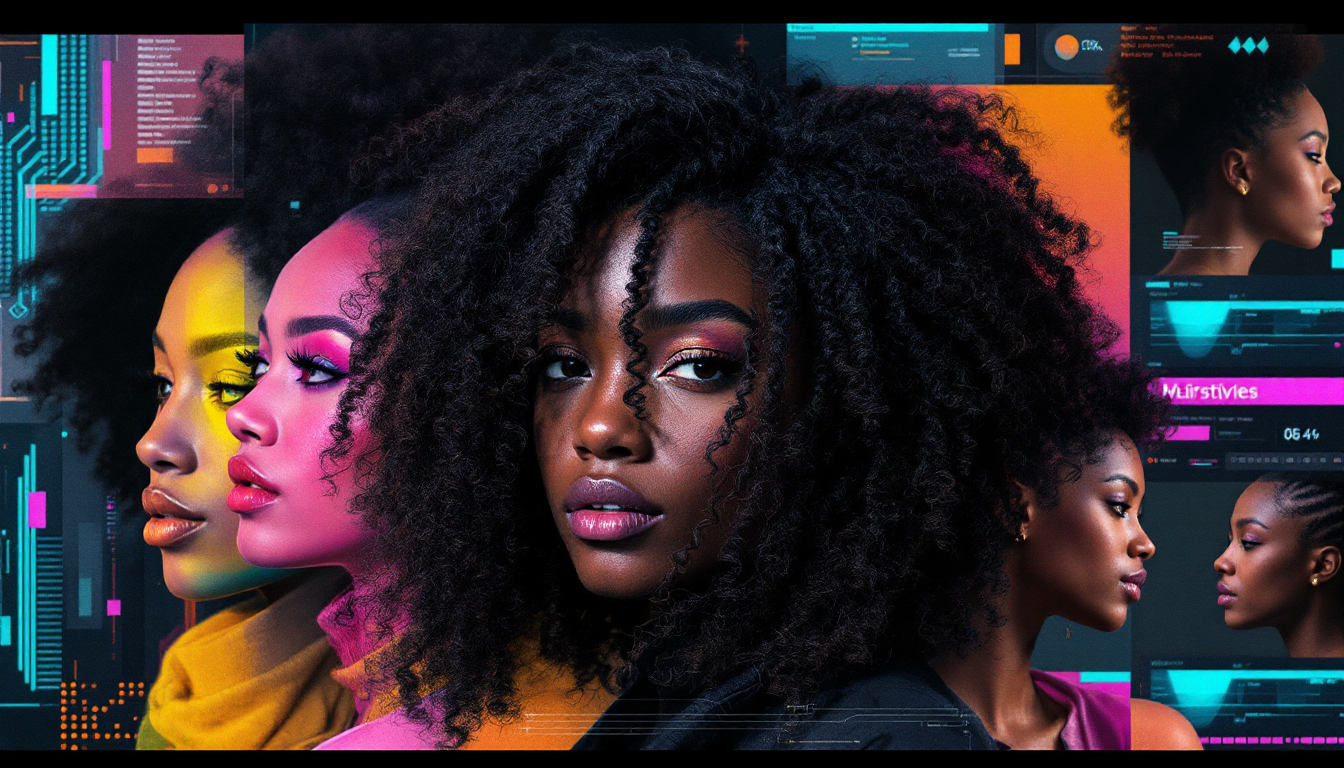
Introduction to AI in Hairstyling
The convergence of artificial intelligence and beauty has ushered in a new era for hairstyling. What was once limited to manual sketches or static photo montages can now be achieved in seconds through powerful AI-driven engines. Consumer-facing apps like Photoleap’s AI Hairstyle Simulator (https://www.photoleapapp.com/features/ai-hairstyle-simulator?utm_source=openai) let users upload a series of selfies and instantly preview dozens of haircuts and colors on their own avatars. Enterprise solutions such as Perfect Corp.’s GAN-based virtual try-on (https://www.perfectcorp.com/business/news/virtual-try-on-for-hairstyles?utm_source=openai) give salons hyper-realistic simulations to consult clients more effectively. These innovations demonstrate how AI can analyze facial structure, parse hair geometry, and render photorealistic transformations—paving the way for “hairstyle mashups,” where elements from multiple styles combine into completely new looks.
The Concept of Hairstyle Mashups
A hairstyle mashup takes fragments—bangs from a bob, texture from a curly weave, color gradients from a balayage—and fuses them into a unified design. Much like DJs sample beats to craft original tracks, AI samples visual “assets” from existing cuts. Instead of choosing a single predefined style, users blend features: the undercut of a pixie, the volume of loose waves, the highlights of a modern ombré. Consumer apps such as Pixelfox AI Hairstyle Changer (https://pixelfox.ai/image/ai-hairstyle-changer?utm_source=openai) and AI Hairstyle Changer (https://aihairstylechanger.me/?utm_source=openai) already enable modular editing: pick curls, length, fringe shape, then fine-tune via text prompt. These modular components become building blocks for infinite creative permutations—ideal for individuals craving originality beyond the latest “it cut.”
How AI Identifies and Combines Hairstyle Elements
Breaking a hairstyle into editable components requires advanced computer vision and generative models:
• Structure decomposition: Techniques like LOHO (Latent Optimization of Hairstyles via Orthogonalization, 2021 – https://arxiv.org/abs/2103.03891?utm_source=openai) invert a GAN’s latent space to isolate hair shape, appearance, and style.
• Strands and volume modeling: HAAR (2023 – https://arxiv.org/abs/2312.11666?utm_source=openai) creates 3D strand-based representations from text, enabling physics-informed blending of textured layers.
• Hierarchical latent spaces: GroomGen (2023 – https://arxiv.org/abs/2311.02062?utm_source=openai) structures hair generation from individual strands to dense masses, allowing smooth interpolation between styles.
• Diffusion-based transfer: Stable-Hair (2024 – https://arxiv.org/abs/2407.14078?utm_source=openai) uses a two-stage pipeline to extract hairstyle attributes, then diffuses them onto target faces while preserving identity.
Together, these architectures enable AI to “understand” and recombine cut length, curl pattern, layering, and color gradients—assembling them into mashups that remain coherent and photorealistic.
Personalization and Unique Style Creation
Personalization lies at the heart of hairstyle mashups. Rather than generic presets, AI can factor in face shape, hair density, skin tone, and user preference to suggest bespoke combinations. Apps like insMind AI Hairstyle Simulator (https://www.insmind.com/ai-hairstyle-changer/?utm_source=openai) analyze facial landmarks to recommend cuts that flatter jawline angles. TryitonAI’s service (https://www.tryitonai.com/ai-hairstylist?utm_source=openai) delivers 35 tailored options based on a few selfies, demonstrating how volume, fringe, and color interplay on an individual basis. Natural-language interfaces (e.g., “long layered bob with caramel highlights”) allow users to specify mood or occasion, and the AI fills in the technical details. Salon-oriented platforms like Pippit (https://www.pippit.ai/templates/ai-hairstyle-change-in-machine?utm_source=openai) extend customization to video content, empowering stylists to craft branded tutorials or pitch unique mashups during consultations.
Case Studies: Success Stories
- Photoleap’s Community Engagement
Photoleap’s AI Hairstyle Simulator generated over 1 million try-ons in its first quarter, with users sharing mashup creations across social media. Custom collage exports fueled viral trends, boosting app downloads by 40%. - Perfect Corp. in Salons
Salons adopting Perfect Corp.’s GAN-based engine reported a 25% increase in consultation conversions. Clients were more decisive when they saw hyper-realistic mashups that combined desired elements before cutting. - CreateIO’s Nine-Grid Inspiration Tool
CreateIO (https://www.createio.ai/showcase/showcase-multiple-hairstyle-variations-id-15?utm_source=openai) launched a “Multiple Hairstyle Variations” demo, generating nine distinct mashups per portrait. Stylists used the grids to spark dialogue about color placements and layering strategies, accelerating the ideation process.
Potential Challenges and Considerations
While promising, AI hairstyle mashups face hurdles:
• Privacy and data security: Consumer apps often require multiple selfies for accurate modeling. Ensuring on-device processing or encrypted storage is vital (ChoppedAI stores all images locally – https://www.ramensoftwarelabs.com/choppedai?utm_source=openai).
• Bias and representation: AI trained on limited datasets may poorly render textures like coily hair or undervalue diverse skin tones. Inclusive training data is critical.
• Unrealistic expectations: Photorealism can mislead clients about how a mashup will translate in a real-world cut and color session. Clear disclaimers and stylist guidance help manage expectations.
• Technical limitations: Real-time preview on low-powered devices remains challenging; many solutions offload compute to cloud GPUs, raising latency and cost concerns.
Future of AI-Powered Hairstyling Mashups
Emerging research promises even deeper mashup capabilities:
• Real-time strand physics: Integrating HAAR’s strand-based 3D generation with real-time rendering engines could let users “play” with flyaways and volume interactively.
• Cross-modal inspiration: Future systems may mine fashion shows, red-carpet galleries, or user-created “mood boards” for novel mashup inputs—automatically extracting trending elements.
• AR-driven in-salon mirrors: Advanced AR glass paired with stable-hair diffusion models will let clients virtually flip through dynamic mashups as they move, under varied lighting.
• Collaborative AI stylists: Shared latent spaces (as in GroomGen) could allow multiple users or stylists to co-edit a mashup remotely, merging visions in real time.
Conclusion
AI-powered hairstyle mashups mark a transformative shift in how we imagine and realize personal style. From consumer apps like Pixelfox and insMind to salon-grade solutions by Perfect Corp. and Pippit, the technology ecosystem now supports modular, hyper-realistic fusion of cuts, textures, and colors. Groundbreaking research—LOHO, HAAR, GroomGen, Stable-Hair—provides the technical backbone for decomposing and recombining hairstyle attributes with unprecedented fidelity. As challenges around privacy, bias, and realistic expectations are addressed, AI mashups will empower both individuals and professionals to explore creativity without limits, designing signature looks that reflect personal identity and aesthetic vision. Whether planning a bold transformation or subtle update, AI hairstyle mashups offer a glimpse into the future of beauty: endlessly customizable, endlessly inspiring.