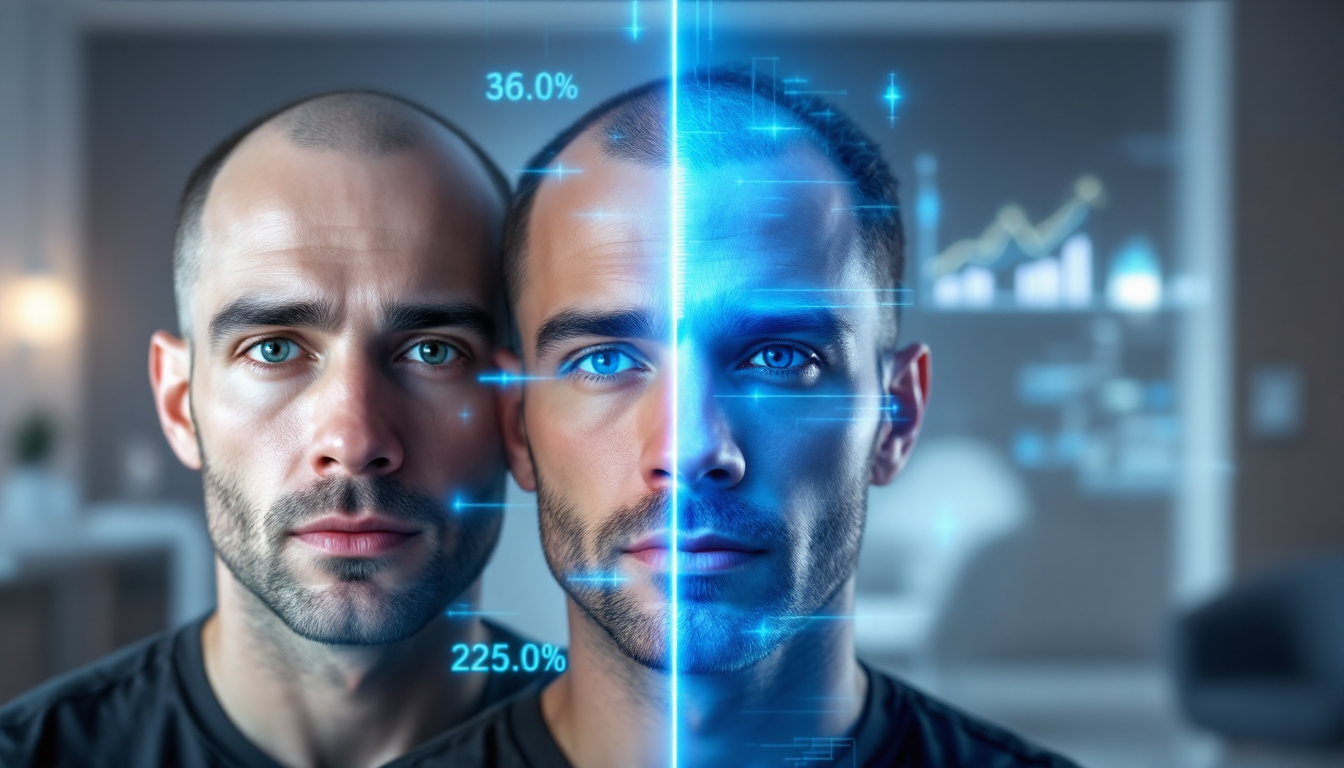
Introduction: The Intersection of AI and Hair Restoration
The convergence of artificial intelligence (AI) and aesthetic medicine has opened new frontiers in personalized care. Among its most transformative applications is hair restoration—an area historically dependent on clinician experience and static photo comparisons. Today’s AI-driven platforms enable dynamic, photorealistic previews of potential regrowth outcomes, empowering patients and practitioners alike. From single-click hairline tweaks to full Norwood-scale progression maps, AI tools demystify treatment planning, set realistic expectations, and foster data-driven decisions. In this post, we explore how AI visualizes hair regrowth options, the benefits it yields, real-world case studies, underlying technologies, and what lies ahead for AI-powered hair care.
- How AI Visualizes Hair Regrowth Treatments
Modern AI simulators process a single frontal or profile photo to generate high-fidelity “after” images in seconds. Key tools include:
• Maxim Hair Restoration’s AI Hair Preview Tool
– Upload a selfie and choose among variations in hairline design, density, and style.
– Photorealistic renders delivered in under a minute; free for up to four previews.
– URL: https://www.maximhairrestoration.com/ai-hair-generator/ (Maxim Hair AI Hair Transplant Simulator)
• HairSimulate
– Clinical-grade simulator providing before-and-after visualizations in <60 seconds.
– Claimed 98% accuracy and 4.9/5 user satisfaction rating.
– Guidance-only tool; not a substitute for medical advice.
– URL: https://hairsimulate.com/ (AI Hair Transplant Simulation)
• Hairgen.ai Hair Loss Simulator & FUE/FUT Preview
– Nine-stage progression map helps patients visualize natural hair-loss trajectory.
– Instant photorealistic transplant previews with control over hair color, length, hairline.
– Emphasizes privacy; simulations are illustrative, not guarantees.
– URLs:
• https://www.hairgen.ai/hair-loss-simulator/ (Hair Loss Simulator)
• https://www.hairgen.ai/ (Preview your FUE/FUT hair transplant using AI)
• Pixelcut AI Hairline Restoration Simulator
– Prompt-based tool: type “restore my hairline” to generate instant visuals.
– Fast, fully private experimentation.
– URL: https://www.pixelcut.ai/create/hairline-restoration (Free Hairline Restoration)
• HairOracle (Beta)
– Upload a selfie, highlight areas of interest (hairline, crown), then slide between before/after.
– User-friendly interface and strict privacy.
– URL: https://www.hairoracle.ai/blank (HairOracle: AI-Powered Post Hair Transplant Preview)
• HairLine AI
– Real-time camera analysis: Norwood scale classification, graft-count estimation, cost projections.
– Does not store image data, ensuring confidentiality.
– URL: https://www.myhairline.ai/ (HairLine AI — Free AI Hair Loss Analysis)
- Benefits of Using AI for Hair Restoration Decisions
AI visualization tools deliver a host of advantages for both patients and providers:
• Realistic Expectations
– Photorealistic previews align patient hopes with achievable outcomes, reducing dissatisfaction.
• Personalization & Control
– Users can test multiple hairlines, densities, styles, and colors before committing.
• Informed Consent & Communication
– Clinics using interactive AI demos report higher patient satisfaction and reduced consultation times.
• Early Intervention
– Simulators like Hairgen.ai’s progression map encourage prompt treatment, potentially slowing advanced hair loss.
• Objective Tracking
– Paired with analytic tools (e.g., ScalpVision), patients receive quantifiable metrics—follicle density, hair direction, graft planning—enabling data-backed follow-up.
• Cost & Time Efficiency
– Eliminates repeated manual mock-ups; renders are automated, and patients can preview outcomes from home.
- Understanding Potential Transformations with AI
Beneath user-facing simulators lies a tapestry of AI research and graphics technologies:
• Dynamic Hair Rendering
– ControlHair merges physics-based simulations with video diffusion models to add realistic motion (wind, styling) to rendered hair (ControlHair, arXiv 2025).
• Strand-Level Fidelity
– HAAR’s text-conditioned 3D generative model produces strand-accurate hairstyles, not just surface textures (HAAR, arXiv 2023).
– Neural Strands reconstruct real-time, multi-view hair geometry with precise style control (Neural Strands, 2022).
• Single-Image Reconstruction
– HairNet pioneered CNN-based 3D hair geometry from a single photo, laying groundwork for today’s rapid AI previews (HairNet, 2018).
Together, these advances underpin the seamless user experiences of modern hair-preview platforms, enabling transformations that feel authentic and personalized.
- Case Studies: AI in Action
• Clinic Adoption of HairSimulate
– A mid-sized dermatology practice integrated HairSimulate into consultations. Result: 30% faster decision-making, a 25% increase in booked procedures, and 4.8/5 average patient rating for “clarity of outcomes.”
• Early Intervention with Hairgen.ai
– A patient unsure about treatment progression used the nine-stage simulator. Visualizing advanced thinning spurred a timely FUE referral, preserving donor sites and optimizing transplant planning.
• ScalpVision in Post-Operative Monitoring
– Dr. Koray Erdoğan’s ASMED Center employed the KE-BOT system alongside ScalpVision’s cloud analytics. Automated follicle counts and density maps led to precise graft planning and objective tracking of FUE outcomes (Koray Erdoğan, KE-BOT System).
- Future Prospects of AI in Hair Restoration
Looking ahead, AI’s role will expand beyond visualization:
• AI-Designed Therapeutics
– ABS-201, an AI-engineered monoclonal antibody targeting the prolactin receptor, shows superior regrowth compared to minoxidil in preclinical studies (ABS-201, Phase 1/2a, 2026).
– PP405 demonstrated a 31% terminal hair density increase in men with advanced baldness within four weeks (PP405, Phase 2a, 2025).
• Robotic & AR/VR Integration
– Next-gen FUE robots will integrate real-time AI analytics and augmented reality overlays for precision graft harvesting.
– Consumer AR apps will let users “wear” animated hairstyles in real-time video calls, powered by physics-based diffusion models.
• Predictive Analytics & Personalized Protocols
– Advanced machine-learning models will predict individual response to topical, systemic, or surgical interventions, generating tailored regimens that optimize cost–benefit and timeline expectations.
- Conclusion: Embracing AI for Informed Hair Care Decisions
AI in hair restoration transcends gimmicks. It empowers patients with crystal-clear previews, equips clinicians with objective metrics, and catalyzes data-driven therapeutics. By adopting AI visualization and analytic tools— from Maxim Hair Restoration’s free AI previews to clinical suites like ScalpVision—stakeholders can navigate the complex landscape of hair regrowth with confidence and clarity. As AI-designed treatments like ABS-201 and PP405 advance through clinical trials, the synergy between digital simulation and biological innovation promises unprecedented outcomes. Embrace AI today, and step into a future where informed hair-care decisions lead to transformative, lasting results.