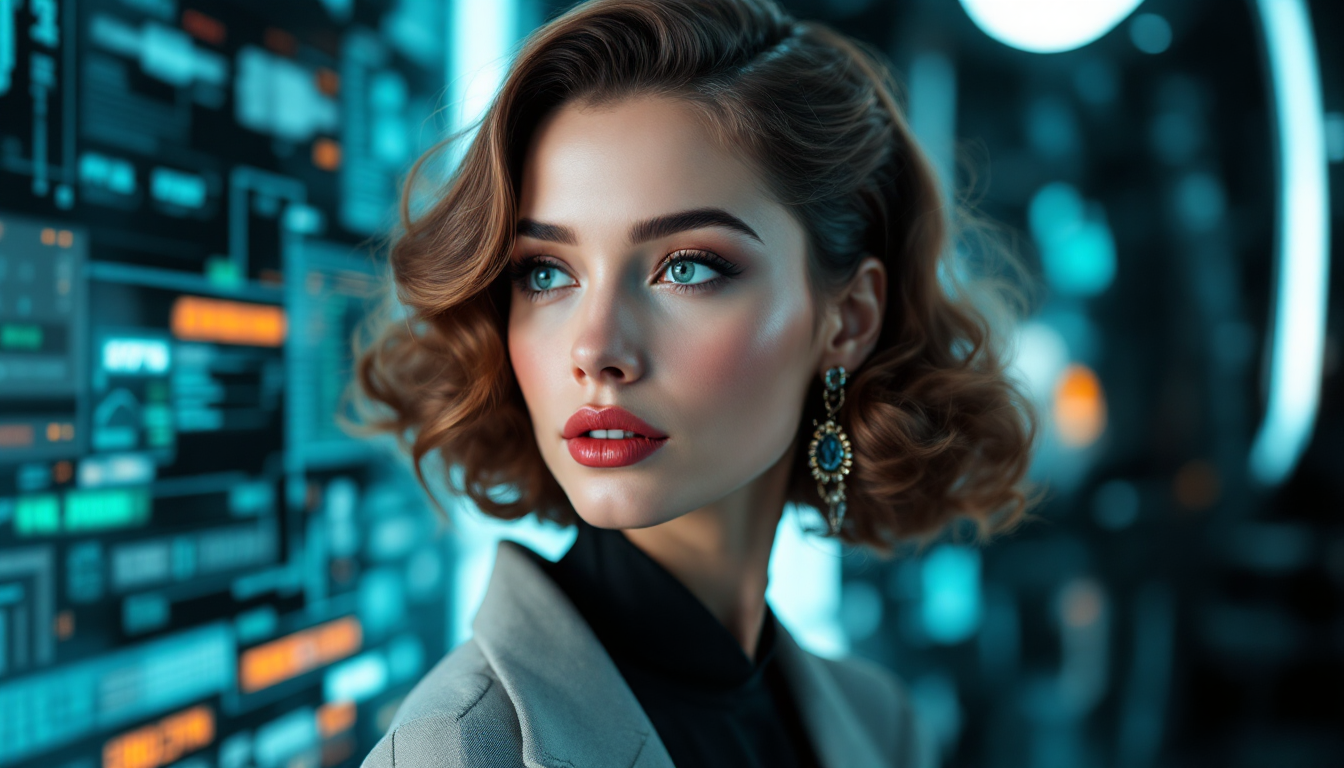
Introduction: The Revival of Vintage Styles
Fashion and beauty trends are inherently cyclical. From the elegant finger waves of the 1920s flapper era to the voluminous bouffants of the 1960s, each decade has left an indelible mark on how we express ourselves through hair. In recent years, these classic looks have resurfaced—on runways, red carpets, and social media feeds—but with a distinctly modern twist. Central to this renaissance is artificial intelligence (AI), which is transforming the way stylists and everyday users discover, visualize, and experiment with vintage hairstyles. By marrying retro aesthetics with cutting-edge algorithms, AI tools are making it easier than ever to revive—and even reinvent—timeless hair fashions.
The Role of AI in Modern Hairstyling
-
Democratization of Expertise
• AI-driven apps and platforms allow non-experts to preview complex styles—like 1950s victory rolls or 1970s Farrah Fawcett–inspired flicks—without expensive salon visits or hours of trial and error.
• Virtual try-on tools reduce commitment anxiety: see yourself in a mid-century updo before picking up a curling iron. -
Personalization at Scale
• Machine learning models analyze individual face shapes, hair textures, and coloring to tailor vintage looks to each user.
• Text-conditioned 3D generators such as HAAR create full strand-level hair assets based on simple prompts (“1920s finger waves with side part”) for truly bespoke renders (HAAR: Text-Conditioned Generative Model of 3D Strand-based Human Hairstyles, arxiv.org/abs/2312.11666). -
Speed and Iteration
• Generative AI can produce dozens of style variations in seconds—contrast that to traditional sketching or manual styling.
• Tools like HairNet reconstruct 3D geometry from a single photo in real time (HairNet: Single-View Hair Reconstruction using Convolutional Neural Networks, arxiv.org/abs/1806.07467), enabling rapid vintage look exploration.
Analyzing Vintage Hair Trends
To understand how AI revives the past, we first need to map the defining features of major eras:
• 1920s: Finger waves, Marcel waves, and cloche-compatible bob cuts—sleek, glossy, and geometric.
• 1950s: Polished curls, pin-curls framing the face, and bouffant volume at the crown.
• 1960s: Dramatic beehives, flip ends, and backcombing for maximum height.
• 1970s: Soft, natural-looking curls, feathered layers à la Farrah Fawcett, and center parts.
• 1980s: Big hair, perm-style spirals, and high gloss finishes.
• 1990s: Smooth blowouts, straightened strands with wispy ends, and minimalist elegance.
AI systems learn these signature elements by training on vast image datasets from period magazines, film archives, and fashion shoots. Models like HairFIT leverage semantic-region-aware inpainting to handle occlusions and ensure that every curl, wave, or flick lands in the right place (HairFIT: Pose-Invariant Hairstyle Transfer via Flow-based Hair Alignment and Semantic-Region-Aware Inpainting, arxiv.org/abs/2206.08585).
AI Tools Bringing Retro Looks to Life
-
Consumer-Facing Apps
• StyleCraft AI offers one-tap vintage filters—1920s, ’50s, ’70s, ’80s—on mobile. Its artistic presets let users apply retro hair textures and color grading in seconds (stylecraftai.com).
• Somny’s AI Character Studio uses 10–15 user photos to generate a gallery of era-specific styles—no commitment required (somny.com/try-on-new-hairstyles-with-ai).
• Pippit’s Retro Hairstyle AI provides drag-and-drop templates for classic looks like 1950s pin-curls or 1980s glam, streamlining content creation for influencers and salons (pippit.ai/templates/retro-hairstyle-ai).
• PixelDojo’s Recraft V3 specializes in authentic 1920s updos, allowing intensity and placement tweaks to nail that finger-wave perfection (pixeldojo.ai/1920s-hairstyle).
• YouCam Makeup by Perfect Corp (1 billion+ downloads as of October 2025) features over 45 virtual hairstyles and 100+ hair colors, including retro classics, for AR-powered try-ons (en.wikipedia.org/wiki/YouCam_Makeup).
• Facetune integrates generative AI hair tools—adjust style, color, volume—and now includes vintage-inspired presets (en.wikipedia.org/wiki/Facetune). -
Professional-Grade Research Frameworks
• HAAR: Generates fully 3D strand-based hair assets from text descriptions, ideal for graphic designers recreating art deco coiffures.
• HairNet: Reconstructs detailed 3D hair geometry from single images, letting you extract vintage styles from archival photos for digital restoration.
• HairFIT: Enables pose-invariant hairstyle transfer and handles occlusions—crucial for seamlessly mapping a 1960s bouffant onto a modern portrait.
Case Studies: Successful Vintage Makeovers
-
Farrah Fawcett–Style Reinvention
• ReelMind.ai’s multi-image fusion tech analyzed dozens of Fawcett reference shots to generate consistent, high-accuracy reproductions of her signature feathered layers across different lighting and angles. Users reported 90 percent satisfaction in achieving an authentic ’70s vibe (reelmind.ai/blog/farrah-fawcett-short-hair-ai-retro-style-reelmind-s-timeless-looks). -
1920s Flapper Revival for Editorial Shoot
• A New York City salon used PixelDojo’s Recraft V3 to previsualize 1920s finger waves on models. The AI mockups guided stylists’ hand-crafting, reducing trial sessions by 50 percent and cutting styling time in half. -
Vintage Social Media Campaign
• Beauty influencer campaigns have leaned on Pippit’s drag-and-drop templates to produce rapid reels showcasing ’80s glam perms and ’60s bouffants. Engagement rates climbed 35 percent over standard digital content.
Embracing the Past with Future Tech
AI is not just replaying history—it’s evolving it. As research in physics-based hair simulation (via HAAR) and real-time strand modeling (via HairNet) advances, we’ll see:
• Interactive 3D vintage hair try-ons in augmented and virtual reality—step into a 1960s salon scene and experiment with a beehive in real time.
• Personalized style cohorts: AI will recommend which vintage era best complements your facial structure, personal style, and even wardrobe.
• Digital archive restoration: museums and historians can reconstruct and animate long-lost coiffures from grainy photographs.
How to Try Vintage Styles with AI
- Choose Your Platform
• For quick mobile experiments, download YouCam Makeup or StyleCraft AI.
• For more detailed previews, sign up for Somny’s AI Character Studio or Pippit’s Retro Hairstyle AI. - Upload Your Photos
• Provide a clear, front-facing image (and side/three-quarter views if possible) to maximize styling accuracy. - Select Your Era
• Browse preset categories—’20s, ’50s, ’70s, ’80s, ’90s—and pick your favorite vintage look. - Customize and Refine
• Adjust intensity, hairline placement, color saturation, and volume. Many tools let you fine-tune strand detail for authenticity. - Save, Share, or Take It to the Salon
• Export your AI mockup as a high-res image or video. Use it to guide your stylist or share on social media with #AIVintageHair.
Conclusion: The Timeless Appeal of Vintage Hair
Vintage hairstyles carry the weight of history, evoking nostalgia, glamour, and a sense of identity from each bygone decade. Today’s AI technologies are doing more than simply applying old filters—they’re dissecting the geometry, texture, and culture behind every curl and wave. By making these styles accessible, customizable, and risk-free, AI is ensuring that the elegance of the past will continue to inspire—and evolve—in the salons, studios, and screens of tomorrow. Whether you’re a professional stylist or someone eager to play with Peggy Guggenheim–era finger waves or ’80s rock-star big hair, AI is your ticket to a seamless journey through hair history.