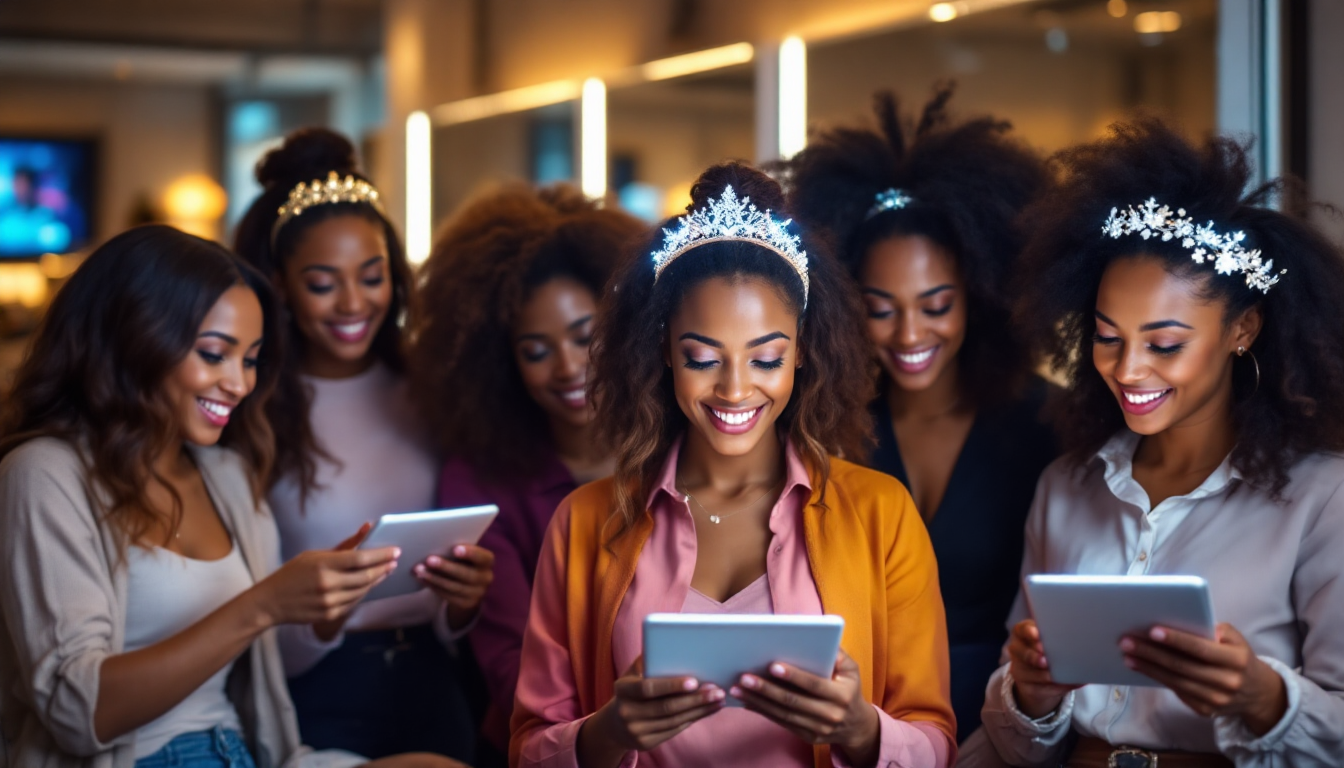
Introduction to AI and Hair Accessories
The fusion of artificial intelligence (AI) and beauty tech is transforming how we shop for and experiment with hair accessories. Once limited to static images or in-store mirrors, today’s virtual try-on tools leverage AI, augmented reality (AR), and computer vision to let users preview headbands, barrettes, scarves, hats, even earrings and necklaces, seamlessly overlaid on live or uploaded images. This evolution not only enhances the online shopping experience—reducing uncertainty and returns—but also empowers individuals to confidently explore bold new looks from the comfort of home.
How Virtual Try-Ons Work
-
Data Capture and Face/Hair Mapping
• Users upload a selfie or enable their device camera. Computer-vision algorithms detect key facial landmarks (eyes, nose, jawline) and hair contours—sometimes reconstructing occluded areas for short cuts.
• Depth-sensing or 3D-model-based techniques build a digital mesh of the head, ensuring accessories conform to head shape, tilt and rotation. -
AI Rendering Engines
• Generative adversarial networks (GANs), such as NVIDIA’s StyleGAN2 used by Ulta Beauty’s GLAMlab Hair Try On, synthesize hyper-realistic hairstyle and accessory overlays in seconds. The initial try-on renders in about five seconds, with subsequent styles generated in roughly one second (blogs.nvidia.com).
• Diffusion-based frameworks like FastFit accelerate multi-item virtual try-ons—combining hair, accessories and apparel—in real time, outperforming previous methods by up to 3.5× (arxiv.org). -
Augmented Reality Integration
• WebAR SDKs (e.g., TRTC’s Beauty SDK) enable real-time, 360° wig and accessory try-ons directly in the browser or app—switching styles in under a second, with accurate color, texture and fit (trtc.io).
• Magic AI Mirror platforms blend AI, AR and computer vision to deliver live try-ons for haircuts, hair color, makeup and accessories—ideal for in-salon kiosks or retail environments (technologicinnovation.com).
Benefits of Using AI for Hair Accessories
• Ultra-Realistic Visualization
AI-generated models render accessories with faithful color, texture, size and drape—ensuring what you see on screen matches reality. For instance, Bandy AI offers hyper-realistic overlays on diverse model images or customer-uploaded photos to reflect any target audience (bandy.ai).
• Personalization and Diversity
Tools adapt to individual traits—skin tone, face shape, hair volume—and support a broad spectrum of hairstyles from pixie cuts to voluminous waves. Perfect Corp.’s solution previews 12 distinct cuts and colors, reconstructing facial areas behind shorter styles for seamless integration (perfectcorp.com).
• Speed and Scalability
Brands can generate thousands of lifestyle or studio accessory images at scale—Bandy AI provides over 2,000 visual templates for rapid content creation, maintaining consistent quality across campaigns (bandy.ai).
• Hygiene and Convenience
Virtual wig try-ons eliminate contamination risks inherent to store trials. Users experiment freely—no scheduling required—and share try-on videos on social media to gather feedback before purchase.
• Reduced Returns and Increased Conversions
Accurate previews translate to higher purchase confidence. Ulta Beauty reports customers who engage with its AI-powered GLAMlab are significantly more likely to complete a purchase than those who do not (blogs.nvidia.com).
Popular AI Platforms for Hairstyle Visualization
• Bandy AI Virtual Accessories
Renders hats, headbands, scarves, jewelry on hyper-realistic AI models. Mix-and-match with 2,000+ templates or custom uploads to suit any campaign or demographic (bandy.ai).
• Ulta Beauty GLAMlab Hair Try On
Powered by NVIDIA’s StyleGAN2, offers ultra-fast hairstyle and color simulations on selfies or model images, driving higher engagement and conversion (blogs.nvidia.com).
• Perfect Corp.’s Hairstyle Simulator
Virtual preview of 12 haircuts and myriad colors, adapting to user-specific facial features. Widely adopted by salons to reduce uncertainty and encourage bold style changes (perfectcorp.com).
• TRTC WebAR Wig Try-On
Real-time, browser-based 360° wig trials that load new styles in under a second. Offers hygienic, shareable experiences and integrates seamlessly into e-commerce platforms (trtc.io).
• Magic AI Mirror
Comprehensive AR installations in retail and salons—simultaneously try on hairstyles, hair color, makeup and accessories with live feedback and AI-driven recommendations (technologicinnovation.com).
• YouCam Makeup
Though cosmetics-focused, its massive adoption (over 1 billion downloads by October 2025) underscores consumer appetite for virtual makeovers—accessory add-ons are a natural next step (en.wikipedia.org).
User Experiences and Testimonials
• “I tried on five different headbands in under a minute via WebAR—no sticky in-store mirrors, and I ended up ordering two!” — Online Shopper
• “Our salon’s new AI station boosted accessory add-ons by 35%, and clients love seeing complete ‘after’ looks before committing.” — Salon Owner
• Ulta reports a measurable lift in cart completion when customers engage with GLAMlab, compared to shoppers who browse without virtual try-ons (blogs.nvidia.com).
Future Trends in AI Hair Accessories
• Multi-Item Diffusion Try-Ons
Next-gen frameworks like FastFit will enable seamless combination of haircuts, hair colors, hats, scarves and jewelry in a single high-fidelity render—3.5× faster than current solutions (arxiv.org).
• AI-Powered Styling Recommendations
Beyond static try-ons, AI advisors will suggest accessory pairings based on face shape, outfit color palettes and trend forecasts—integrating real-time inventory data.
• Full-Body Virtual Mirrors
Evolving Magic AI Mirror concepts will allow head-to-toe AR styling sessions—coordinating hair accessories with apparel, footwear and makeup for a holistic fashion preview.
• Metaverse and Social Commerce Integration
Virtual avatars in social-commerce platforms will sport AI-tested hair accessories—users will seamlessly transition looks between personal profiles, e-commerce sites and VR environments.
Conclusion
AI-driven virtual try-on technologies are democratizing hair accessory exploration—making vibrant scarves, elegant barrettes, statement hats and more instantly accessible to anyone with a camera. From hyper-realistic AR overlays to rapid, scalable content creation, these tools reduce friction, increase sales and inspire confidence. As generative AI, diffusion models and AR hardware continue to advance, the line between digital preview and real-world style will blur further—ushering in a new era where personalized beauty experiences are limited only by imagination.