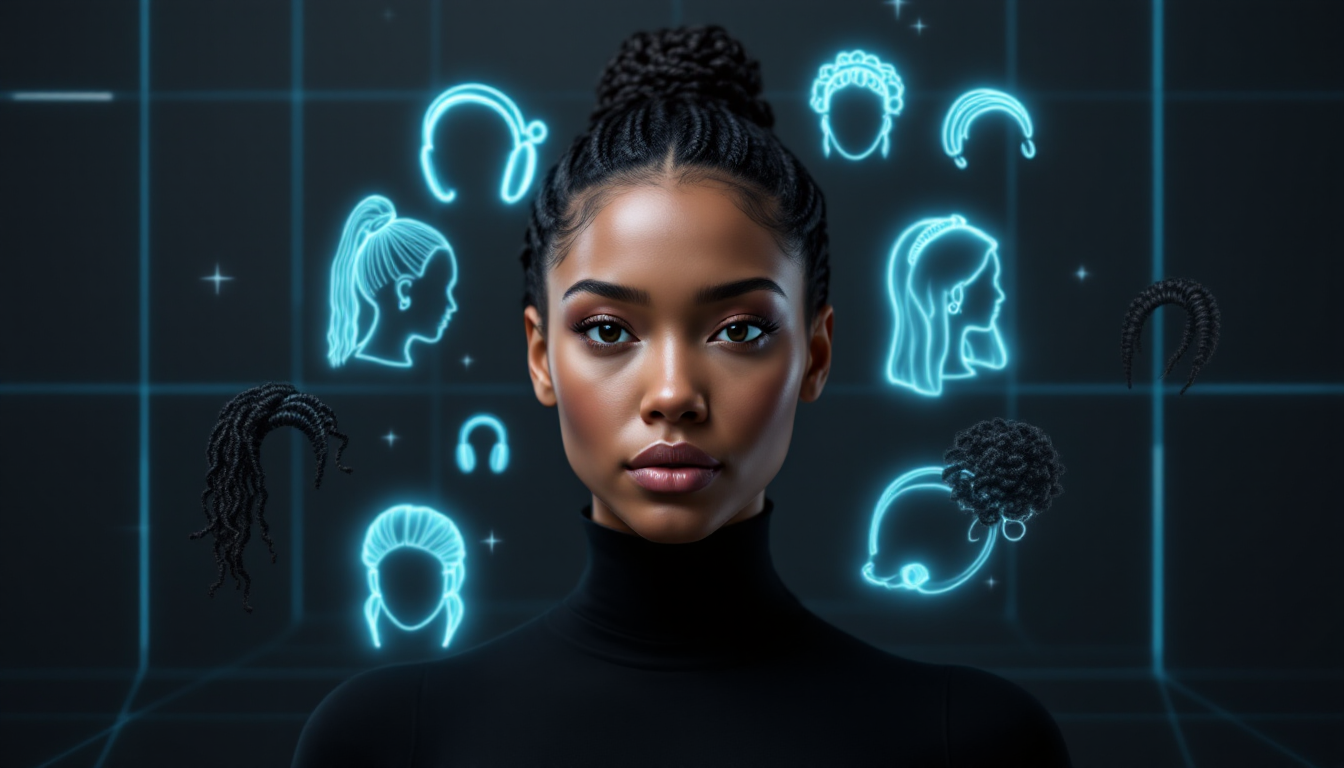
Introduction to AI in Hair Fashion
The intersection of artificial intelligence (AI) and fashion has revolutionized how consumers discover, try on, and purchase style products. While AI-driven outfit recommendations and virtual fitting rooms have made headlines, hair fashion—specifically the pairing of hairstyles with accessories—has emerged as a hotbed for innovation. From smart algorithms that analyze face shape and personal preferences to AR-powered try-on tools that render photorealistic previews, AI is redefining how we accessorize our hair. In this post, we explore the key technologies, business impacts, and future trends shaping AI’s role in creating the perfect match between hair and accessories.
- How AI Recommends Accessories
Modern AI recommendation engines combine computer vision, machine learning, and large-scale visual search to curate accessory suggestions tailored to an individual’s features and style history.
• Face and Hair Analysis
– Deep neural networks detect facial landmarks (jawline, cheekbones, forehead) and hair attributes (length, texture, color).
– Banuba’s TINT platform, for instance, includes an AI recommendation engine that factors in face shape and hairstyle to propose matching accessories in real time (businesswire.com).
• Visual Similarity Search
– LookSync, a large-scale pipeline using OpenAI’s CLIP model, maps user-uploaded images to visually and semantically similar accessory products across millions of listings. This boosts recommendation accuracy by 3–7%, ensuring that suggested hair clips, headbands, or barrettes align with both style and context (arxiv.org).
• Personalization via Behavioral Data
– Beyond pure vision, models like Alibaba’s POG (Personalized Outfit Generation) leverage Transformer architectures to learn compatibility between items. Trained on 1.01 million outfits and 280 million clicks, POG demonstrates how cross-item affinity can drive relevant accessory pairings based on user preferences (arxiv.org).
- Visualizing the Perfect Match
Seeing is believing. AI-powered virtual try-on and hairstyle simulators allow users to preview accessories in context—boosting confidence and reducing returns.
• Photorealistic Accessory Try-On
– Pic Copilot’s accessory try-on tool lets brands upload flat images of hair clips, headbands, and hats, then generate photorealistic lifestyle images with AI models whose face shape, hairstyle, and skin tone match the target audience. Reported benefits include a 57% uplift in conversion rates, a 79% cut in marketing design costs, and a 90% reduction in photography time (piccopilot.com).
– Bandy AI extends the concept with over 2,000 accessory templates—rings, scarves, hair brooches—transformed into lifelike on-model visuals that can be layered onto user images or video feeds (bandy.ai).
• Hairstyle Simulation with GANs
– Perfect Corp’s Virtual Try-On for hairstyles uses GANs (Generative Adversarial Networks) and machine learning to simulate 12 different cuts—from pixie to long waves—with ultra-realistic color rendition and hair physics. This lets users see how a headband or jeweled clip complements their chosen cut before they buy (perfectcorp.com).
– Sally Beauty’s ColorView, powered by Perfect Corp, integrates hair color try-on with accessory suggestions at in-store kiosks and in their mobile app. Customers can experiment with Wella or Arctic Fox shades and instantly see which clips or scrunchies accentuate their new hue, driving higher purchase confidence (allure.com).
• Virtual Hair Extensions
– AlgoFace holds a patent for a system that matches user photos to virtual hair extensions—factoring in length, volume, texture, and shade—to deliver a realistic preview. Brands can integrate this to decrease extension return rates and up conversion by demonstrating exactly how clip-ins or tape-ins will look in situ (algoface.ai).
- Impact on Personal Style
AI-driven tools not only boost sales but also deepen consumer engagement and foster more personalized style journeys.
• Democratizing Access to Styling Expertise
– Virtual stylists powered by AI can mimic professional advice at scale—making suggestions that once required a salon visit accessible via a smartphone. This levels the playing field, giving users of all backgrounds tailored hair-accessory pairings.
• Reducing Decision Paralysis
– With thousands of clips, combs, and bands available online, many shoppers feel overwhelmed. AI curation narrows options to a handful of high-probability matches, streamlining the decision process and increasing user satisfaction.
• Building Brand Loyalty
– Interactive try-on experiences—whether web-based or in-store—encourage users to experiment more. Gamified recommendation engines and shareable before-and-after images drive social engagement and repeat visits.
- Challenges and Opportunities
While the benefits are clear, companies face hurdles in deploying AI for hair-accessory styling.
• Technical Limitations
– Real-time AR overlays require robust device performance and network speeds. Ensuring accurate hair segmentation—especially with complex hairstyles or movement—remains a challenge.
• Dataset Bias and Representation
– Models trained on limited demographics may underperform on diverse hair types, skin tones, and cultural hair traditions. Gathering inclusive, high-quality training data is essential to avoid exclusion.
• Privacy and Consent
– Face and hairstyle analysis raises privacy concerns. Brands must adhere to GDPR, CCPA, and similar regulations when processing biometric data, and clearly communicate data usage to consumers.
• Business Integration
– Legacy e-commerce platforms may struggle to integrate advanced AI modules. Successful implementation often requires collaboration between tech vendors, marketing teams, and supply-chain partners.
- Future Prospects
The synergy between AI and hair fashion is only beginning. Emerging trends promise to deepen personalization and broaden applications.
• Metaverse and Virtual Avatars
– As virtual worlds mature, users will want fully accessorized hair avatars. AI engines will need to recommend and render 3D hair clips and extensions that integrate seamlessly into digital ecosystems.
• Voice-Activated Styling Assistants
– Imagine asking a smart mirror, “Which hairpin goes best with my bob and red lip?” and receiving instant AI guidance. Advances in natural language understanding will make this a reality.
• Sustainability and On-Demand Production
– AI-driven demand forecasting can minimize overproduction of seasonal hair accessories. Coupled with 3D printing, customers might order bespoke barrettes manufactured on demand—reducing waste and inventory costs.
• Cross-Modal Personalization
– Future systems will fuse voice, text, image, and purchase history to offer holistic style advice: not just “claw clip for your waves” but “complete the look with these earrings, sunglasses, and nail shades.”
Conclusion
AI’s infusion into hair accessory discovery and visualization heralds a new era of personalized style. By marrying advanced computer vision, generative modeling, and large-scale recommendation engines, brands can offer hyper-relevant suggestions, reduce returns, and deepen customer loyalty. While challenges around bias, privacy, and integration persist, forward-looking companies are already leveraging patented systems (AlgoFace), GAN-powered simulators (Perfect Corp), and AR-driven try-ons (Pic Copilot, Bandy AI) to create seamless experiences. As technology continues to evolve—into voice-activated assistants, Metaverse avatars, and sustainable on-demand manufacturing—the perfect match between hair and accessories will become ever more accessible, inclusive, and personalized.