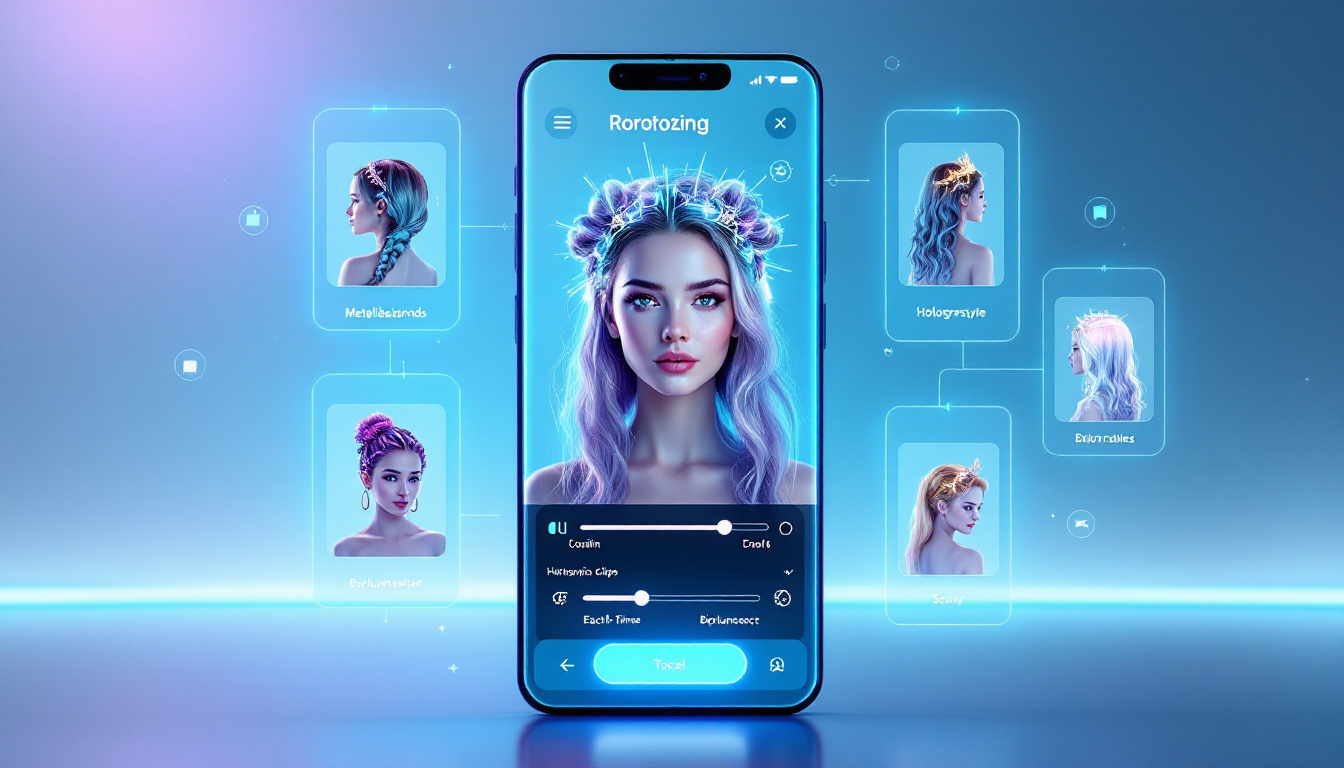
Introduction: The Fusion of AI and Fashion
The world of beauty and styling is undergoing a profound transformation. No longer confined to salon consultations and glossy magazine pages, hair accessory selection and styling have entered the realm of artificial intelligence. From virtual try-ons that let you “wear” accessories before purchase to deep-learning engines that analyze your unique facial geometry and hair texture, AI is redefining the way we choose barrettes, headbands, clips and decorative pins. In this post, we explore how AI-driven tools and platforms enhance personal style, guide accessory choices, and pave the way for truly individualized beauty experiences.
Chapter 1: How AI Enhances Hair Accessory Selection
-
AI-Powered Visualization Engines
• Face Shape AI (iOS) uses computer vision to classify your face as oval, round, square or diamond, then recommends complementary hair accessories and styles. Users simply upload a selfie, and within seconds the app suggests headband shapes, clip placements and earring-hair pairings tailored to their features (apps.apple.com).
• FaceHair combines convolutional neural networks, facial landmark detection and hair segmentation to render realistic hairstyle and accessory previews. Its style-transfer algorithms respect lighting, perspective and hair physics, achieving 85–90% accuracy in photo-realistic results (lionaibox.com).
• AI HairStyle Changer and My Perfect Hairstyle accept text prompts or photos to generate dozens of accessory-complemented looks—everything from floral pins for updos to minimalist metallic clips for sleek bobs (tyy.ai). -
Accessory-Specific Rendering
• a1.art’s AI Elaborate Hair Accessories Art Generator can overlay stylized braids, jeweled pins or ornamental combs onto any photo. Filters adjust color, stroke style and accessory density, perfect for mood-board creation or e-commerce mock-ups (a1.art).
• AI Hair Accessories Product Modeling platforms let brands produce high-fidelity images of clips, claws and headbands on virtual models—eliminating costly photo shoots while maintaining visual consistency across web catalogs (aitwo.co).
Chapter 2: Understanding Face Shapes and Hairstyles
Selecting accessories that flatter both your face shape and hairstyle is an art—one that AI can now systematize.
• Face Shape Categories
– Oval: Balanced proportions—most accessory styles work well.
– Round: Aim to elongate; vertical clips or angular barrettes add definition.
– Square: Soften angles with curved headbands or cascading clips.
– Diamond: Highlight the cheekbones with side-swept pins or minimalist barrettes near temples.
• AI Detection and Recommendations
– Facial landmark detection pinpoints eyes, cheekbones and jawline.
– Hair segmentation distinguishes hair from background, ensuring accessories “sit” naturally in rendered previews.
– Style transfer applies accessory designs from a curated library onto users’ photos, preserving shadow, depth and hair movement.
By combining these techniques, tools like Face Shape AI and FaceHair not only recognize your features but also suggest specific accessory shapes, sizes and placements. The result is a virtual try-on that feels as accurate as an in-person stylist’s pin placement.
Chapter 3: The Benefits of AI-Driven Personalization
- Reduced Styling Risk and Enhanced Confidence
• Virtual previews eliminate guesswork. Users can experiment with bold clips or delicate chains before committing to a purchase or salon appointment. - Inclusive Styling for Diverse Hair Types
• AI models trained on broad datasets ensure Afro-textured hair, curly coils and fine straight strands are all accurately represented. No more one-size-fits-all accessory guides. - Time and Cost Savings
• At-home try-ons and automated recommendations reduce back-and-forth with stylists or return rates for online accessory orders. - Data-Driven Insights for Brands
• Engagement metrics (click-through on virtual accessories, top-tried styles) inform product development and inventory planning in real time.
Chapter 4: Real-World Applications and Success Stories
- Perfect Corp (YouCam Makeup)
• In late 2024, Perfect Corp introduced camera-based virtual hairstyle tools, enabling live accessory overlays and wig try-ons. Early 2025 saw the launch of an AI Frizzy Hair Analyzer to recommend hair-care products for reducing flyaways (en.wikipedia.org). - Revieve
• The Finnish beauty-tech provider’s AI Haircare Advisor and AI Hair Color Artist assess hair type, scalp condition and color preferences. Integrated into e-commerce sites, users receive personalized accessory and product bundles along with real-time color-change visualizations (en.wikipedia.org). - DRESSX Agent
• Originally a virtual clothing marketplace, DRESSX now experiments with digital head-to-toe styling. While hair accessory modules are nascent, the platform demonstrates how avatars and AR can deliver full “digital couture” experiences (en.wikipedia.org). - Academic Innovations
• HAAR, a text-conditioned generative model, can create 3D strand-level hairstyles—paving the way for virtual accessories that interact naturally with individual hair fibers (arxiv.org).
• HairFIT achieves pose-invariant hairstyle and accessory transfers via optical-flow alignment and semantic inpainting, so accessories remain convincingly placed from any angle (arxiv.org).
Chapter 5: Challenges and Future Prospects
- Data Privacy and Consent
• Facial analytics require sensitive biometric data. Clear opt-ins, data minimization and secure storage are imperative. - Algorithmic Bias
• Underrepresented hair textures or face shapes can lead to skewed recommendations. Ongoing dataset audits and inclusive model training are essential. - Realism Versus Computation
• High-fidelity 3D simulations (strand-level modeling) demand significant processing power. Balancing server costs with real-time experiences is a key technical hurdle. - The Road Ahead
• Augmented-reality mirrors in salons that overlay accessories in real time.
• AI accessory stylists recommending curated sets—earrings, hairpins and scarves that harmonize with your digital style profile.
• Sustainable e-commerce models where AI forecasts demand, minimizing overproduction and waste.
Conclusion: Embracing Digital Style
Artificial intelligence is doing more than streamlining hair accessory selection—it is democratizing style, empowering individuals to explore looks previously reserved for high-end salons or stylists’ portfolios. As visualization engines become more sophisticated and personalization tools more integrated, consumers and brands alike will enjoy richer, more confident styling journeys. In this digital age, the perfect barrettes, bands and bobby pins are no longer found solely on store shelves or stylist trays—they are generated, tested and perfected in pixels and code, ready to transform real-world beauty routines.