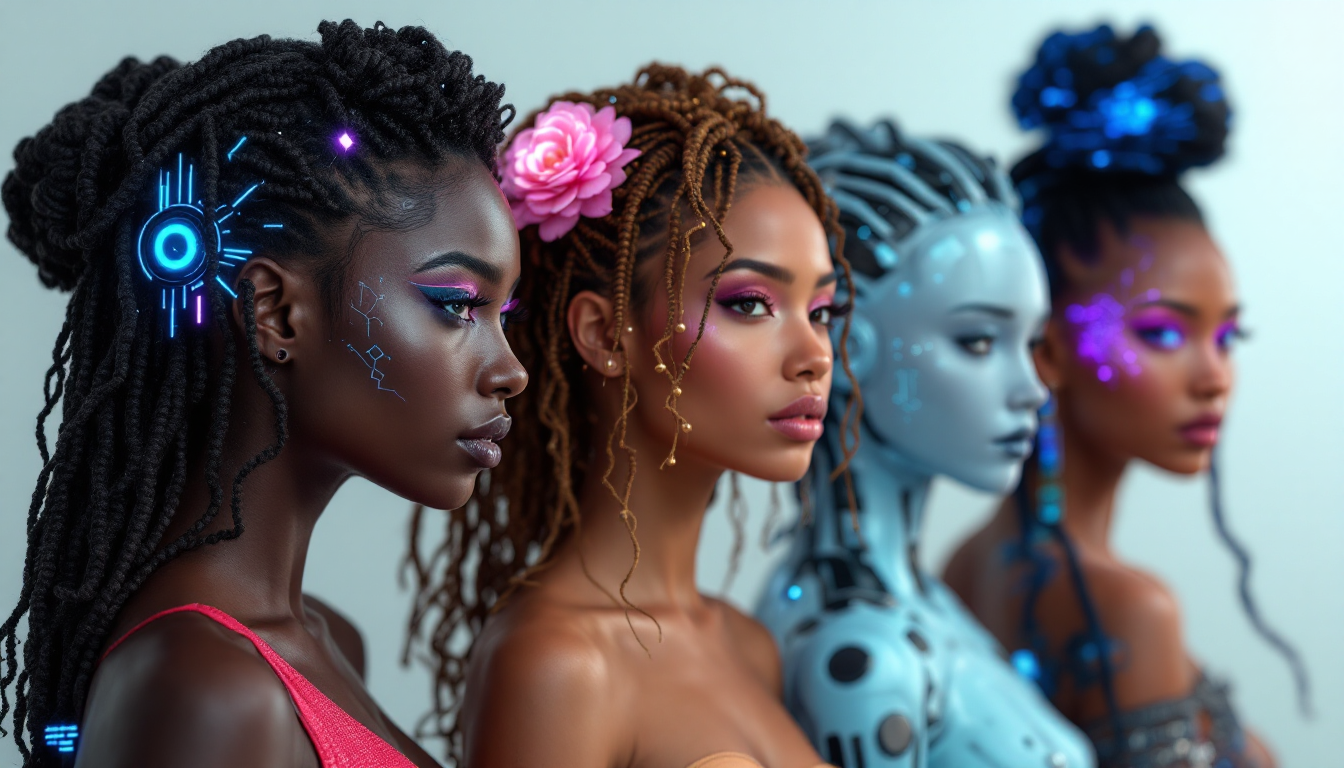
Introduction to Cultural Hairstyles
Hairstyles have long served as powerful symbols of identity, community and heritage. From the intricate braids and knots of various African societies to the elegant coifs of European courts and the ornate updos of East Asian dynasties, hair carries stories of migration, social status and spiritual belief. As globalization accelerates cultural exchange, there is a growing desire to both preserve these traditions and reinterpret them for a modern audience. But traditional hairstyling techniques—often passed down orally or in hands-on apprenticeships—risk being lost in an increasingly digital world. This is where artificial intelligence (AI) emerges as a potent ally, offering new ways to document, analyze and revitalize global hair customs.
The Role of AI in Hairstyling
Recent AI breakthroughs are enabling unprecedented fidelity in digital hair modeling. One such innovation is the TANGLED system, introduced in February 2025, which generates fully coherent 3D hair strands from single images (arxiv.org/abs/2502.06392). Trained on datasets annotated with culturally significant styles—braids, twists and complex textures—TANGLED can recreate the subtle geometry of a Fulani braid or the voluminous silhouette of an Afro. Beyond static renders, AI-driven video tools like ReelMind.ai apply multi-image fusion to animate traditional hairstyles across time and movement, ensuring consistency and cultural authenticity (reelmind.ai).
These platforms democratize access to hairstyling knowledge. Instead of learning exclusively from local salons or specialized instructors, enthusiasts anywhere can study step-by-step AI-generated tutorials. For example, “Afros of Hollywood” tutorials produced by ReelMind.ai combine realistic texture simulation with motion guidance, making it easy for users to follow along and archive techniques that were once confined to oral tradition (reelmind.ai).
Reviving Traditions Through Technology
AI’s capacity to restore and reconstruct historical artifacts is well documented in other artistic fields. A notable project in Asia used AI to reconstruct approximately 20 percent of a damaged 17th-century Japanese folding screen, with human artisans refining the output for authenticity (Tatler Asia). Translating this approach to hairstyling, AI-enhanced imagery tools have colorized and clarified late 19th-century photographs of Siamese noblewomen, revealing the subtle layering and adorned sashes of their long hairstyling rituals (aifashionlab.design). Such restorations serve not only as academic resources but also as training data for AI models seeking to learn these bygone styles.
Digitally preserving the freehand wrapping techniques of African hair threading—a practice dating back to at least the 15th century—offers another example. By capturing high-resolution scans and video of threading patterns, AI can analyze the symbolic geometry behind each design, ensuring that future generations understand both aesthetic and cultural significances (Wikipedia).
Exploring Diverse Hair Cultures
AI-driven hairstyling initiatives span the globe:
• African Diaspora Styles: Bantu Knots, once taught within families and communities, are now accurately depicted in video sequences via AI multi-image fusion, preserving knot size, pattern and positional symmetry (reelmind.ai).
• Hollywood Afros: Reflecting a chapter of Black cultural pride, AI tutorials disassemble each step of creating a classic Hollywood Afro, from combing patterns to the sculpting of the round perimeter (reelmind.ai).
• East Asian Dynasties: From Tang Dynasty “butterfly” buns to traditional Korean texturized cuts, AI-driven generative models merge historical authenticity with modern aesthetics, offering creative direction and narrative coherence (reelmind.ai).
• Southeast Asian Court Styles: Photo enhancement algorithms applied to 19th-century Siamese portraits reveal intricate hair ornaments and layering techniques—information now feeding into AI models that can suggest historically informed modern updos (aifashionlab.design).
• Global Fusion Trends: Contemporary stylists use AI to blend elements—such as West African threading with East Asian pinning—to create new, hybrid forms that celebrate interconnected heritages while spotlighting each tradition’s roots.
Benefits of AI in Preserving Heritage
The application of AI in cultural hairstyling yields multiple benefits:
- Documentation and Archiving: High-fidelity 3D models and animated tutorials create a permanent digital record that survives beyond oral transmission.
- Educational Outreach: AI-generated content can be localized—subtitles, interactive guides and voiceovers—broadening access for non-specialists and diaspora communities worldwide.
- Creative Innovation: Stylists can experiment with digital prototypes, mixing textures and shapes before committing to real-world execution, reducing waste and trial-and-error.
- Ethical Storytelling: As academic discourse highlights, combining AI with human contextualization ensures sensitive handling of cultural narratives and avoids digital misrepresentation (digitalcommons.lindenwood.edu).
- Economic Empowerment: Open-access AI tools lower barriers for small salons and independent creators, preventing monopolies by large brands and promoting equitable participation.
Case Studies: Global Styles Reimagined
Bantu Knots & Short Hair (ReelMind.ai)
By fusing multiple reference images, ReelMind.ai produces consistent Bantu Knot sequences—from tight, mini-knot patterns to voluminous statement styles—enabling beauty creators to integrate authentic African traditions into digital content without losing cultural nuance (reelmind.ai/blog/bantu-knots-short-hair-ai-for-diverse-beauty-content).
Afros of Hollywood Tutorials (ReelMind.ai)
These AI-driven tutorials offer a narrative structure—tools, sectioning, pick-out techniques—paired with realistic hair dynamics. They serve as both learning modules for at-home stylists and archival resources for cultural historians (reelmind.ai/blog/afros-of-hollywood-ai-generated-hair-styling-tutorials).
Eastern Influence Haircut Trends (ReelMind.ai)
By analyzing centuries-old paintings and modern street style, AI models propose haircuts that echo Tang Dynasty elegance or Joseon-era refinement. Stylists receive detailed guides on integrating historical motifs—like ornamental hairpins—into contemporary cuts (reelmind.ai/blog/eastern-influence-haircut-ai-style-trends-global-aesthetics).
Long Hairstyles in Siam (AI Fashion Lab)
Photo-enhancement and colorization highlighted the interplay between Western colonial influences and Siamese identity in the late 1800s, revealing layered locks bound with ornamental threads. AI leverages this data to reconstruct plausible modern interpretations for fashion runways (aifashionlab.design).
African Hair Threading Documentation
Using 3D scanning and machine learning, researchers have catalogued the distinct wrapping techniques of different regions—from Mali’s geometric grids to Nigeria’s symbolic swirls—providing a searchable database for artists and scholars (en.wikipedia.org/wiki/African_hair_threading).
Conclusion: Blending Tradition with Innovation
The intersection of AI and cultural hairstyling is more than a technological novelty; it represents a collaborative canvas where heritage and innovation coalesce. By digitizing fragile oral traditions, reconstructing lost techniques and inspiring new cross-cultural creations, AI offers both preservation and progression. As we move forward, the most meaningful advances will marry machine precision with human sensitivity—ensuring that every braid, knot and coil carries forward its ancestral story, reimagined for the global stage.