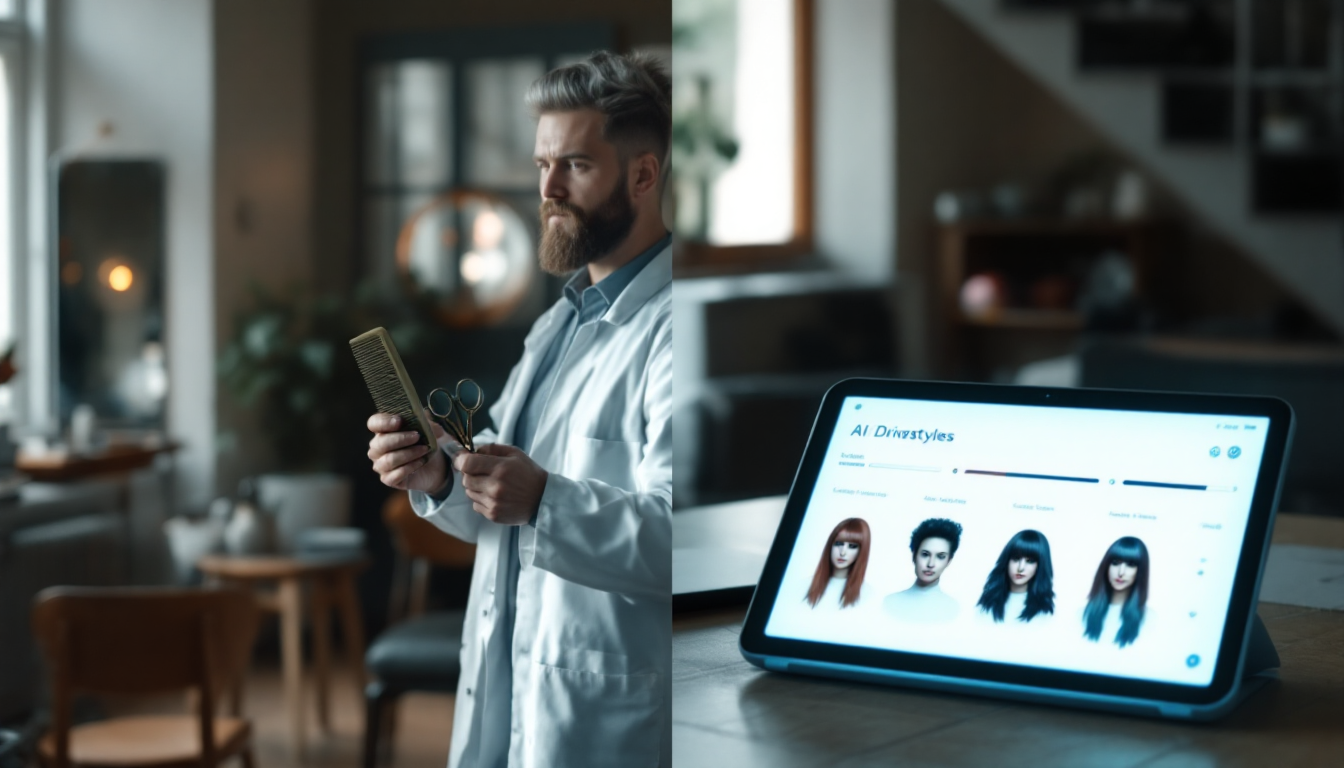
Introduction to AI in Hairstyling
The intersection of artificial intelligence and hairstyling marks one of the most exciting evolutions in beauty and culture. Traditionally, hairstyling has thrived on the creativity and manual skill of stylists, passed down through apprenticeships and familial lineages. Today, AI is augmenting these age-old practices by offering generative creativity, hyper-personalization, and data-driven insight. Platforms like ReelMind.ai leverage generative adversarial networks (GANs) and diffusion models to propose entirely new hairstyle concepts—futuristic braided updos with simulated bioluminescent strands, for example—that would be virtually impossible to visualize by hand alone (https://reelmind.ai/blog/modern-art-of-hair-ai-styling-trends-visualized?utm_source=openai). Meanwhile, apps such as Get Hair Vision allow clients to upload a selfie and virtually “try on” dozens of cuts and colors, reducing anxiety and boosting confidence before they even step into the salon. This chapter introduces why AI is uniquely poised to bridge tradition and innovation in hairstyling, benefiting stylists, clients, and cultural heritage alike.
Traditional Practices in Hairstyling
Hairstyling is deeply woven into cultural identity around the world. From the intricate Bantu knots of West Africa to the elaborate geometric topknots of Japan’s samurai era, each tradition carries symbolism, social significance, and ritual. These practices rely on techniques handed down generation to generation:
• Oral transmission of methods—from comb selection to sectioning strategies.
• Community rituals—braiding sessions as social gatherings or rites of passage.
• Local materials—natural dyes, oils, and wood-carved styling tools.
Maintaining these traditions can be challenging amid globalization and fast-fashion trends. Many younger clients seek fresh looks yet still want a connection to their heritage. AI can help preserve and revitalize these traditional forms by capturing stylistic elements in digital form and making them accessible to a new generation.
How AI is Innovating Hairstyling Techniques
AI is not replacing stylists; it’s empowering them. Three major innovations illustrate this shift:
-
Generative Concept Tools
• GANs and diffusion models enable stylists to input parameters—length, volume, cultural motif—and receive dozens of unique variations instantly.
• For example, ReelMind.ai algorithms can blend Indian braid patterns with Afro-textured volume to create hybrid designs, pushing creative boundaries while respecting origin styles (https://reelmind.ai/blog/modern-art-of-hair-ai-styling-trends-visualized?utm_source=openai). -
Hyper-Realistic Virtual Try-Ons
• By mid-2025, AI-powered virtual try-ons accounted for lighting, hair texture and even scalp curvature, making digital previews nearly indistinguishable from reality. Clients gain confidence in their choices, and salons reduce wasted time and product trial (https://reelmind.ai/blog/modern-art-of-hair-ai-styling-trends-visualized?utm_source=openai). -
Stylist Augmentation
• Conversational AI chatbots can handle preliminary consultations—asking about lifestyle, hair health, and cultural preferences—freeing stylists to focus on creative execution (American Salon Survey, 77% of professionals cite chatbots as having high potential for immersive client experiences: https://www.americansalon.com/business/survey-these-are-most-impactful-ai-tools-salons?utm_source=openai).
• Color placement simulations let stylists experiment rapidly with highlight patterns or vivid dye blends virtually before committing to chemicals.
Case Studies: Culture Meets Technology
-
Futuristic Fusion Updos (ReelMind.ai)
A London salon partnered with ReelMind.ai to co-develop braided updos incorporating simulated glow-in-the-dark fibers. The AI generated over 200 concept images; stylists selected the top 10 to prototype, resulting in a signature collection showcased at London Fashion Week (https://reelmind.ai/blog/modern-art-of-hair-ai-styling-trends-visualized?utm_source=openai). -
African and Indian Heritage Revival (Toolify.ai)
AI trained on global hairstyling datasets learned to identify region-specific braid patterns—from intricate Maharashtrian plaits to West African Fulani styles—and to recreate them digitally. Clients in New York and Mumbai now use a shared app to virtually explore and book heritage-inspired looks, fostering cross-cultural appreciation (https://www.toolify.ai/ai-news/aidriven-beauty-exploring-global-cultural-interpretations-3466674?utm_source=openai). -
Retro Revival with Style Transfer (ReelMind.ai)
Using style transfer, a Seoul salon revived 1960s sharp geometric cuts and 1970s voluminous blowouts with extreme fidelity. The AI ensured that each recreated look maintained historical accuracy in silhouette and texture, enabling a retro pop-up event that sold out within hours (https://reelmind.ai/blog/hair-trends-2017-vs-2025-ai-style-transfer-for-retro-revival?utm_source=openai). -
Sustainable Color Consultations (American Salon)
A California-based chain reported a 30% reduction in unused hair color waste after deploying AI virtual try-ons. Clients saw precise color outcomes on their own hair virtually, which cut down on costly “fixes” and product samples (https://www.americansalon.com/business/survey-these-are-most-impactful-ai-tools-salons?utm_source=openai).
The Benefits of Merging Tradition with AI
• Heritage Preservation: Digital archiving of traditional techniques ensures cultural styles are documented and accessible.
• Creative Expansion: Stylists access an infinite palette of AI-generated variations, fueling innovation beyond human imagination.
• Client Empowerment: Virtual try-ons and AI consultations increase confidence, reduce decision-making anxiety, and enhance satisfaction.
• Business Efficiency: Chatbots and automated bookings free staff for high-value tasks; reduced product waste boosts sustainability and profitability.
• Global Exchange: AI platforms trained on diverse datasets promote cross-cultural inspiration, strengthening mutual respect among beauty traditions.
Challenges and Ethical Considerations
While AI offers immense promise, several challenges must be addressed:
• Cultural Homogenization: AI models often rely on Western-centric datasets. A recent study found that Western-oriented AI writing suggestions nudged Indian participants toward Western styles, risking erosion of local nuance (https://arxiv.org/abs/2409.11360?utm_source=openai). Similar biases in hairstyling algorithms could dilute rich cultural identities.
• Data Bias and Representation: Under-representation of certain hair textures or cultural patterns in training data can lead to inaccurate or insensitive outputs.
• Intellectual Property: Who owns AI-generated hairstyles derived from traditional motifs? Communities and individual artists must be recognized and compensated.
• Privacy and Consent: Virtual try-ons capture biometric data—facial structure, hair metrics—that must be protected under data-privacy regulations.
Addressing these issues requires transparent dataset curation, community involvement in design processes, and robust ethical guidelines.
Future Trends in AI-Driven Hairstyling
• In-Salon AR Mirrors: Augmented-reality mirrors powered by AI will offer live, 360° hairstyle previews as stylists work.
• Biometric Hair Health Diagnostics: AI analysis of scalp images could recommend personalized treatments, integrating tradition (herbal masks) with data-driven protocols.
• NFT-Backed Signature Styles: Stylists may mint unique AI-designed hairstyles as digital collectibles, preserving provenance and offering licensing revenue streams.
• Geo-Localized Datasets: Training models on region-specific hair data to ensure authenticity and cultural sensitivity.
• Collaborative Platforms: Global stylist communities will co-create style libraries, blending local heritage with generative AI, further democratizing innovation.
Conclusion
Artificial intelligence is reshaping hairstyling by enhancing creativity, preserving cultural heritage, and improving salon efficiency. Far from displacing human artistry, AI acts as a catalyst—helping stylists reimagine tradition, clients experience confident transformations, and communities share their unique beauty legacies on a global stage. As we move forward, mindful stewardship of data ethics, cultural nuance, and collaborative design will be key to ensuring that this fusion of tradition and innovation remains rich, respectful, and revolutionary.