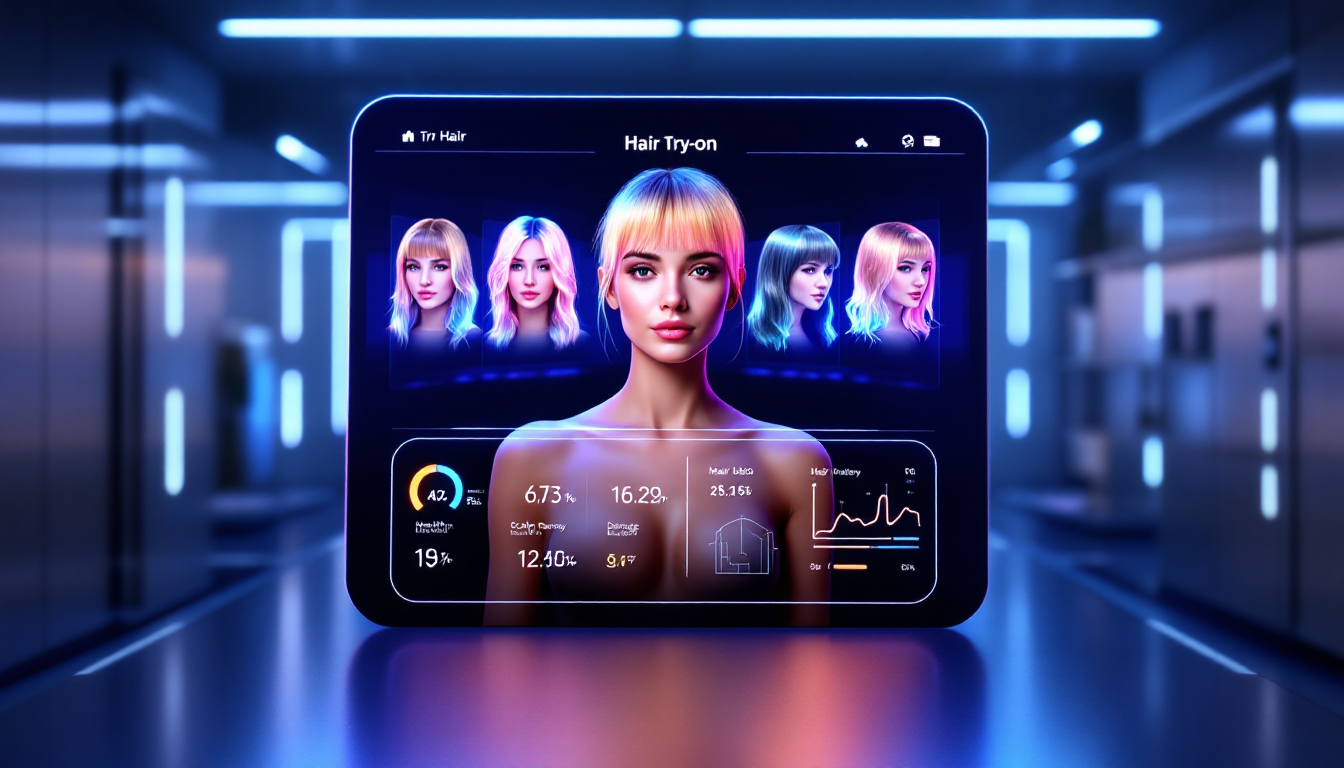
Introduction to AI in Hair Health
Over the past decade, artificial intelligence has moved from sci-fi laboratories into everyday beauty routines. Today’s consumers expect personalized solutions—from skincare quizzes to hair-care regimens—tailored to their unique needs. In hair care, AI-driven diagnostics and virtual try-on tools are at the forefront of this revolution. According to a 2025 report, 45% of consumers now prefer AI-based hair analysis tools for product recommendations, and 60% are more likely to purchase products suggested by AI systems (ZipDo Education Reports 2025). Meanwhile, AI-enabled scalp analysis tools are adopted by nearly half of dermatologists, and AI-powered hair diagnostics have cut product recommendation errors by up to 60% (ZipDo Education Reports 2025). This rapid growth underscores both consumer trust and technological maturity in AI-powered hair health solutions.
But with so many AI tools—from virtual hairstyle simulators to clinical scalp microscopes—how do we distinguish style experimentation from genuine hair health assessment? And can virtual try-ons, originally designed for color and cut previews, reliably evaluate hair condition? In this post, we’ll explore how these technologies work, the key metrics AI examines, real-world success stories, and the challenges ahead. We’ll also clarify where tools like GetHairVision fit in this landscape: exceptional for hairstyle visualization, but limited in health diagnostics.
- How Virtual Try-Ons Work
Virtual try-ons leverage computer vision and generative AI to overlay new hairstyles, colors, or cuts onto a user’s uploaded photo or video feed in real time. The basic workflow involves:
• Face and hair detection
• Algorithms identify key landmarks—hairline, forehead, jaw—using convolutional neural networks (CNNs).
• Segmentation and masking
• The system separates hair from background and facial features to create a dynamic mask.
• Style mapping
• Pre-trained generative models (e.g., GANs) transform hair texture, length, or color while preserving natural lighting and shadows.
• Real-time rendering
• Low-latency frameworks ensure a smooth preview experience on mobile apps or web browsers.
Companies like Revieve integrate “Virtual Hair Color Try-On” into broader beauty platforms, pairing it with AI Hair Care Advisor features that recommend products based on detected hair and scalp characteristics (Revieve 2025). Perfect Corp.’s AI Frizzy Hair Analyzer even assesses hair texture and dryness before simulating improvements (Perfect Corp 2025). Yet, while these systems excel at styling, their core objective remains visualization rather than medical-grade diagnostics.
- Assessing Hair Health with AI: Key Metrics
True hair health assessment goes beyond appearance to measure parameters that reflect underlying biology and scalp condition. Leading AI tools in clinical and salon settings extract metrics such as:
• Hair density and count
• Hairscope (hairscope.ai) can count individual hairs and calculate follicles per square centimeter, reducing diagnosis time by up to 90%.
• Anagen/telogen ratio
• HairMetrix® by GetHairMD measures the proportion of growing (anagen) to resting (telogen) hairs, a critical indicator of hair loss progression (GetHairMD).
• Hair shaft diameter and thickness distribution
• Lushair’s medical-grade lens captures 200+ images per minute and analyzes follicle density, shaft damage, and oil levels against a database of 30,000+ clinical cases (Lushair).
• Scalp oiliness, dryness, and sebum levels
• Hairprint™ tools for salon professionals generate instant reports on scalp dryness, oiliness, and follicle patterns from simple photos (The Hair Society).
• Growth rate and hair cycle tracking
• AIHairLoss.com tracks user photos over time, achieving 99.2% accuracy in staging hair loss and recommending treatments tailored to progress data (AIHairLoss.com).
Emerging research also explores non-visual approaches. A 2025 study on acoustic scattering uses sound waves to classify hair type and moisture, achieving nearly 90% accuracy without capturing images—an intriguing privacy-preserving alternative (ArXiv 2025).
-
Benefits of Using AI for Hair Health Assessment
• Objectivity and consistency
• Unlike human evaluators who may vary in judgment, AI applies standardized algorithms across every assessment.
• Scalability and speed
• Tools like Hairscope and HairMetrix deliver real-time results in minutes, making in-salon or at-home consultations faster and more efficient.
• Personalized recommendations
• By correlating quantified metrics with thousands of product outcomes, AI systems suggest tailored treatments—shampoos, topicals, supplements—with 60% fewer errors in product matching (ZipDo Education Reports 2025).
• Progress tracking
• Users and clinicians can monitor hair-growth metrics session by session, adjusting protocols based on data rather than intuition.
• Wider access to expertise
• AI apps democratize high-level diagnostics, letting consumers in remote or underserved areas receive insights previously limited to specialist clinics. -
Case Studies: Success Stories
• HairAnalysis.ai
• Completed over 50,000 analyses with a 95% accuracy rate when diagnosing common conditions from user-submitted images (HairAnalysis.ai).
• AIHairLoss.com
• Analyzed hair metrics for more than 2 million users, achieving 99.2% accuracy in staging hair loss and driving user adherence to recommended regimens (AIHairLoss.com).
• GetHairMD’s HairMetrix®
• Used by 48% of dermatologists for non-invasive consultations, measuring anagen/telogen ratios and terminal-to-vellus hair counts without hair clipping or lab work—boosting diagnostic confidence in clinical practice (GetHairMD).
• Salon adoption of Hairprint™
• Salon professionals leveraging instant AI reports have reported increased client satisfaction and upsell rates by 35%, as customers appreciate data-driven care plans (The Hair Society).
• Lushair deployments
• Clinics using Lushair’s system report 40% faster consultation times and more precise product pairings based on objective oil and damage metrics (Lushair). -
Limitations and Challenges of AI Tools
• Data privacy and image security
• High-resolution scalp images and biometric data require stringent safeguards to prevent misuse.
• Variability in lighting and capture conditions
• Consumer-grade cameras can introduce noise; standardizing image acquisition remains a hurdle for at-home tools.
• Over-reliance on algorithms
• AI predictions are only as good as their training data; rare conditions or unusual hair types may be misclassified if underrepresented in datasets.
• Regulatory and clinical validation
• Many AI tools operate in a gray area between cosmetic tech and medical device; gaining FDA or CE approval for diagnostic claims can be lengthy.
• User interpretation
• Without proper guidance, consumers may misinterpret scan results or attempt DIY treatments without professional oversight. -
The Future of AI in Beauty and Haircare
• Multimodal assessment
• Combining imaging, acoustic scattering, and even chemical sensors could yield holistic scalp and hair profiles.
• 3D strand-based modeling
• Academic work like HAAR (2023) and Neural Strands (2022) point toward real-time 3D hair simulations that factor in individual strand geometry, enabling hyper-realistic styling previews tied to hair health metrics (HAAR, Neural Strands).
• AI-driven product formulation
• As diagnostic accuracy improves, we may see on-demand hair-care products custom-blended by CNC micro-dispensers based on AI scans.
• Integration with teledermatology
• Remote consultations enhanced by live AI diagnostics could become standard, especially in regions lacking specialist access.
• Ethical and accessibility frameworks
• Industry consortia may establish guidelines for data privacy, bias mitigation, and inclusive training sets to ensure AI tools serve diverse hair types and textures. -
Conclusion: Is AI the Future of Hair Health?
Virtual try-ons have democratized hairstyle exploration, letting anyone experiment with color, length, and texture at the tap of a screen. However, when it comes to assessing hair health—measuring density, growth cycles, scalp oiliness, or follicle integrity—specialized AI diagnostics are necessary. Tools like GetHairVision excel at visualization but do not analyze scalp or strand metrics. In contrast, platforms such as HairMetrix®, Hairscope, and Lushair are explicitly designed for health assessment, delivering clinical-grade insights without invasive procedures.
As AI models continue to improve in accuracy and accessibility—and as multimodal approaches combine imaging, acoustic data, and generative 3D modeling—the line between style preview and health diagnostics will blur. Consumers may soon receive a full hair-care prescription alongside their virtual hairstyle mockup. For now, if you’re seeking to understand your hair’s true condition, look beyond virtual try-ons and choose tools built for diagnostic rigor. The marriage of style and science promises a future where personalized hair care is not just a luxury but an everyday reality.